

I’d reach Rust and Go developers with 2 separate campaigns, each built around one technical problem, matching proof, and a clear next step - not a generic language-based pitch.
Here’s how I’d plan each campaign:
- Define the audience and goal. Match the workload and buying role to a signup, technical read, event registration, application, or sales opportunity.
- Build trust with proof. Share test conditions and limits, and follow community submission and sponsorship rules.
- Choose the placement. Use daily.dev Ads feed placements for discovery, Sponsored Posts for technical reading, and contextual or newsletter placements where the topic fits.
- Measure what happens next. Keep Rust and Go results separate, connect visits to qualified actions, and allow time for conversions before judging results.
My rule: keep the ad, landing page, proof, and conversion goal aligned. Then test one major change at a time and use technical feedback to decide what to improve.
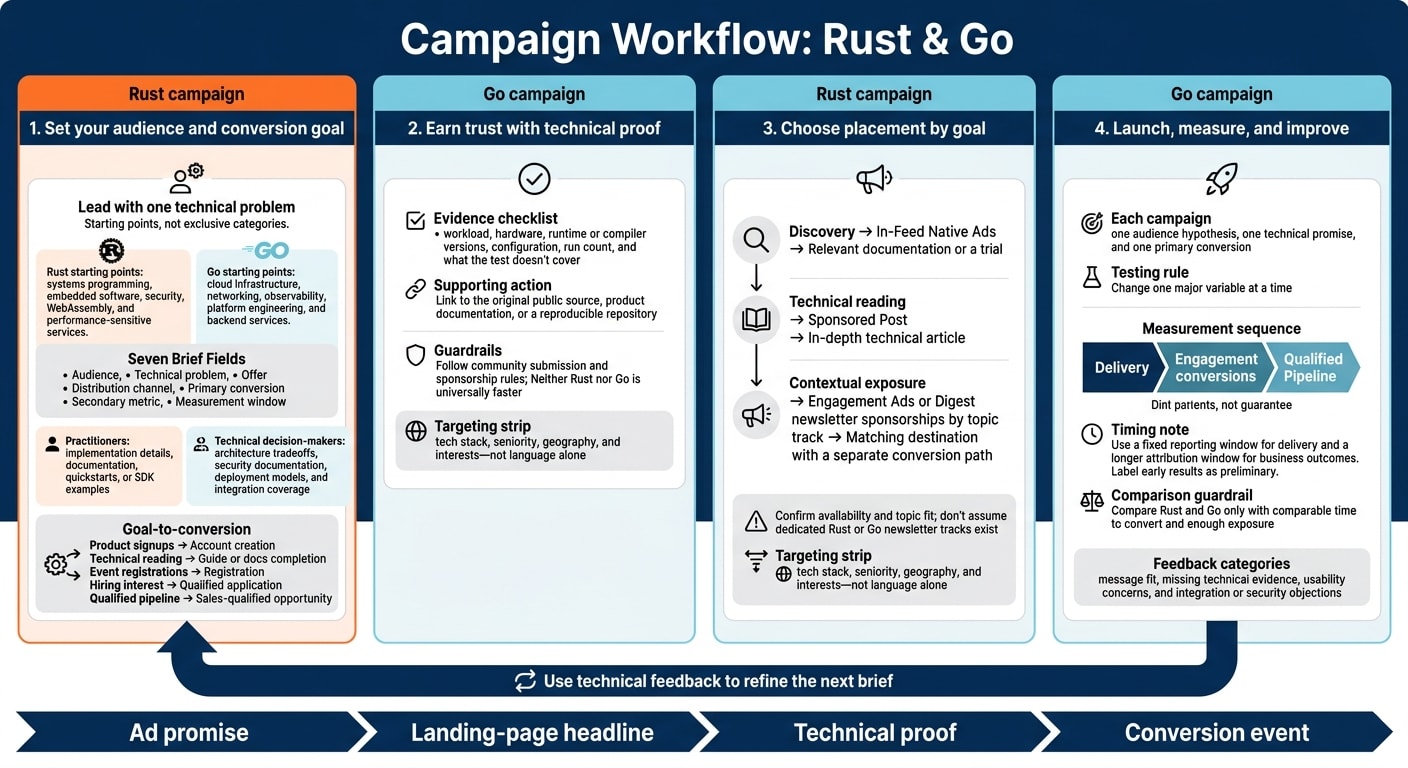
1. Set your audience and conversion goal
Create separate Rust and Go briefs with seven fields: audience, technical problem, offer, distribution channel, primary conversion, secondary metric, and measurement window. Set the review window based on the action you want - not just the campaign end date. Qualified pipeline may take several weeks or longer to assess. Use these briefs to separate Rust and Go campaigns before you write copy.
| If your objective is… | Use this primary conversion | Track this secondary metric |
|---|---|---|
| Product signups | Account creation | First API call or quickstart completion |
| Technical reading | Guide or docs completion | Reading time or return visits |
| Event registrations | Registration | Attendance |
| Hiring interest | Qualified application | Application completion |
| Qualified pipeline | Sales-qualified opportunity | Meeting acceptance or account fit |
Segment Rust and Go developers by use case
Consider Rust developers for systems programming, embedded software, security, WebAssembly, and performance-sensitive services. Then narrow each segment to a specific problem, such as resource constraints or memory safety.
For Go developers, start with cloud infrastructure, networking, observability, platform engineering, and backend services. Apply the same problem-first approach, then refine each segment by workload and responsibility.
These are starting points, not exclusive categories. An infrastructure developer may fit several segments. Keep campaigns separate when the problem, offer, or proof differs, rather than sending every Rust or Go developer to one landing page.
Match buying roles to messages and landing pages
Use those filters to separate practitioners from decision-makers. Practitioners need implementation details, documentation, quickstarts, or SDK examples. Technical decision-makers need architecture tradeoffs, security documentation, deployment models, and integration coverage.
Seniority alone does not determine buying authority. Senior individual contributors can influence purchases, while managers may still need implementation proof.
Keep the ad promise, landing-page headline, technical proof, and conversion event consistent. A security-focused message should lead to a page that addresses security - not a generic product homepage.
Record the landing-page URL, UTM naming convention, exact conversion definition, and follow-up owner in the brief. That lets reporting distinguish a content visit from a product evaluation or sales-qualified opportunity, while keeping the landing page and proof tied to the same buying role.
2. Earn trust in Rust and Go communities
Participation earns trust. Sponsorship buys placement on a host’s terms. Advertising pays for distribution, with clear labeling and conversion goals, often through expert developer marketing insights. Community membership is not permission to promote without an invitation, including through direct messages.
Once you’ve defined your audience and offer, use public communities to test your message and the evidence behind it.
Find relevant publications and communities
Review This Week in Rust, Golang Weekly, Gophers Slack, RustConf, and GopherCon. Look for recurring topics, submission rules, and sponsorship terms. Focus on debugging, deployment, observability, performance investigation, and platform work.
This Week in Rust favors in-depth technical material. It rejects sales-only, gated, or AI-generated submissions and prefers links to the canonical URL rather than a lead-capture page.
Use RustConf and GopherCon agendas to map current technical topics. Before reaching out, check the official sites for dates, event status, sponsorship availability, and conduct rules.
In these communities, evidence earns trust. Promotion alone doesn’t.
Back performance claims with test details
Publish the method alongside the claim: workload, hardware, runtime or compiler versions, configuration, run count, and what the test doesn’t cover. Link to the original public source, product documentation, or a reproducible repository.
Keep your conclusions within those test conditions. State whether a result came from a synthetic workload, a small dataset, or hardware-specific behavior. Identify the production conditions you didn’t test.
Neither Rust nor Go is universally faster. Give systems and infrastructure buyers enough evidence to judge whether a result applies to their reliability, debugging, or operations needs.
3. Choose daily.dev Ads formats by goal
Once the message is proven, choose the format that supports the next action in the funnel. Keep distribution tied to the same workload-specific proof standard.
Choose formats for discovery and technical reading
Use daily.dev Ads In-Feed Native Ads to help developers discover tools, technical resources, events, or engineering jobs. Send Rust and Go audiences to separate landing pages that match each offer.
Choose Sponsored Post when a technical article needs guaranteed feed impressions, a read-floor commitment, and canonical republishing.
| Campaign objective | Recommended format | Audience signals | Campaign asset | Primary success metric | Main limitation |
|---|---|---|---|---|---|
| Tool or resource discovery | In-Feed Native Ads | Tech stack, seniority, geography, interests | Native card linking to relevant documentation or a trial | Qualified clicks | Ad quality drives performance |
| Technical reading | Sponsored Post | Relevant stack and technical interests | In-depth technical article | Delivery against the agreed read floor | Requires detailed technical content |
| Contextual exposure | Engagement Ads or Digest newsletter sponsorships by topic track | Relevant tag, keyword, stack, or confirmed topic-track fit | Placement-specific brand assets or sponsorship copy and visuals with a matching destination | Assisted conversions, where measurable, or track-level engagement | Requires a separate conversion path; newsletter sponsorships require an available track and slot |
Use contextual placements to reinforce the same technical story. Then handle testing and measurement separately.
Build repeat visibility with contextual placements
Engagement Ads include Branded Tags, Keyword Spotlights, Custom Upvotes, Tag Page Takeovers, and Stack Placements. Pick the context that fits the product’s technical use case, then confirm availability and asset requirements.
Consider Digest newsletter sponsorships by topic track only after confirming that an available track fits the campaign. For a 2026 Rust or Go campaign, don’t assume dedicated language tracks exist. Check what the track actually covers before tailoring the sponsorship copy.
Combine targeting signals and placement options
Target by tech stack, seniority, geography, and interests, not language alone. Keep Rust and Go reporting separate so strong results in one segment don’t hide weak performance in the other.
If verified partner publisher distribution fits the campaign’s intended outcome - such as evaluating deployment reliability or observability - confirm placement availability. Document delivery and reporting terms separately from feed and Digest placements.
4. Launch, measure, and improve your campaign
Test separate Rust and Go messages
After launch, keep Rust and Go tests separate so you can interpret each result clearly. Give each campaign one audience hypothesis, one technical promise, and one primary conversion.
Before launch, record the baseline conversion rate, qualified-lead rate, pipeline contribution, and conversion lag using comparable campaigns or organic traffic. Keep UTM parameters consistent across analytics, forms, product analytics, and CRM records.
Change one major variable at a time.
Compare a Rust message focused on memory safety with one focused on deployment reliability while keeping the audience, budget, placement, and landing page constant.
Once the test is live, track response metrics separately from business outcomes.
Measure delivery and business outcomes separately
Review delivery, engagement, qualified conversions, and pipeline separately by audience, placement, and asset. Use a fixed reporting window for delivery and a longer attribution window for business outcomes. Label early results as preliminary.
Compare Rust and Go only when both audiences have had comparable time to convert and enough exposure. Otherwise, timing differences can look like performance differences.
Use technical feedback to plan the next campaign
Let the strongest and weakest signals guide your next test. Review comments, reading behavior, landing-page engagement, sales notes, and support questions. Group that feedback into message fit, missing technical evidence, usability concerns, and integration or security objections.
Use these signals to check whether the technical promise matched buyer expectations. Then address the gap with the greatest impact before increasing distribution.
Use the systems, infrastructure, and adjacent persona guides to sharpen the next brief. To turn that brief into a test plan, discuss a campaign with the daily.dev Ads team.
FAQs
How should I split my budget between Rust and Go campaigns?
You don’t need to manually divide your budget between Rust and Go campaigns on daily.dev. daily.dev Ads uses AI to track performance in real time and move budget toward the best-performing segments, helping improve cost-per-trial efficiency.
The daily.dev team handles campaign setup, pacing, and optimization. They also use live engagement data to recommend spend adjustments across tech stacks.
How much technical proof do I need before launching?
You need enough data to measure lift on the action that matters. For daily.dev Ads, set up a conversion pixel before you spend and choose a goal: signup, first API call, or activation.
Run a focused pilot with several ad variations and an incrementality check, such as a holdout group or geographic split. Include view-through attribution, not just clicks. Optimize the campaign, then use cost per activation and observed lift against the holdout to decide whether to scale.
When should I scale a campaign on daily.dev Ads?
Scale daily.dev Ads once you’ve proven product-level lift - not just clicks. Start with In-Feed Native Ads on one stack, using focused stack and topic tags. Run the test for 4–6 weeks, track signups, first API call, and activation with the conversion pixel, and use a holdout to confirm lift.
If cost per activation is acceptable and downstream results stay consistent, increase the winning placement’s budget. Then add Sponsored Post or Digest newsletter sponsorships.