
If I want mobile developers to pay attention in 2026, I can’t market to “developers” as one group. I need to target by stack, show proof fast, and put my message in places where iOS, Android, Flutter, and React Native teams already spend time.
Here’s the short version:
- Target by stack: Swift, Kotlin, Flutter, and React Native each need different copy.
- Skip vague claims: Mobile developers tend to ignore broad promises and gated PDFs.
- Use hands-on assets: Docs, repos, demos, benchmarks, and sandboxes work better than soft thought pieces.
- Pick stack-first channels: Reddit communities, Discord groups, event coverage, and stack-based ad targeting.
- Track intent, not just clicks: Look at doc views, GitHub activity, sign-ups, and assisted conversions.
A few points stand out from the article:
- Native communities like r/iOSProgramming and r/androiddev work best for trust and research-stage outreach.
- Cross-platform spaces fit Flutter and React Native messages, especially when the pitch covers both iOS and Android use cases.
- Event windows like WWDC and droidcon can help when I have timely content, launches, or technical demos.
- Paid placements do better when they match the developer’s daily tools and use direct CTAs like “View Docs” or “Try the Sandbox.”
Bottom line: if my message does not match the developer’s stack, there’s a good chance it gets ignored.
Quick comparison
| Channel | Best for | Main limit | What I should use |
|---|---|---|---|
| Native communities | Trust, research, peer discussion | Little targeting control | Technical posts, code, problem-solving |
| Cross-platform communities | Awareness and evaluation | Message must fit both stacks | Integration examples, performance trade-offs |
| WWDC / droidcon orbit | Timely reach and launch support | Attention comes in short windows | Demos, event-tied content, sponsor spots |
| Stack-based advertisement campaigns | Scale with tighter targeting | Paid budget needed | Problem-first headlines, direct landing pages |
In other words: this article says I should start with developer behavior, narrow by stack, then match the channel, format, and KPI to that audience.
Understand mobile developer behavior before you buy reach
Before you pick a channel or write ad copy, you need to know how mobile developers screen marketing. Most are skeptical from the start. They tune out vague promises, unsupported claims, and anything that hides what the product actually does. So specificity, proof, and stack fit aren't nice extras. They're the baseline.
What mobile developers distrust in marketing
Mobile developers tend to ignore buzzwords, claims without proof, and gated content that hides the useful part. Asking someone to hand over an email address for a PDF whitepaper usually performs poorly. And since many developers use ad blockers, interruptive formats often don't even get seen.
| Distrust Signal | Why It Fails | Recommended Alternative |
|---|---|---|
| General tech newsletters | Audience is too broad, mixes in managers and designers | Stack-specific newsletters |
| Gated whitepapers | Developers rarely trade an email for a PDF | Ungated docs and open repos |
| Inflated claims | Create skepticism instead of trust | Concrete benchmarks |
| Interruptive display ads | Get blocked or ignored | Native placements in developer content |
What earns mobile developer attention
What gets attention is simple: language that matches the developer's stack and content they can use right away.
Instead of generic "build faster" messaging, use stack-specific terms. Name the tools directly, like Swift, Kotlin, Flutter, and React Native. That makes the message feel relevant instead of broad and fuzzy.
Practical content also tends to do better. Think docs, repos, examples, and hands-on experiences. Calls to action should be direct and task-focused, such as "View Docs" and "Try the Sandbox." In many cases, technical newsletters tied to one stack get better engagement than broad marketing sends.
Use that filter to choose the channels in the next section.
The mobile channels developers already use
Start with the places mobile developers already spend time.
These developers tend to gather in platform-focused communities, newsletters, and conference coverage. So instead of forcing your message into general tech spaces, show up where iOS, Android, Flutter, and React Native are already part of the conversation. Tie each channel to the same stack signals you use elsewhere, like #swift, #kotlin, #flutter, and #react-native.
Native communities: iOS and Android
r/iOSProgramming and r/androiddev are go-to communities for iOS and Android developers. If you post there, keep it technical and specific to the stack. Hard-sell copy usually gets ignored.
If you want reach across both iOS and Android at the same time, use the cross-platform communities below.
Cross-platform communities: Flutter and React Native
Flutter and React Native communities stay active on Reddit and Discord. They make sense when you're trying to reach teams building for both iOS and Android. These audiences work best when your message fits both native stacks or speaks to cross-platform mobile work more broadly.
If you need a short burst of attention around a release or talk, conference coverage is the next move.
Conference orbit: WWDC and droidcon
WWDC and droidcon create focused windows when iOS and Android developers are all watching the same themes at once. You can extend that reach by adding stack-specific newsletters around those events. That makes these moments useful for timely content, sponsorships, and newsletter placements tied to what developers are already paying attention to.
Use stack-aware targeting to reach the right mobile developers
Picking the right channel is only part of the work. You also need to reach the developers who are actually building in Swift, Kotlin, Flutter, or React Native, not just people grouped under the broad label of "mobile."
Target by tags, languages, and frameworks
Once you know where mobile developers spend time, filter by the stack they use day to day.
Role-based targeting can put you in front of a big audience, but there's a tradeoff: relevance drops fast. A campaign aimed at "mobile developers" can still lump together iOS engineers, Android engineers, and cross-platform teams. In practice, that usually means the message feels a little off for everyone.
Stack-aware targeting flips that around. Start with the tech, not the title. Begin with Swift, Kotlin, Flutter, or React Native, then narrow further with tools like Xcode or Android Studio. That gives you room to write tighter copy, and you should carry that detail into the ad headline too.
How daily.dev Ads fits into a mobile developer media plan
For paid reach, stack-aware targeting helps keep the message close to the developer's actual workflow.
daily.dev Ads reaches developers at scale and lets you filter by programming language, framework, and tooling interest, so you can zero in on senior iOS engineers or Flutter developers. The ad placements sit natively in the feed, right next to the technical content developers are already reading. That makes the platform a good fit for promoting SDKs, developer tools, and mobile-focused product launches aimed at iOS and Android teams.
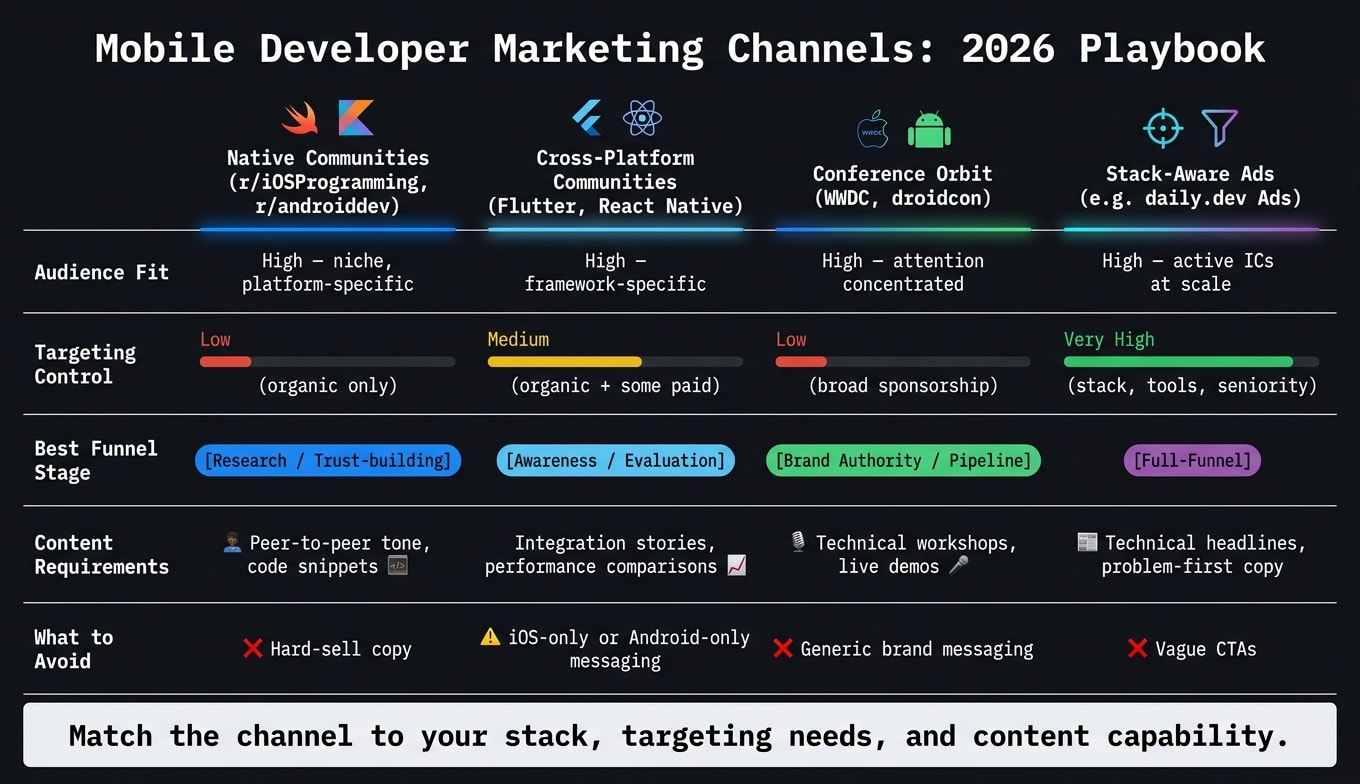
Mobile outreach channels compared by use case
Each channel in this guide does a different job. Here's how they compare across the decisions that matter most when planning a campaign:
| Channel | Audience Fit | Targeting Control | Best Funnel Stage | Content Requirements |
|---|---|---|---|---|
| Native Communities (r/iOSProgramming, r/androiddev) | High - niche, platform-specific | Low - organic only | Research / Trust-building | Peer-to-peer tone, troubleshooting, code snippets |
| Cross-Platform Communities (Flutter, React Native) | High - framework-specific | Medium - organic + some paid | Awareness / Evaluation | Integration stories, performance comparisons |
| Conference Orbit (WWDC, droidcon) | High - attention concentrated | Low - broad sponsorship | Brand authority / Pipeline | Technical workshops, live demos, timely content |
| Stack-Aware Ads (daily.dev Ads) | High - active ICs at scale | Very high - stack, tools, seniority | Full-funnel | Technical headlines, problem-first copy |
Match the channel to both your targeting needs and the kind of content your team can actually produce. After that, align the format with the placement and track results beyond clicks.
Build a mobile developer campaign you can measure
Match content format to the channel
Use the same core message, but shape it to fit the channel and the stack.
WWDC and droidcon are good moments for timely content because they line up with what mobile developers are already focused on. If your message lands while that attention is already there, it has a much better shot.
For paid placements, lead with the problem in the headline. Then get to the answer fast on the landing page. No detours. No fluffy setup.
That same approach should guide measurement too.
Measure outcomes beyond clicks
Click-through rate doesn't tell you much about whether a mobile developer campaign is doing its job.
Better signals include:
- Documentation views
- Newsletter sign-ups
- GitHub activity
- Meaningful conversion events
It's also smart to track assisted conversions, not just last clicks.
Those signals tell you whether the campaign is building intent, not just sending traffic.
Conclusion: The 2026 mobile developer reach playbook
Mobile developers are a specific audience, and they don't have much patience for vague marketing.
The campaigns that work meet them on those terms. They show up in communities developers already trust, time content around moments developers are already watching, and use stack-aware targeting so the message fits the right framework or language.
What separates pipeline-driving campaigns from ones that only generate impressions? Relevance at the stack level, content that fits each channel, and KPIs tied to actual developer intent.
FAQs
How do I choose the right stack to target first?
Focus on the tools and frameworks that line up best with your product’s main strengths and the way your audience works day to day. Start with the stack where your technical case is strongest, whether that comes from performance benchmarks or clear integration stories.
With daily.dev Ads, you can narrow that focus using tags like #swift, #kotlin, #flutter, or #react-native. That way, your message shows up in front of developers who are already reading about those technologies.
What should I put on the landing page for mobile developers?
Give people useful technical detail right away, and make sure the page lines up with your ad. If someone clicks expecting one thing and lands on something else, you've lost them fast.
Keep the page mobile-responsive, easy to scan, and centered on short, direct copy. Your CTAs should be obvious and plainspoken, like Install or Try the API Sandbox.
Back up claims with specific data, benchmarks, and technical visuals. If there are limits, edge cases, or best-fit use cases, say so clearly. Use clean spacing, legible text at 14 px or larger, and skip pushy sales copy.
Which KPIs best show real mobile developer intent?
Look past clicks and pay attention to activation metrics that show people are actually trying the product, not just browsing. That includes:
- documentation visits
- sandbox launches
- GitHub repository interactions
- trial workspace starts
Track those next to account activation, first successful builds, and steady usage over 7, 14, or 30 days. That’s where intent gets a lot clearer. When developers move from “this looks interesting” to hands-on product actions, you’re seeing the shift from curiosity to active use.