
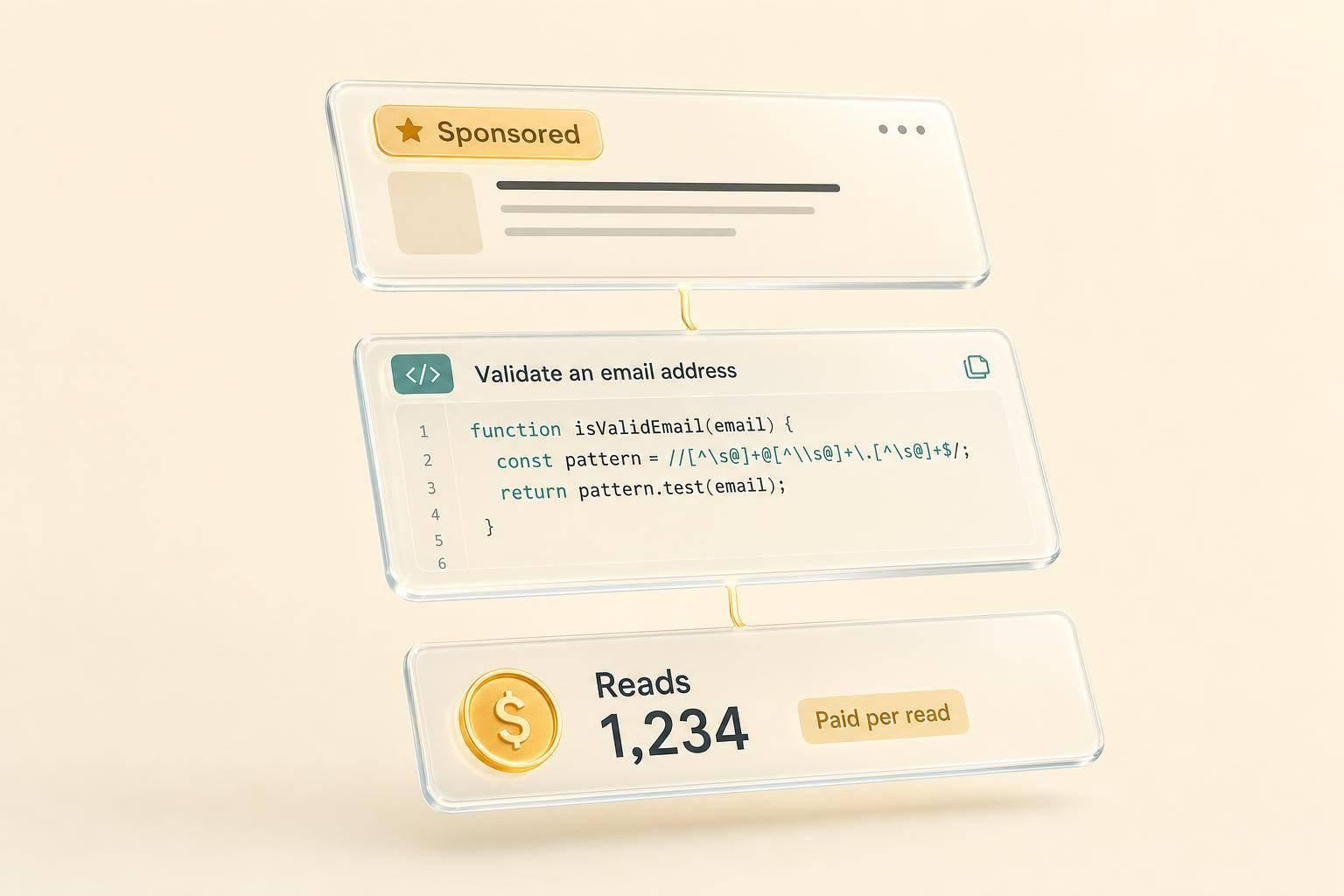
Sponsored content works when it teaches, discloses the ad up front, and ties cost to reads instead of just impressions. In 2026, the main formats I see are platform posts, newsletter placements, and syndicated articles. The big checks are simple: Is it clearly labeled? Does it solve one technical problem? Does syndication protect the original URL with rel=canonical?
If I were judging a package fast, I’d look at:
- Format: post, newsletter, or syndication
- Disclosure: clear Ad or Sponsored label on every surface
- SEO handling: canonical tag or a source link back to the original
- Pricing inputs: read floor, distribution window, usage rights, editorial help, and exclusivity
- Reporting: impressions and reads tracked separately
A good example in the piece is daily.dev: a package built around 500,000 impressions, delivery over about 30 days, and a read-floor model. One cited campaign reported 32,410 reads in May 2026.
| Format | Best for | Main check |
|---|---|---|
| Sponsored post | Long-form teaching | Read floor + disclosure |
| Newsletter placement | Traffic and awareness | Inbox reach + CTA |
| Syndicated article | More reach from existing content | Canonical back to source |
So the short version is this: developer sponsored content is not about hiding an ad inside an article. It is about paying for distribution of a useful technical piece, with clear labeling and clean search handling.
The three sponsored-content formats developers actually see
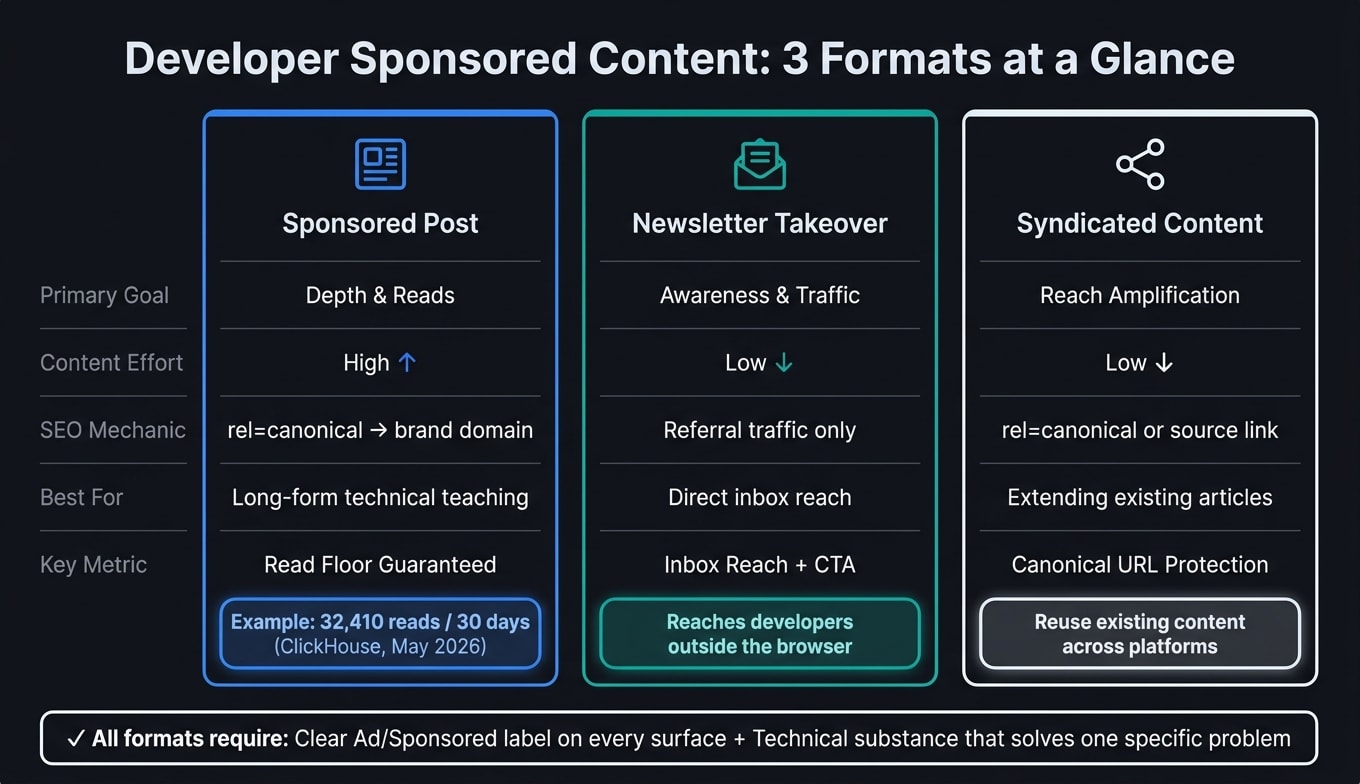
Developers tend to run into sponsored content in three main formats: platform posts, newsletter takeovers, and syndicated articles. Each one does a different job.
Sponsored posts on platforms
A sponsored post is a full technical article published right on a publisher's platform. It shows up in the feed next to editorial content, and the brand pays to get it in front of that platform's audience.
This format is built for people who will actually sit down and read, not just skim a headline and move on. In many cases, packages include a read floor: a guaranteed minimum number of actual reads.
That said, this only works when the disclosure is plain and the article teaches something specific.
Newsletter takeovers
A newsletter takeover puts your message straight into a developer's inbox. It usually takes a shorter form - a blurb, a headline, and a call to action - instead of a full article. The goal here is awareness and traffic.
It reaches developers outside the browser, in a place they already check. So this format is built for direct inbox reach and traffic, not long-form technical education.
Syndicated technical content
Syndicated content means you take an article you've already published and republish it on third-party platforms with proper attribution. In plain English, you're reusing existing content to extend reach.
The rel=canonical tag keeps search value tied to your original URL, not the site that republishes it.
| Format | Primary goal | Content effort | SEO mechanic |
|---|---|---|---|
| Sponsored post | Depth and reads | High | rel=canonical to brand domain |
| Newsletter takeover | Awareness and traffic | Low | Minimal; mostly referral traffic |
| Syndicated content | Reach amplification | Low | rel=canonical or clear source link |
No matter which format you use, developers still want two things: clear disclosure and technical substance that helps them do something. The format is just the wrapper. Trust comes from being upfront and useful.
How to run sponsored content without losing developer trust
Once you’ve picked the format, trust comes down to two things: clear disclosure and technical substance. The rules after that are pretty simple. Label the piece the right way, make it worth a developer’s time, and protect search visibility when you share it around.
Make disclosure immediate and hard to miss
Use plain labels like "Ad" or "Sponsored" above the headline, where people can see them right away. They shouldn’t blend into the page or sit in tiny type. Labels like "Promoted", "Presented by", "Brought to you by," or "Sponsored by [Brand]" can blur the line for readers, so it’s better not to use them.
That label also needs to show up everywhere the content appears, not just on the article page itself. That includes:
- Homepage teasers
- Category archive pages
- Social shares
Publish content that teaches something specific
The best sponsored content for developers doesn’t try to do too much at once. It should teach one specific technical problem and show the reader how to solve it.
That means using runnable code, setup steps, and a fix for one common error. The more specific the piece is, the more useful it feels. And that’s the whole game here. If it helps someone get unstuck, they’re far less likely to write it off as just another paid post.
Preserve SEO equity with canonical republishing
If you syndicate the article, search performance depends on where the original version lives. Publish it on your own domain first. Then republish it elsewhere with rel=canonical pointing back to the original URL. That tells search engines which version should count as the main source and helps keep search equity with the original page.
If the other platform doesn’t support canonical tags, add a clear line at the very top of the article, such as "Originally published at [Link]", with a direct link.
Once trust and SEO are handled, the next issue is pricing structure.
What fair pricing looks like structurally
Once disclosure and SEO are in place, pricing is mostly about structure, not one flat rate card. You’re not just paying for a banner slot. You’re paying for a read, a set distribution period, and the rights tied to that placement. When you know which levers change the price, you can judge any package on what it actually gives you.
The inputs that change campaign value
Six inputs shape what a sponsored content package is worth.
Read floors move pricing away from impressions and toward actual reads. That puts consumption risk on the publisher. Editorial support also changes price. If you hand over a finished draft, the cost is lower than if you ask the publisher’s team to write the piece from a brief. Canonical rights help keep SEO value on your domain. Usage rights matter if you want to reuse the piece in paid social or email, since that adds a licensing premium. Category exclusivity during the campaign window adds a scarcity premium. And distribution pacing over 30 days gives you a steadier way to reach developers instead of one short spike.
How to compare packages without relying on rate-card shortcuts
The easiest way to compare offers is to tie each line item to the thing it changes in your campaign.
| Pricing Variable | Why It Matters | Value Metric |
|---|---|---|
| Read Floor | Shifts consumption risk to publisher; guarantees actual reads, not visibility | Cost per read |
| Canonical Rights | Preserves SEO equity for the sponsor's domain | Search value |
| Distribution Window | Changes reach from a short burst to sustained pacing | Traffic persistence |
| Usage Rights | Allows sponsor to repurpose content in paid social or email | Licensing premium |
| Editorial Support | Publisher writes in its native voice, increasing trust and engagement | Engagement / Read time |
| Category Exclusivity | Prevents competitors from appearing in the same context | Competitive share of voice |
A simple way to think about it: start with the base rate, then add ONLY the extras you need. If you won’t reuse the content in email or paid social, skip usage rights. If you plan to book several posts across a quarter, ask about retainer pricing. That kind of commitment can bring down the per-post rate.
daily.dev Sponsored Post follows this same setup: read floor, placement scale, and canonical republishing.
Worked example: how daily.dev Sponsored Post is packaged
Here’s how that setup works on daily.dev.
Placement, distribution scale, and read-floor
daily.dev Sponsored Post puts technical content into the feed and email digests, then spreads delivery across about 30 days. The package is built around 500,000 impressions plus a read floor. If the campaign misses that read floor, the gap isn’t billed. Reporting also separates feed impressions from actual reads, so you can see reach and engagement as two different things.
In May 2026, ClickHouse Engineering ran a sponsored post on daily.dev and reported 32,410 reads over 30 days.
That’s why this package is judged by reads, not impressions alone.
Why canonical republishing is part of the model
daily.dev republishes the post natively and adds a canonical tag that points to the brand’s original URL. In plain English, search engines treat the brand’s page as the main source. So ranking signals flow to the brand’s domain, not to daily.dev.
FAQs
do developers read sponsored content?
Yes - if it gives clear technical help and feels natural. Developers usually tune out banner ads and old-school marketing copy. But they do spend time with sponsored content when it’s useful - things like tutorials, engineering deep dives, or technical launch write-ups.
When that content shows up on platforms they already use, and it helps them solve a specific problem or check a claim fast, it lands more like a recommendation than an ad.
sponsored post vs guest post?
A sponsored post is a paid placement. An advertiser partners with a platform to publish technical content and make sure it gets seen.
A guest post is usually unpaid. It’s a piece from an outside author who wants to share expertise with a new audience.
Both can show up alongside editorial content. The difference is simple: sponsored posts involve payment, may be linked to targets like a read floor, and should be clearly labeled as Ad or Sponsored.