

If I had to sum it up in one line: the best AI ad options in 2026 are the ones you can buy now, track with clear data, and match to live user intent.
This article is about ad placement inside AI products - not AI tools that write copy or make images.
Here’s the short version:
- daily.dev Ads is the best fit if I want to reach developers
- Partner publisher networks help me place ads across AI chats, coding tools, voice apps, and image tools
- Microsoft Copilot ads are a strong pick for B2B and enterprise
- Google AI Overviews give me large search reach, but reporting is less clean
- OpenAI ChatGPT ads are still limited-access pilot inventory
One stat stands out: ads appeared in 25.5% of Google AI Overviews by April 2026. That tells me AI ad inventory is no longer a side case. It is already part of how search and AI answers get monetized.
If I’m choosing where to start, I’d use three filters:
- Can I buy it today?
- Does it match buyer intent at the moment of the query?
- Can I measure results without mixed reporting?
Quick Comparison
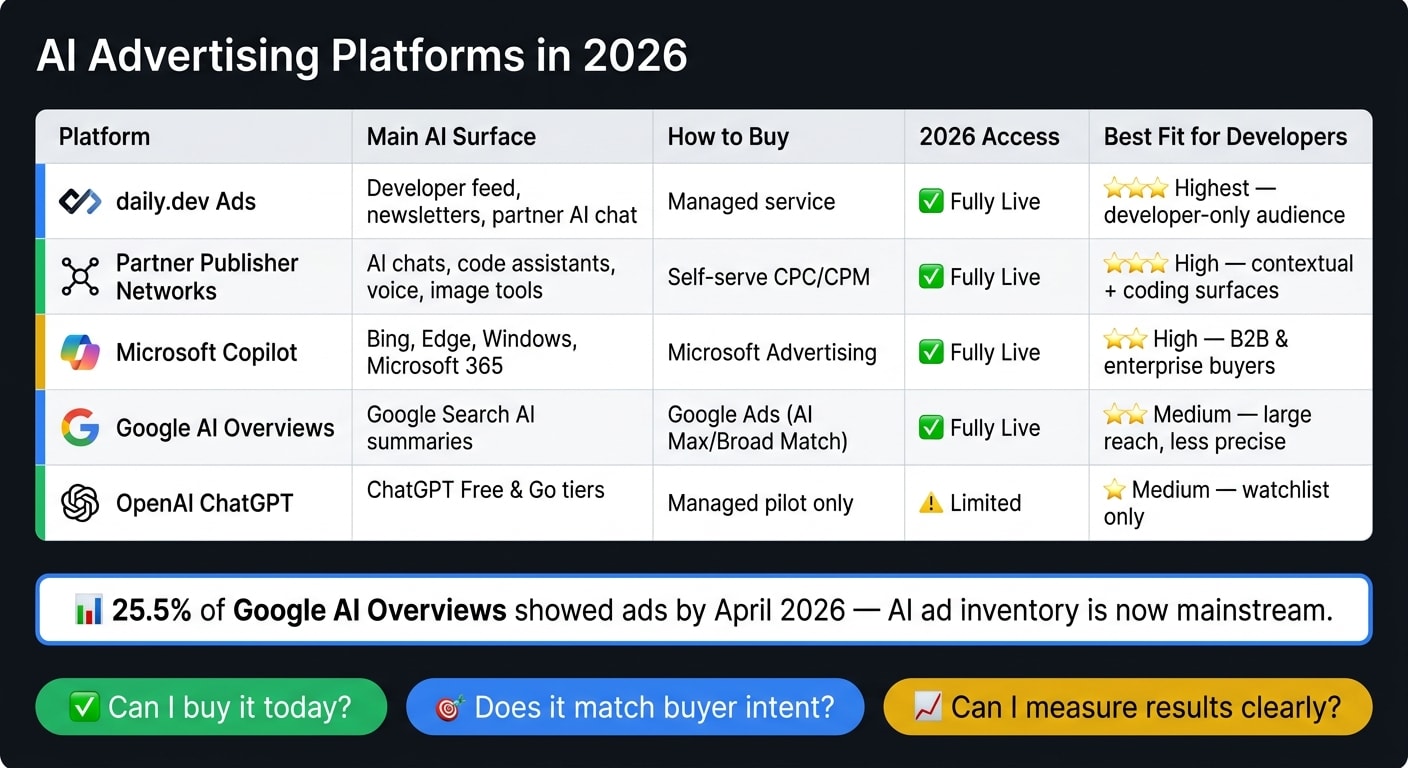
| Platform | Main surface | How I buy | Access in 2026 | Best fit |
|---|---|---|---|---|
| daily.dev Ads | Developer feed, newsletters, partner AI chat reach | Managed service | Live | Developer tools, infra, DevOps |
| Partner publisher networks | AI chat apps, code assistants, voice, image tools | Self-serve or managed | Live | Context-based campaigns, dev tools |
| Microsoft Copilot | Bing, Edge, Windows, Microsoft 365 | Microsoft Advertising | Live | B2B, enterprise |
| Google AI Overviews | Google AI Overviews and AI Mode | Google Ads | Live | Search scale, high-intent queries |
| OpenAI ChatGPT | ChatGPT Free and Go | Managed pilot | Limited | Watchlist for most teams |
So if you want the short answer: developer marketers should start with daily.dev, enterprise teams should test Copilot, and broad search advertisers should look at Google AI Overviews. ChatGPT is still one to watch, not the first place I’d put budget.
What counts as an AI advertising platform in this list
To keep this list honest, every option below has a live buy path. For developer marketers, that’s the main filter. The question isn’t just whether AI shows up somewhere in the product. It’s whether you can pay for placement inside that experience.
An AI ad network lines up offers with live conversation or search intent. When someone asks a question in a chatbot or an AI search surface, the network decides if your ad makes sense in that moment. The match comes from live query context, not third-party cookies.
Each entry uses the same four-part structure:
- What it is - the kind of platform
- What you can buy - the ad formats on offer
- Who it reaches - the audience on that surface
- How to start - the actual onboarding path
Only placements that appear inside or directly alongside AI-generated outputs make the cut.
First up: the developer-specific option.
1. daily.dev Ads
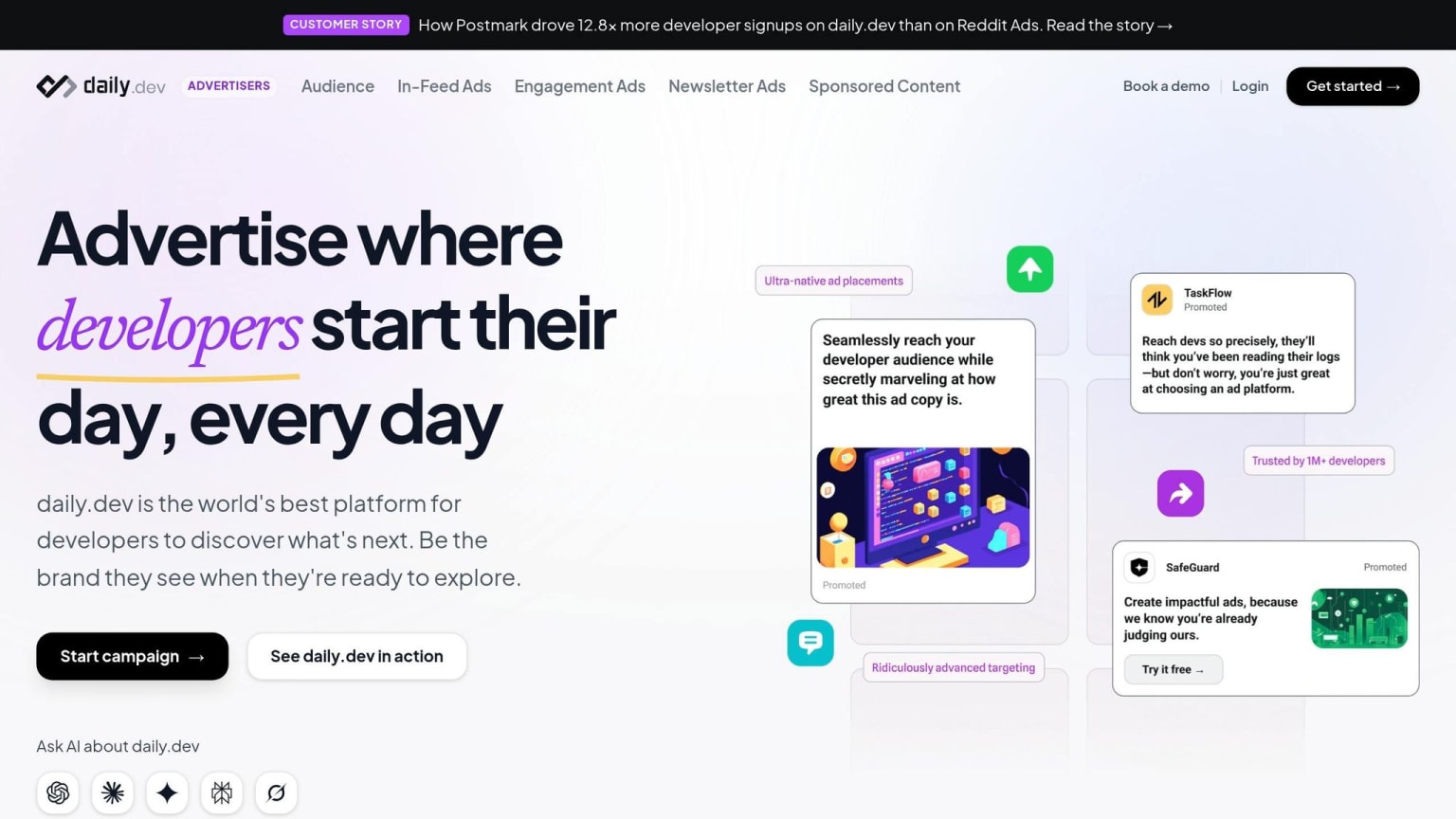
daily.dev is the most developer-focused option on this list. It offers placements on daily.dev itself, plus reach across verified partner publishers.
What it is
daily.dev’s AI surface centers on its personalized developer feed. It also reaches developers inside AI chats through verified partner publishers, with ad matching based on live intent.
Who it reaches
This option makes the most sense for developer-tool, infrastructure, and DevOps brands trying to reach a professional technical audience.
What you can buy
| Format | What it is | Key detail |
|---|---|---|
| In-Feed Ads | Native sponsored cards in the personalized feed | Intent-driven discovery |
| Engagement Ads | Brand tags, keyword spotlights, takeovers, and stack placements | Category recall |
| Newsletter Ads | One-week sponsorship slots in the daily.dev Digest | Five topical audiences: Web Development, AI & Machine Learning, DevOps & Cloud, Security & AppSec, and Data & Databases |
| Sponsored Content | Distributed technical posts with guaranteed minimum reads | Republished for SEO and AI visibility |
How to start
daily.dev Ads runs as a managed service. That means you’re paired with a dedicated account manager who takes care of setup, pacing, and reporting.
There’s also an invite-only Agency Partner Program for agencies. It includes priority access to limited inventory and up to 33% bonus value on campaign credits.
To get started, go to business.daily.dev and submit a short intro through the Get started form. From there, an account manager handles setup, pacing, and reporting.
Next: broader AI chat inventory bought through publisher networks.
2. Partner publisher networks for ads in AI chats
A single developer feed is one path. Partner publisher networks take that idea and spread sponsored placements across many AI apps at the same time.
What it is
Partner publisher networks buy sponsored placements across many AI apps, including chatbots, coding assistants, voice assistants, and image tools.
The network reads the live query and serves a relevant sponsored placement in real time. Targeting uses the live query and publisher metadata, not cookies.
For developer marketers, the strongest use case is code assistants. That’s where recommendations can show up while someone is actively looking for a fix, a tool, or a better way to solve a problem.
What you can buy
| Surface type | What it looks like | Best use |
|---|---|---|
| Text | Sponsored answers, inline product cards, sponsored follow-up questions | Research and comparison queries |
| Code | Sponsored tool recommendations inside AI coding assistants | Developer tool and infrastructure marketing |
| Voice | Spoken sponsor spots with audible disclosures | Voice-assisted use cases |
| Image | Labeled brand placements in image generation tools | Visual discovery |
Placements are labeled as "Sponsored" in line with IAB Tech Lab's AI Content Monetization Protocols (CoMP), so disclosure is built into the format.
Who it reaches
These networks tend to work best for brands trying to reach buyers in the comparison stage, especially developer-tool companies that want privacy-safe targeting.
For developer campaigns, code surfaces stand out. They place tool recommendations inside coding assistants at the exact moment of intent.
How to start
Some networks offer self-serve dashboards with low minimums. Pricing can run on CPC, CPM, or outcome-based billing.
A simple way to begin is to launch a small test campaign on a text or code surface through a self-serve dashboard.
Next: Microsoft Copilot's native ad inventory.
3. Microsoft Copilot ads via Microsoft Advertising
What it is
There’s no separate Copilot media buy. Instead, Copilot ads show up inside responses across Bing, Edge, Windows, and Microsoft 365.
What you can buy
You buy these placements through Microsoft Advertising using active Performance Max, Multimedia, Product, or Responsive Search Ads campaigns. To stay eligible for AI placements, use smart bidding with Target CPA, Target ROAS, or Maximize Conversions.
Ad formats and inventory
Copilot turns your current headlines, descriptions, images, and videos into native cards and carousels.
Who it reaches
These placements make sense for B2B and enterprise brands that want to reach Microsoft 365 and Windows decision-makers, especially people asking multi-step questions.
Microsoft has reported that Copilot placements deliver a 69% higher click-through rate and a 76% higher conversion rate than standard search results.
How to start
Start in Microsoft Advertising with active Performance Max, Multimedia, Product, or Responsive Search Ads campaigns. Then use Target CPA, Target ROAS, or Maximize Conversions so your campaigns can qualify for AI placements.
If your team already runs Microsoft Advertising, Copilot is the first AI placement worth testing.
Next: Google’s ads inside AI Overviews.
4. Google ads in AI Overviews
What it is
Google now places ads in AI Overviews and AI Mode, though AI Overviews are the main place advertisers can buy into right now. Ads can show above, below, or inside the AI Overview box. Those in-block placements are live for English-language queries in the U.S. on both desktop and mobile.
For advertisers, the main issue is simple: which current Search campaigns can show there?
What you can buy
The buying path is still Google Search. There isn't a separate AI-only campaign type. Instead, Google pulls inventory from existing Search, Shopping, and Performance Max campaigns.
To qualify, campaigns need:
- Broad Match or AI Max for Search
- Smart Bidding
Manual bidding does not qualify.
Within AI Overviews, Google can show Search text ads, Shopping cards, and Performance Max assets. Shopping cards pull from Merchant Center, which means your pricing, shipping, and promo data needs to stay current.
One catch: Google groups AI Overview impressions into Top Ads reporting, so it can be harder to break out AI-only ROI on its own.
Who it reaches
AI Overviews tend to line up with high-intent searches, especially when someone asks a specific question or works through a multi-step problem.
That makes this placement a strong fit for B2B and technical buyers who are researching tools, platforms, or vendors. It also matters for retail advertisers with strong purchase intent, especially when they want to stay visible as standard organic links get pushed farther down the page.
How to start
Start with your current Search, Shopping, or Performance Max campaigns. Then turn on Broad Match or AI Max for Search and use Smart Bidding with Target CPA, Target ROAS, or Maximize Conversions to become eligible for AI placements.
Next: OpenAI's current status on ads inside ChatGPT.
5. OpenAI ChatGPT advertising pilots
Where ads appear
ChatGPT ads are part of a managed pilot on the Free and ChatGPT Go ($8/month) plans. Paid plans still have no ads.
Buying access
Right now, OpenAI is running this as a managed pilot only. There isn't a public self-serve option yet.
Ad formats and inventory
Ads show up as native Sponsored cards inside the chat, with a clear visual break from the main response. Targeting is based on conversation context, not keywords.
Who it reaches
At this stage, the pilot is aimed mostly at approved consumer brands in areas like lifestyle, travel, CPG, education, and technology. For most developer marketers, this isn't a practical channel yet.
So while ChatGPT is getting a lot of attention, it belongs on the watchlist for most developer teams, not in the active media mix.
How to start
There is no public buying path yet. Access is limited to OpenAI's managed pilot.
The bigger question now is which AI ad options are actually useful for developer marketing.
Which option works best for developer marketing?
Pick the platform that matches your buyer, intent, and buying friction.
For developer marketing, reach isn't the main thing. The bigger issue is which surface lines up with technical intent.
Here’s the quick decision view:
| Platform | Primary AI Surface | Buying Mechanism | 2026 Availability | Fit for Developer Campaigns |
|---|---|---|---|---|
| daily.dev Ads | Developer feed and newsletters | Managed / Agency Partner | Fully available | Highest - developer-only audience |
| Partner publisher networks | Independent AI apps and chatbots | Self-serve CPC/CPM | Fully available | High - contextual, including coding surfaces |
| Microsoft Copilot | Windows, Edge, Microsoft 365 | Microsoft Advertising (Performance Max / Search) | Fully available | High - strong for B2B and enterprise buyers |
| Google AI Overviews | Google Search generative summaries | Google Ads (AI Max for Search / broad match) | Fully available | Medium - large reach, less precise targeting |
| OpenAI ChatGPT | ChatGPT interface, Free and Go tiers | Managed pilot only | Limited access | Medium - high intent, high cost |
If your team sells into enterprise, Microsoft Copilot is the strongest fit. It lives inside tools that enterprise developers and decision-makers already use every day, like Windows, Edge, and Microsoft 365.
Google AI Overviews gives you scale through broad match targeting. By contrast, OpenAI ChatGPT is still a limited pilot with no public buying path, which makes it a poor starting point for most teams.
If you're trying to reach developers, start where technical readers already are. daily.dev Ads is the only option on this list built only for a developer audience.
Where developer-audience buyers should start
After looking at the AI ad options on the market, this is the best place for developer teams to begin.
If you sell to developers, start with business.daily.dev. On daily.dev, you can run in-feed, engagement, newsletter, and sponsored content placements. daily.dev also extends your reach into AI chats through verified partner publishers.
If you're new to developer marketing, read /blog/how-to-advertise-to-developers before you plan placements.
The conclusion below breaks this into a simple launch order.
Conclusion
In 2026, the bigger opening is buying placement inside AI experiences, not using AI to churn out ad creative.
After looking at the live options, three things decide the pick: access, intent, and clear reporting. The strongest choices are the ones you can buy right now, measure without guesswork, and line up with live intent. When reporting gets mixed into broader search inventory, transparent placements matter even more.
For developer-audience campaigns, start with business.daily.dev. Then read /blog/how-to-advertise-to-developers before you plan placements. Avoiding common developer marketing mistakes is critical for maintaining credibility.
FAQs
what is an ai ad network
An AI ad network is the system that places paid brand content inside AI apps like chatbots, search assistants, and coding tools.
Unlike standard search ads, these ads show up inside AI-generated answers as context-based recommendations. They rely on SDK or API integrations to match offers with real-time conversational intent across many AI surfaces.
which ai platforms sell ads
In 2026, several major AI platforms sell ads. But the way you get access - and the ad formats you can use - still differs from platform to platform.
Here’s the short version:
- Google: ads in AI Overviews and AI Mode through Google Ads
- Microsoft: ads in Copilot through Microsoft Advertising
- OpenAI: a direct ChatGPT ad program in the U.S. with sponsored placements and a minimum spend
- Independent AI ad networks: inventory across multiple AI apps and assistants
That means you can’t treat AI advertising like one single channel. Google and Microsoft tie access to their own ad systems. OpenAI runs a direct program for ChatGPT in the U.S. And independent networks can help you buy placements across several AI tools at once, which may be useful if you want broader reach without managing each platform one by one.
can i buy ads in chatgpt
Yes. As of August 2026, OpenAI offers an ads manager for buying placements directly in ChatGPT.
These ads show up as labeled sponsored recommendation cards at the bottom of responses for Free and Go users in the United States.
Targeting uses the topic of the conversation at that moment. It does not rely on third-party cookies or behavioral segments.