
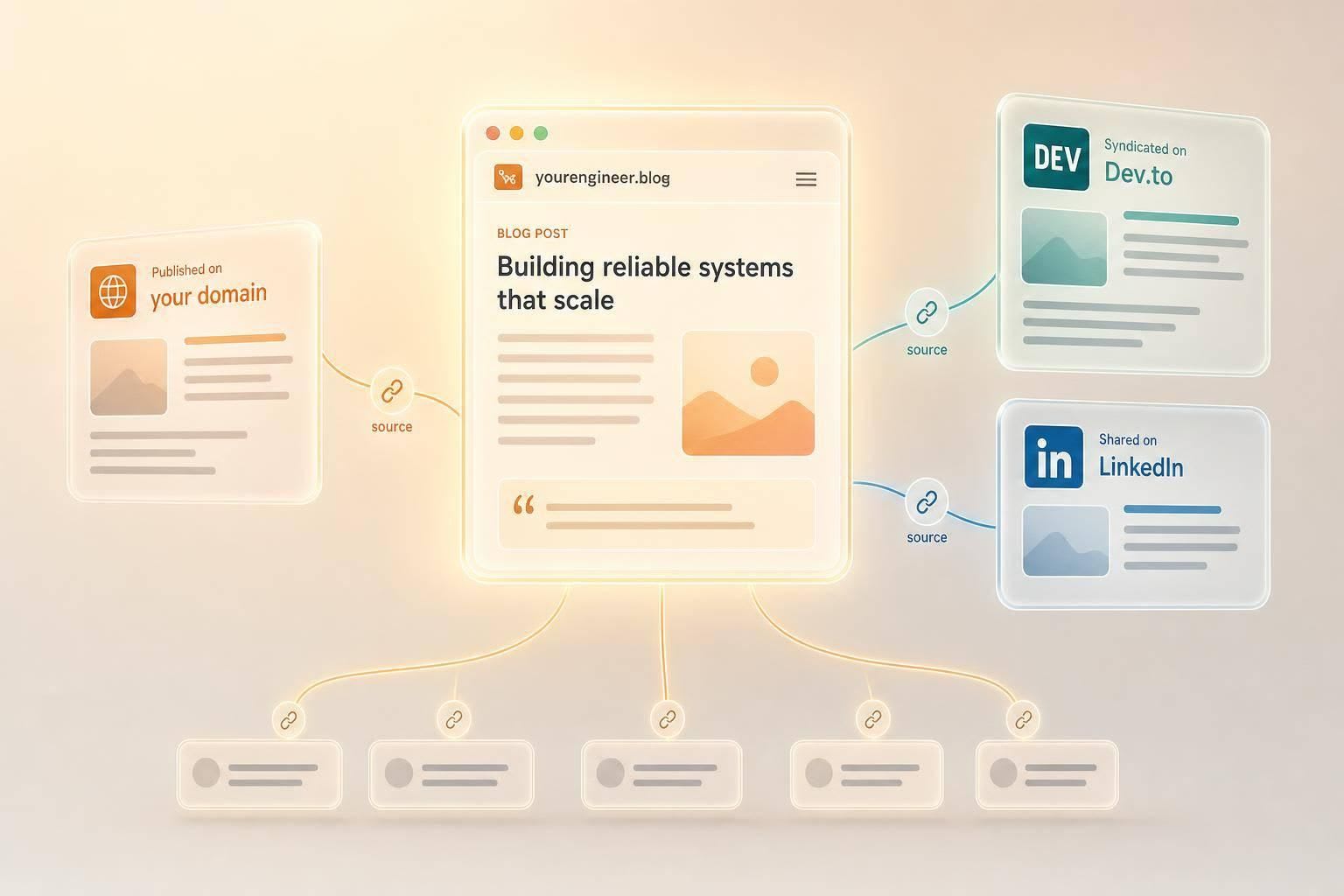
If developers don’t see your post, it does almost nothing for hiring. A good engineering blog helps only when the right readers find it, read it, and connect it to your team.
Here’s the short version: publish on your own site first, republish with a canonical link, share with context in the right developer spaces, and use newsletters, aggregators, or paid distribution when a post deserves more reach. Most posts get a short traffic bump, then drop off fast if sharing stops after launch.
What I’d focus on right away:
- Own the source: put the original post on your company domain first
- Republish smartly: syndicate the full piece elsewhere with a canonical URL back to your site
- Don’t just drop links: explain the problem, incident, or lesson in 2 to 3 plain sentences
- Match the post to the channel: Reddit, Hacker News, Slack, and Discord each react to different framing
- Build repeatable distribution: use newsletter pitches, aggregator submissions, and paid promotion for posts with strong reader fit
- Stay in the discussion: replies and follow-up answers do as much for employer brand as the post itself
A few details matter more than most teams think. For example, paid promotion can extend a post beyond its first 30 days, and syndication can help you get more readers without losing the original source on your own domain. That means one post can keep working longer instead of fading after one internal share cycle.
Bottom line: your engineering blog becomes a hiring asset when distribution is part of publishing, not an afterthought.
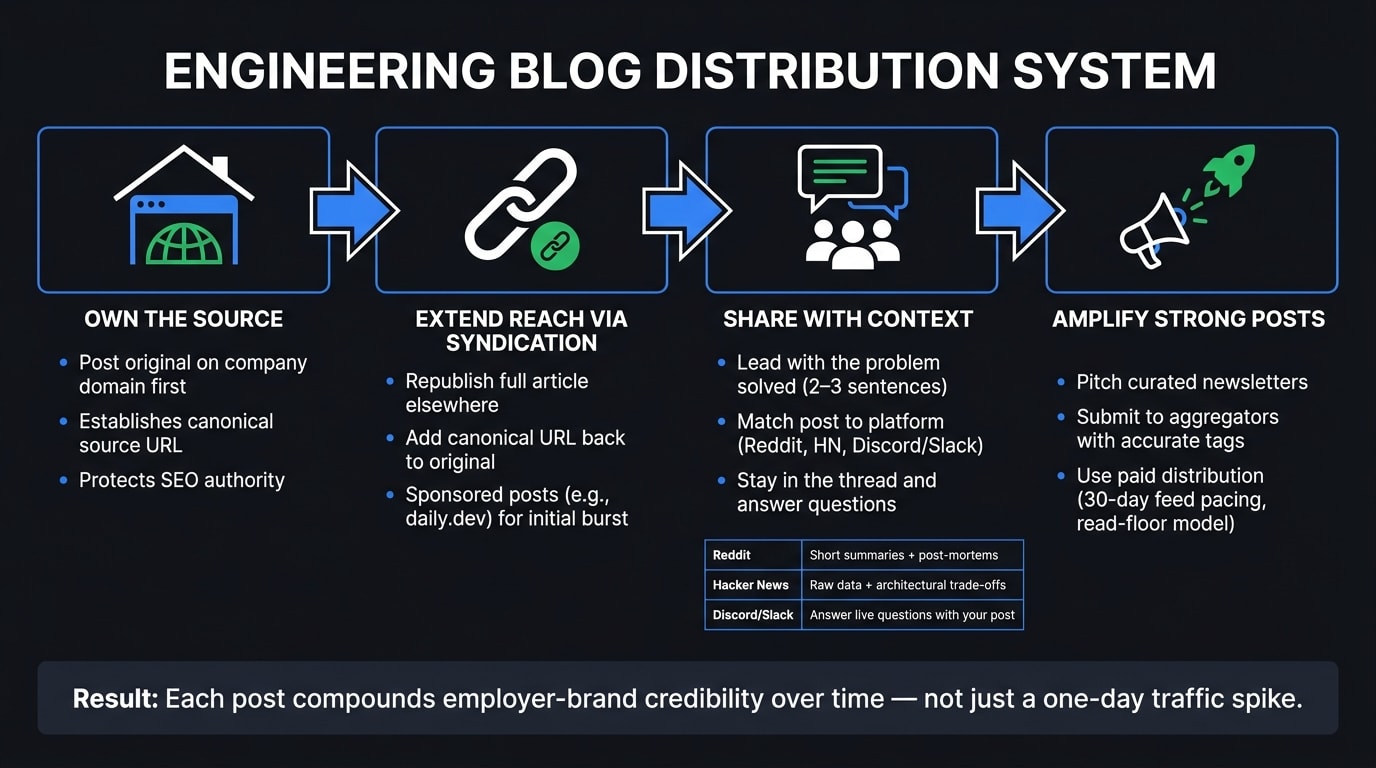
Publish on your own domain first, then extend reach through syndication
Publish the original piece on your company domain first. That gives every later placement a clear source URL to support.
Syndication helps you get more eyes on the post, but your company blog should still be the main home for the original version.
After that, republish the full article elsewhere with a canonical tag that points back to the original URL. That way, one strong engineering post can keep working across more than one channel, while the original stays discoverable on your site.
For posts that should reach a bigger audience, canonical republishing is a solid setup. Sponsored posts on daily.dev fit this model: they add an initial reach burst while the canonical tag keeps the original on your domain.
Share in developer communities without sounding like a promotion
Once the post is syndicated, community sharing can turn reach into actual developer attention. But this part is touchy. Developers can spot promotion fast, and they often judge your credibility by how you share, not just what you share. Push too hard, and trust drops. Add useful context, and the post feels worth their time before they even click.
Lead with the problem the post solves, not just a link
Before you share a link, add two or three sentences that explain the situation the post covers. For example: We hit a p99 latency spike after a schema migration. Here's what we found and how we fixed it. That kind of framing tells people exactly what they’ll get.
Developers usually scan for relevance and technical depth. A short, plain summary of the incident, migration, scaling issue, or tooling lesson gives them a reason to care. It also shows that the post is there to help, not to sell.
That same clarity makes it easier to share the post in communities where it actually fits.
Match each post to the community where the topic fits
Not every post belongs everywhere. Check the audience and rules before you post. Many subreddits and Discord servers ban self-promotion or expect you to participate before sharing your own work. The better move is simple: share once, in the right place, with context that matches the room.
Each community tends to respond to a different kind of entry point.
| Platform | What works best | What to avoid |
|---|---|---|
| Short summaries that add value without a click, and technical post-mortems | Raw link drops with no context | |
| Hacker News | Straightforward titles; raw data and architectural trade-offs | Clickbait framing or marketing language |
| Discord/Slack | Answering a live troubleshooting question with your post as a reference | Posting in unrelated channels or off-topic threads |
If people reply, stay in the thread and answer questions. That follow-through goes a long way.
It also helps to use a clear profile that shows your company affiliation. When people know who’s speaking, the post feels more honest. Employer-brand trust gets stronger when Developer Relations or engineering teams join the discussion, answer questions, and share code or background details.
Build repeatable reach with newsletters, aggregators, and paid amplification
After community sharing, the next step is to build channels that keep working every time you publish a strong post. Newsletters, aggregators, and paid distribution give you repeatable reach after organic sharing. That matters even more for employer-brand posts, where you often need the right people to see the piece more than once.
How to pitch your post to curated newsletters
Use newsletter pitches when you want more reach without reworking the article itself. Keep it simple: send a one-sentence topic summary, name the technical audience, and explain why the piece matters right now.
That gives editors the context they need. It also keeps your pitch from sounding like a sales note, which is usually where things go sideways.
Submit to aggregators and curated feeds that match your topic
With aggregators and curated feeds, short and clear wins. Write a concise description centered on the problem the post helps solve, so developers browsing by stack or issue can spot the value fast.
Accurate tags matter too. If your tagging is off, the right readers may never come across the article.
Use targeted paid distribution to put strong posts in front of the right developers
Some posts are worth pushing past organic channels, especially when you want a longer shelf life. Paid distribution helps you extend the same work instead of letting a good piece fade after the first wave of shares.
daily.dev Ads is built for that use case, with targeting by seniority, programming languages, tools, and interests. Sponsored Content uses a read-floor model and 30-day feed pacing, so you pay for readers who actually opened and read the post, not just impressions .
Conclusion: make distribution part of your employer-brand system
One well-written post won't build your employer brand by itself.
What moves the needle is repeatable distribution. Publish the original on your site, syndicate it with the proper canonical setup, share it with context in the right communities, and give extra reach to the posts that earn it.
That process matters because reach compounds only when every post has a distribution plan. The edge comes from treating distribution like a system instead of a one-off job.
Consistent distribution compounds over time. Each strong post becomes lasting proof of your engineering team's credibility.
Once developers actually see your posts, your blog starts doing employer-brand work. Treat distribution as part of publishing, not something you tack on later.
FAQs
How do I set up a canonical link correctly?
Publish the content on your own domain first. Then wait 2 to 10 days so search engines have time to index it.
After that, syndicate the piece and use the platform’s canonical field or import tool if it offers one. Next, check the page source to make sure the canonical tag points to your original URL. You can also use Google Search Console to confirm that your site is recognized as the primary source.
Which engineering posts are worth paid distribution?
Reserve paid distribution for your highest-value content: engineering deep dives, technical announcements, product launches, and detailed implementation guides or whitepapers.
Focus on posts that teach something useful, help readers solve a specific technical problem, and already show strong organic engagement. Content that supports your technical brand is also a smart bet for paid promotion.
How often should we share a post after publishing?
First, publish on your own domain and give search engines 2–10 days to index the page. After that, syndicate the piece to 2–5 partner platforms over the next quarter, and use a rel=canonical tag that points back to the original source.
For promotion over time, aim to publish 2–4 original posts per month. Then, refresh and re-syndicate evergreen content once a year so it keeps pulling in attention and engagement.