




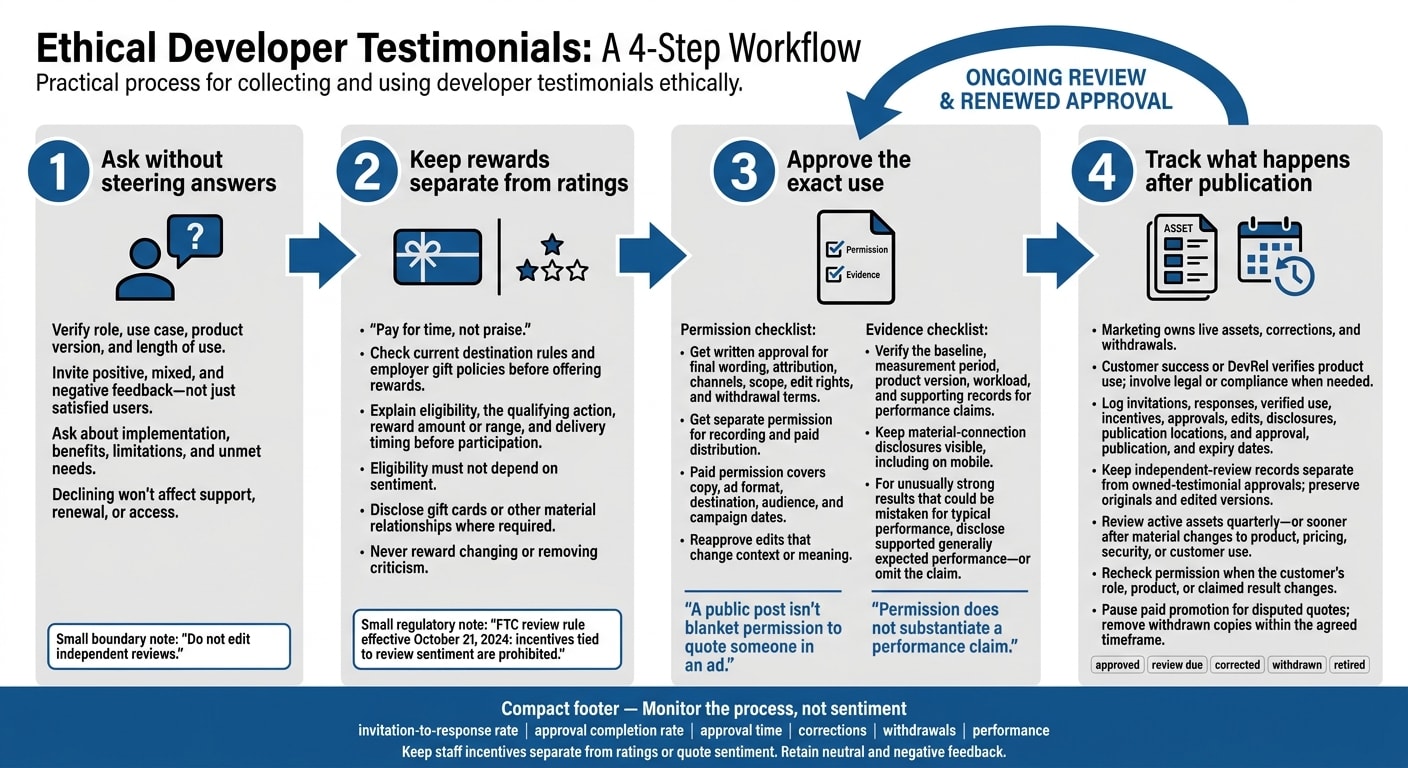
Ask actual users for honest feedback - not praise - and get written permission before using their words in marketing. Any reward should pay for participation, never a positive rating. The FTC’s review rule, effective October 21, 2024, prohibits incentives tied to review sentiment.
An ethical collection process covers four steps:
- Ask without steering answers. Verify product use and invite positive, mixed, and negative feedback.
- Keep rewards separate from ratings. Check review-site rules and disclose gift cards or other material relationships where required.
- Approve the exact use. Confirm wording, attribution, channels, and separate permission for paid ads. Check evidence for every performance claim.
- Track what happens after publication. Assign an owner, review active assets quarterly, and handle corrections and withdrawals.
A public post isn’t blanket permission to quote someone in an ad. And permission to publish doesn’t prove a claim is accurate.
1. Get consent and collect feedback without bias
Before asking for feedback, match the format to your claim. Independent reviews, owned testimonials, case studies, and paid endorsements each serve a different purpose. See where developer-tool review sites matter to help choose review placements.
Verify product use and permission to publish
Check that the person’s experience supports the claim you plan to publish. Confirm their role, use case, product version, and length of use through account records or a customer-confirmed project summary. A demo attendee cannot claim production results.
Record the approved wording, attribution, channels, scope, edit rights, and withdrawal terms. Make sure the person has authority to approve the exact attribution details. Get separate consent for recording, collect only the personal data you need, and limit access.
Invite users with neutral questions
Choose participants based on product tenure, use case, or implementation stage - not satisfaction scores alone. Send the same core invitation to users with positive, mixed, and negative experiences. Ask about implementation, benefits they’ve seen, limitations, and unmet needs.
Make clear that declining won’t affect support, renewal, or access. Send reported problems through standard support channels. Do not edit independent reviews; limit edits to owned testimonials and case studies.
Track consent, edits, and publication
Put one person in charge of logging invitations, responses, verified use, incentives, approvals, edits, disclosures, and publication locations. Track approval, publication, and expiry dates, too.
Keep independent-review records separate from owned-testimonial approvals. Save the original alongside every edited version, and get approval again if an edit changes the context or meaning.
For your 2026 workflow, set a review date and recheck permission whenever the customer’s role, product, or claimed result changes. Label selected quotes as customer testimonials, and keep critical responses in the master feedback log.
2. Offer incentives without paying for praise
Once you have neutral feedback and permission to publish it, consider whether a reward could skew the response. Gift cards can increase participation, but they may also pressure reviewers or draw people who only want the reward. Pay for time, not praise.
Compare incentive options
Base your choice on the destination’s rules, participants’ employer policies, and your team’s ability to manage rewards.
| Option | Independence risk | Disclosure obligations | Platform compatibility | Administrative effort | Best for |
|---|---|---|---|---|---|
| No incentive | Lowest direct risk; response bias remains | Disclose other relevant relationships | Broadest, subject to destination rules | Low | Customer programs or destinations that prohibit incentives |
| Sentiment-independent gift card | Moderate; the reward can affect participation and create perceived pressure | Explain the terms and disclose the reward relationship where required | Platform-specific | Moderate | Destinations that allow modest rewards regardless of sentiment |
| Charitable donation | Moderate; donations can influence participation | Explain eligibility, amount, recipient, and required disclosures | Platform-specific | Moderate to high | Participants who prefer a community benefit |
| Recognition or content-sharing | Low to moderate | Disclose the relationship; get permission before quoting, tagging, or promoting | Better suited to owned channels; check destination rules | Moderate | Customer stories, community recognition, or educational content |
Match the reward to the destination’s policy before launching your campaign.
Explain rewards and check review-site rules
Before anyone participates, explain who qualifies, what action earns the reward, its amount or range, and when it will arrive. Make clear that eligibility does not depend on sentiment. Never offer bonuses for positive reviews or rewards for changing or removing criticism. Under FTC guidance effective October 21, 2024, incentives cannot depend on a particular review sentiment. Disclosure does not make that condition acceptable.
For each 2026 campaign, check the destination’s current rules on allowed incentives, value limits, notification, and labels. Record the date you reviewed the policy.
Ask participants to check their employer’s gift and procurement policies before accepting a reward. Let them participate without a reward, and still include their feedback. Clearly disclose the reward relationship wherever required, including when you reuse a rewarded review in marketing. Never present employees, agencies, or partners as independent customers. Keep the reward policy separate from the testimonial approval process.
3. Publish accurate quotes and clear disclosures
Approved feedback isn't ready to publish until you've checked usage rights, disclosures, and claims.
Ask before quoting public posts
Get written approval for the exact excerpt, attribution, profile image, screenshot, channel, date, and any expiration or withdrawal terms. Don't suggest that an employee’s personal post represents their employer’s endorsement unless the company has approved it.
Edit only for grammar and length, then send the final version back for approval. Keep the version, workload, environment, and limits that explain the result. Never merge separate posts into what looks like a single statement. Paid distribution requires separate approval because it changes how you use the feedback.
Confirm permission for paid distribution
Before using a testimonial through daily.dev Ads, get explicit permission for paid distribution. That permission should cover the copy, ad format, destination, audience, and campaign dates. Target by tech stack, seniority, geography, and interests that match the subject. Keep attribution and any material-connection disclosure visible in the final placement, including on mobile.
Approval alone doesn't establish legal compliance or provide proof for a claim.
Check compliance requirements for 2026
In 2026, FTC endorsement guidance and consumer reviews and testimonials rules require separate checks. Meeting one doesn't mean you've met the other. Check incentive limits, material-connection disclosure requirements, and current destination policies. Prohibit fabricated testimonials, including AI-generated reviews of experiences that never happened.
Ethical collection doesn't excuse inaccurate marketing claims. Permission does not substantiate a performance claim. Before publishing a result claim, verify the baseline, measurement period, product version, workload, and supporting records. Keep the developer’s experience separate from broader marketing claims. If readers could reasonably mistake an unusually strong result for typical performance, disclose the generally expected performance with supporting evidence - or leave out the claim. Don't rely on this disclaimer alone:
results may vary
4. Make ethical review collection a routine
Keep consent, disclosures, and reuse permissions intact after publication. Use the same prepublication checklist for every testimonial, and save it with the approval record.
Assign ownership and keep testimonials current
After the checklist is complete, marketing should own live assets, corrections, and withdrawals. Record the approved wording, channels, permission dates, incentive terms, and next review date. Have customer success or DevRel verify product use, and bring in legal or compliance when needed.
Review active campaign assets quarterly - or sooner after material changes to the product, pricing, security, or customer use. Label each asset approved, review due, corrected, withdrawn, or retired. Pause paid promotion for disputed quotes, and remove withdrawn copies within the agreed timeframe.
Track invitation-to-response rate, approval completion rate, approval time, corrections, withdrawals, and performance to catch process gaps early. Keep staff incentives separate from ratings or quote sentiment. Keep neutral and negative feedback available to help improve the product and messaging.
Teams ready for paid distribution can discuss an approved testimonial campaign.
FAQs
Can I publish an anonymous developer testimonial?
Yes, but anonymous testimonials often carry less weight than verified, public endorsements from known community members. Developers tend to trust candid peer feedback more than polished marketing. If you share an anonymous quote, label it as coming from a verified user - but only if that’s true.
Avoid incentives that skew feedback. Developers may spot praise driven by rewards. Always get permission before quoting a public post.
How long should I retain testimonial consent records?
Legal retention periods vary by jurisdiction. Store testimonial consent records with your source-check data in a formal research and evidence management process. This lets you provide verification when requested.
For each testimonial or review, record the source, access date, and proof of consent. Clearly label factual documentation, independent peer feedback, and vendor-managed content so readers can tell them apart. Verify claims at least every three months or whenever product information changes.
What if a developer’s employer disputes an approved testimonial?
Remove or pause the testimonial immediately while you investigate. Leaving disputed claims public can weaken trust in your reviews and harm community relationships.
Contact both the developer and the employer to check the facts. Then update or retract the testimonial based on a clear, documented resolution.