



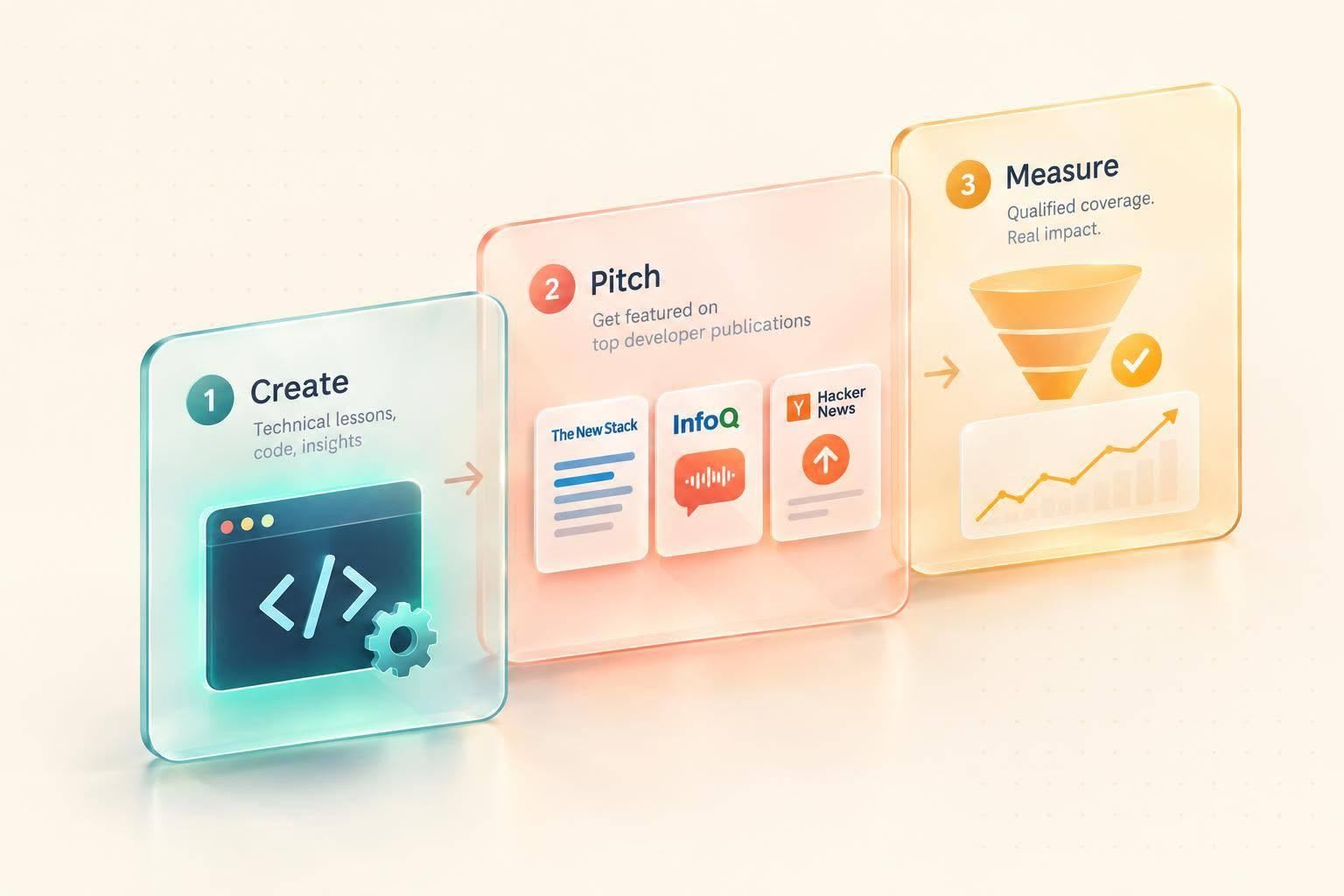
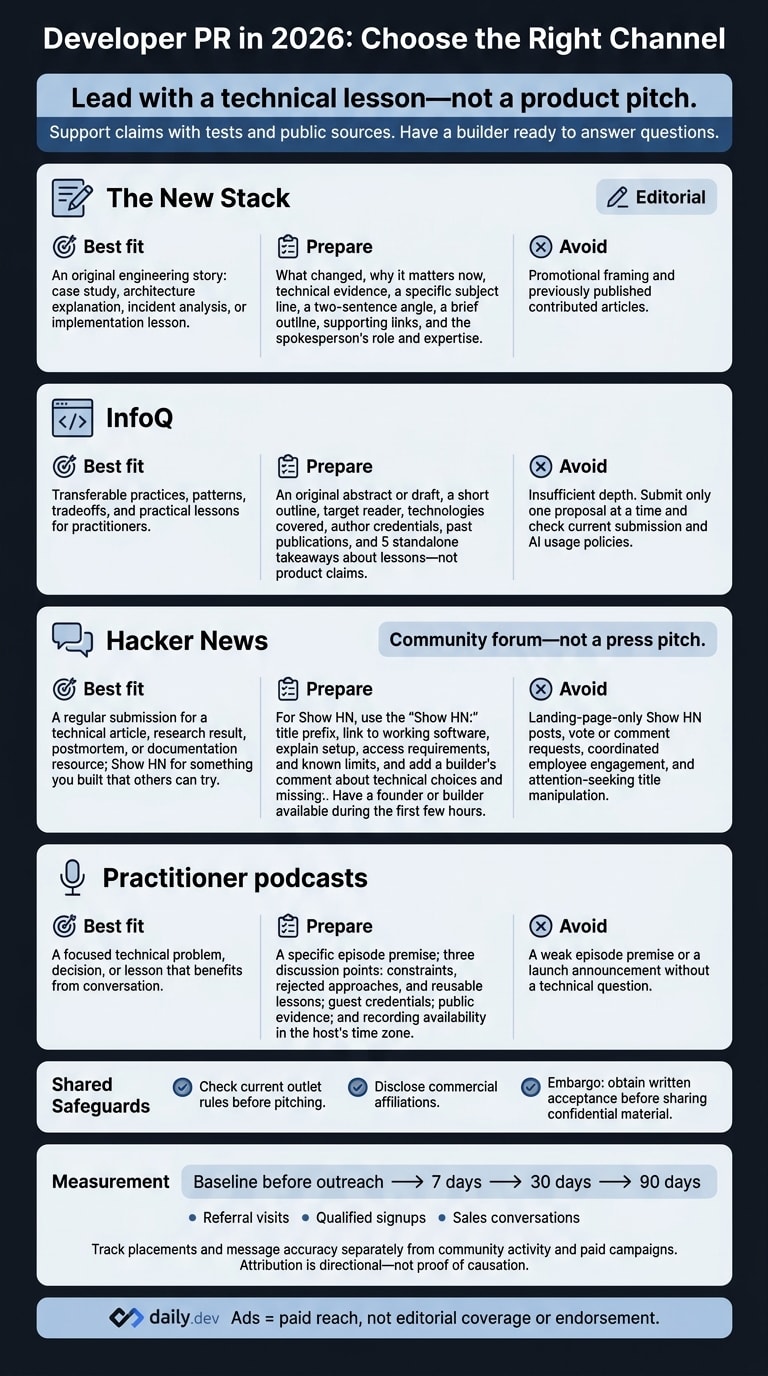
Developer PR in 2026 starts with a technical lesson - not a product pitch. Show what changed, support claims with tests and public sources, and have a builder ready to answer questions.
Match the story to the channel:
- The New Stack: Pitch an original engineering story with technical details and a clear reason it matters now.
- InfoQ: Propose a practical article with 5 standalone takeaways.
- Hacker News: Share a useful technical resource or a working project through Show HN. Answer questions without requesting votes or coordinating engagement.
- Podcasts: Offer a focused technical topic and a guest who can explain the decisions behind it.
Agree on embargo terms before sharing confidential material. Track qualified visits, signups, and sales conversations after 7, 30, and 90 days - not just mentions. Keep paid distribution, including daily.dev Ads, separate from editorial coverage.
2. Tailor pitches to The New Stack and InfoQ
In 2026, read recent coverage of your exact topic and check each outlet’s current submission rules before pitching. Note the questions editors ask, the people they quote, and what your story adds.
Once disclosure is settled, fit the pitch to the outlet’s format. Put the engineering lesson before the product.
Pitch a technical story to The New Stack
For news pitches, lead with what changed, why it matters now, and who can explain the technical facts. For contributed articles, start with an original implementation lesson.
Include a specific subject line, a two-sentence angle, a brief outline, supporting links, and the spokesperson’s role and expertise. The outlet’s contributor guidance directs original article pitches to contributors@thenewstack.io - not previously published blog posts.
Disclose commercial ties up front. Keep earned-media outreach separate from sponsored submissions, which follow their own guidance. Check current instructions before promising a response window. Follow up once with a useful update, such as a released artifact or a clearer explanation of your methods, rather than repeated status checks.
Send InfoQ a proposal with 5 takeaways
Make your proposal easy to scan. Include an original abstract or draft, a short outline, the target reader, technologies covered, author credentials, and past publications.
Write five standalone takeaways about lessons, not product claims. Explain the constraints, approaches evaluated, implementation steps, measurement conditions, and limitations behind those lessons.
Follow the current form’s length guidance and submit only one proposal at a time. The call for articles describes 2,000 to 3,000 words, while the form lists 1,500 to 4,000 words, excluding code snippets. Acknowledge the applicable AI usage policy, and make sure editors can open every linked document.
When the story is public and ready for open debate, follow the Hacker News rules in the next section.
3. Follow Hacker News submission rules
Hacker News is a community forum, not a press pitch. It can help more people see your launch, but it doesn’t guarantee coverage. For a 2026 launch, check the official community guidelines, which stress relevance, intellectual curiosity, and constructive participation. Then choose the post type that fits what you’re sharing.
Choose a regular submission or Show HN
Use a regular submission for a technical article, research result, postmortem, or documentation resource that can spark discussion. Show HN is for something you built that others can try and discuss.
Start the title with “Show HN:” and explain what the project does. Link to working software - not just a landing page, waitlist, or announcement.
Test what users see and do on their first visit. Spell out setup steps, access requirements, and known limits. Then add a builder’s comment explaining why you built it, your technical choices, and what’s still missing.
Once you’ve chosen the post type, focus on the thread rather than just the headline.
Have the founder or builder answer questions
Have the founder or builder stay in the thread during the first few hours. Answer questions about architecture, security, licensing, and performance honestly. Make it clear which features have shipped and which are planned. Acknowledge valid criticism, then return with concrete fixes.
Do not organize coordinated voting, request upvotes or comments, coordinate employee engagement, or manipulate titles to attract attention. Participation should come from independent interest, not a launch campaign.
Reuse launch-day discussions
Turn recurring questions into documentation, reproducible tests, or a technical follow-up for later earned-media outreach. For practical guidance, see the daily.dev guide to Hacker News launch-day marketing and sustained coverage.
Use those launch-day questions and responses to help choose your next earned-media channel.
4. Choose a coverage route and measure results
After outreach, choose the channel that fits your evidence. Then measure what it drives.
| Story condition | Best-fit route | Preparation required | Main risk |
|---|---|---|---|
| An engineering lesson pitched to The New Stack | Submit a technically useful case study, architecture explanation, incident analysis, or implementation lesson | A clear engineering problem, original evidence, technical detail, and a proposal without product-marketing language | Promotional framing |
| An educational article for InfoQ | Send an article proposal about transferable practices, patterns, tradeoffs, or lessons for practitioners | A concise proposal with five concrete takeaways, a defined audience, and enough depth for an expert article | Insufficient depth |
| A usable project for Hacker News Show HN | Publish a working project readers can try and discuss | A stable public demo or repository | Engagement manipulation |
| Timing condition: an embargo | Coordinate timing only after the outlet accepts the embargo in writing | Written acceptance before sharing confidential material | Assumed confidentiality |
| A practitioner podcast pitch | Propose a focused episode about a technical problem, decision, or lesson learned | A specific episode premise, three discussion points, guest credentials, public supporting evidence, and recording availability | A weak episode premise |
If your story works better as a conversation than a written piece, pitch a podcast.
Pitch podcasts with a clear episode topic
Lead with a technical question - not the launch announcement. Outline three discussion points: constraints, rejected approaches, and reusable lessons.
Include the guest’s relevant experience, public supporting material, and recording windows in the host’s time zone. Disclose employer and commercial affiliations. Keep editorial invitations separate from paid sponsorships.
Measure qualified interest, not just coverage
For your 2026 plan, record a baseline before outreach, then check results after 7, 30, and 90 days. Track relevant placements and message accuracy separately from community activity and paid campaign reporting.
Use tagged links, CRM data, and a “How did you hear about us?” field to track referral visits, qualified signups, and sales conversations.
Referral data won’t tell the whole story. Readers may return through search, direct visits, or private recommendations. Treat uncertain attribution as a directional signal, not proof of cause and effect.
Match your story to the right channel
Use daily.dev Ads only when you need paid reach. It doesn’t replace editorial coverage.
For a separate paid-distribution plan, daily.dev Ads offers In-Feed Native Ads with targeting by tech stack, seniority, geography, and interests. Prepare with developer marketing insights and the developer advertising planning hub, or discuss a campaign when useful. Paid distribution is not editorial endorsement.
FAQs
How can I tell if my technical story is newsworthy?
A technical story is worth sharing when it shows how to solve a real problem, not just what features a product offers. Back it up with working code samples, runnable demos, or benchmarks that clearly explain how tests were run. Skip slogans and sales-heavy language.
Match the story to the venue. A Hacker News launch needs a working product and a plain description. Offer something useful, be honest, and make any promotion clear.
Can I pitch the same story to multiple outlets?
Yes, you can pitch the same story to multiple outlets. But tailor each pitch to the outlet’s norms and etiquette instead of sending the same message everywhere. Hacker News calls for a one-of-a-kind, high-quality Show HN launch moment - not something you can repeat or manufacture.
Keep your outreach transparent and technical, with a clear focus on what developers gain.
What should I do if an editor declines my pitch?
Respect the editor’s decision and don’t follow up again on that story. Developers and their communities value honesty. Earned coverage depends on what your story offers the publication’s readers.
For future pitches, lead with useful technical content, such as tutorials or benchmarks, instead of press releases. If you need guaranteed distribution, consider a Sponsored Post to help your technical content reach your target audience.