




A useful comparison page helps buyers choose - not just choose the publisher’s product. Start with the buyer’s task, apply the same criteria to every option, link claims to sources, and disclose commercial ties before the first recommendation.
The daily.dev alternatives hub shows how this works for developer advertising: daily.dev Ads for developer-focused campaigns, EthicalAds for contextual placements, and LinkedIn Ads for job-title or company targeting. The hub is a vendor-published example, not independent proof of which option is best.
An honest comparison covers:
- Scope and fit: Who the page serves, which workflows each option replaces, and what falls outside the review.
- Buying criteria: Audience, targeting, formats, delivery terms, measurement, ad requirements, setup, and workflow fit.
- Limits and unknowns: Separate sourced facts from judgments. Missing documentation does not mean a feature is absent.
- Review dates and ownership: Keep publication, update, and source-check dates separate. Assign reviewers and check claims at least every 3 months, or sooner when something changes.
The goal is a conditional recommendation: explain when each option fits, where it falls short, and what buyers should confirm before spending.
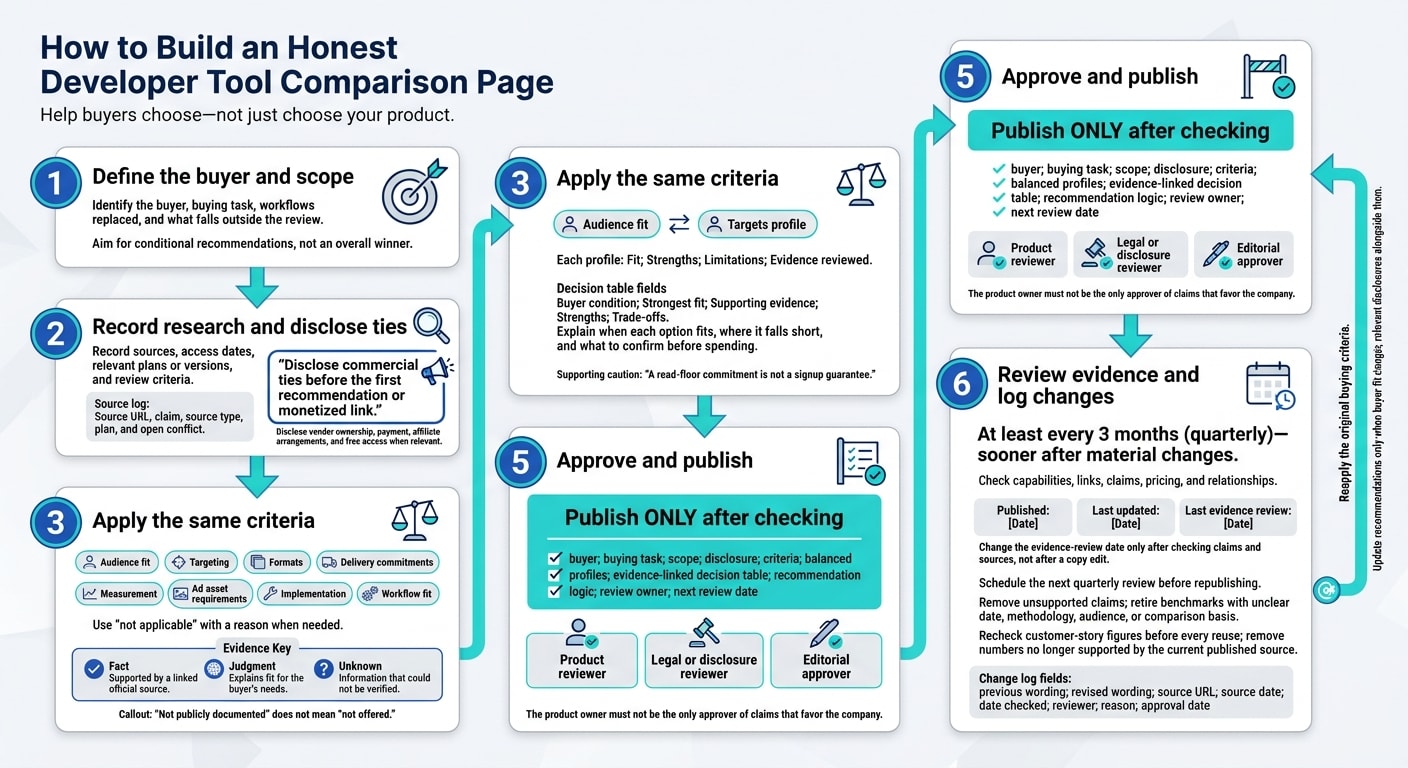
2. Explain your research and disclose relationships
Before making recommendations, add a research note with your sources, access dates, relevant plans or versions, and review criteria. Log each source URL, claim, source type, plan, and open conflict. Use current official documentation whenever possible to support capability claims. A clear research record lets readers check the comparison.
Put the disclosure before the first recommendation or monetized link, not in a footer. State vendor ownership and any payment, affiliate arrangement, or free access that could affect the recommendation. The FTC endorsement guidance calls for clear disclosure next to the recommendation.
Disclosure: daily.dev publishes this comparison and offers daily.dev Ads. The criteria are applied consistently across all options.
After the disclosure, assess every option using the same criteria.
Choose criteria that match the buying task
For advertising decisions, assess audience fit, targeting, formats, delivery commitments, measurement, ad asset requirements, implementation, and workflow fit. Ask the same questions for every entry, and use these criteria to classify each claim in the log.
Use “not applicable” with a reason where needed. If pricing isn't publicly comparable, leave it out of the scorecard.
Separate facts, judgments, and unknowns
Give each claim a clear label:
- Fact: Supported by a linked official source.
- Judgment: Explains how an option fits the buyer's needs.
- Unknown: Identifies information you couldn't verify.
These labels help keep the comparison balanced and prevent unsupported claims from shaping recommendations. Use “not publicly documented,” not “not offered.”
Remove unsupported benchmarks, audience counts, and performance claims. For published results, retain metric definitions and campaign timeframes.
3. Write balanced profiles and one decision table
Apply the criteria from Section 2 to every option, then use one table to connect those criteria to a buying decision. Use the daily.dev alternatives hub as the example, keeping the disclosure established above. Show where each option fits - and where it doesn't.
Describe what daily.dev Ads offers
Fit: daily.dev Ads serves developer-tool companies, demand-generation teams, DevRel-adjacent marketers, employer-brand teams, and agencies that need developer-specific reach and managed campaign execution. Strengths: targeting by tech stack, seniority, geography, and interests; In-Feed Native Ads; Engagement Ads; and Digest newsletter sponsorships by topic track. Sponsored Post provides guaranteed feed impressions, a read-floor commitment, and canonical republishing. Limitations: developer-focused reach may not match a broader buying committee; confirm delivery terms and conversion tracking. Evidence reviewed: official product overview and Sponsored Content documentation.
When to choose a competitor
Fit: EthicalAds suits briefs that prioritize contextual, privacy-oriented delivery. Strengths: contextual placements across documentation and open-source sites. Limitations: confirm contextual targeting matches your precision needs. Evidence reviewed: EthicalAds contextual advertising overview.
Fit: LinkedIn Ads suits briefs where professional identity matters. Strengths: job-title and company targeting. Limitations: confirm those attributes reach the technical practitioners you need. Evidence reviewed: LinkedIn advertising overview.
When to choose daily.dev Ads
For Sponsored Post, agree on what counts as a read and how delivery will be reported. A read-floor commitment is not a signup guarantee. Use the table to make conditional recommendations, not name an overall winner.
| Buyer condition | Strongest fit | Supporting evidence | Strengths | Trade-offs |
|---|---|---|---|---|
| Needs developer discovery with tech-stack, seniority, or geography targeting | daily.dev Ads | Product overview: targeting by tech stack, seniority, geography, and interests | Native placements that match technical audience requirements | Confirm available segments for the brief |
| Needs guaranteed feed impressions and a read-floor commitment | daily.dev Ads Sponsored Post | Product overview: guaranteed feed impressions, a read-floor commitment, and canonical republishing | Content distribution with agreed delivery terms | Reads do not guarantee conversions; confirm reporting definitions |
| Needs contextual documentation or open-source placement | EthicalAds | EthicalAds contextual advertising overview: contextual placement description | Fits context-led, privacy-oriented briefs | Confirm contextual targeting matches your precision needs |
| Needs job-title or company targeting | LinkedIn Ads | LinkedIn advertising overview: professional targeting description | Fits buying-committee selection | Professional attributes may not establish technical interests |
| Needs newsletter sponsorship by topic track | daily.dev Ads | Product overview: Digest newsletter sponsorships by topic track | Newsletter delivery for content-led campaigns | Confirm topic-track availability and reporting |
4. Review evidence and update recommendations
Use the same criteria and source log from the research section. A comparison page is only as reliable as its current evidence. Check capabilities, links, claims, pricing, and relationships at least quarterly. Review sooner after any material change, including broken links or changes to customer stories.
Display Published, Last updated, and Last evidence review as separate U.S.-format dates, such as November 13, 2026. Change the evidence-review date only after checking claims and sources - not after a copy edit. Schedule the next quarterly review before republishing.
Remove unsupported claims. Retire benchmarks when their date, methodology, audience, or comparison basis is unclear. Label unavailable information Unknown: missing documentation does not prove a capability is absent. Recheck customer-story figures before every reuse, and remove any number the current published source no longer supports.
With the review schedule in place, assign an owner to each check.
Assign reviewers and log changes
Assign a product reviewer, a legal or disclosure reviewer, and an editorial approver. Record each approval separately. The product owner must not be the only person approving claims that favor the company.
For every changed claim or recommendation, log the previous and revised wording, source URL, source date, date checked, reviewer, reason, and approval date. Include changes to criteria, customer evidence, and commercial relationships.
When evidence changes, reapply the original buying criteria. Update the recommendation only when the buyer’s fit changes, and update relevant disclosures alongside it - not just in the footer.
5. Conclusion: publish a page buyers can check
Once the table and disclosures are in place, publish ONLY after checking the buyer, buying task, scope, disclosure, criteria, balanced profiles, evidence-linked decision table, recommendation logic, review owner, and next review date.
Use the daily.dev alternatives hub as a worked example - not as evidence.
Honesty is the mechanism. Tradeoffs and limitations give readers what they need to judge the recommendation.
If daily.dev Ads fits your audience and campaign goals, you can discuss campaign fit with the team.
FAQs
How can I spot bias in a vendor-published comparison?
Check whether the vendor defines qualified visits, signups, and activation the same way across channels. Scoring criteria should stay consistent, too - not favor the vendor’s own metrics. Look for clear pros and cons, a standard decision table, and openly stated limits.
Honesty guides daily.dev’s comparisons. We explain what competitors do well before showing where our approach fits. To discuss your marketing goals, you can speak with our team.
How should I weigh criteria for my campaign goals?
Match your campaign goals to developer intent - discovery, searching, or problem-solving - and how precisely you need to target by tech stack, seniority, and geography. Tie those choices to business outcomes, such as signups or demos.
For technical discovery, focus on stack and seniority signals. For demand capture, prioritize keyword-based search.
Use the same scoring scale across channels to measure delivery, engagement, and business results. Before launch, define what counts as a qualified visit and how you’ll link it to a signup or demo request.
What evidence should I request before committing a budget?
Define what counts as a qualified visit and link it to a signup, activation, or demo request. Ask how the platform tracks conversions and measures incrementality - not just clicks. Cover conversion pixels, view-through attribution, and incrementality holdouts.
Score each channel against the same criteria for delivery, engagement, and business results. Keep your offer, target geography, and conversion goal the same across tests so you can compare channels on equal terms.