




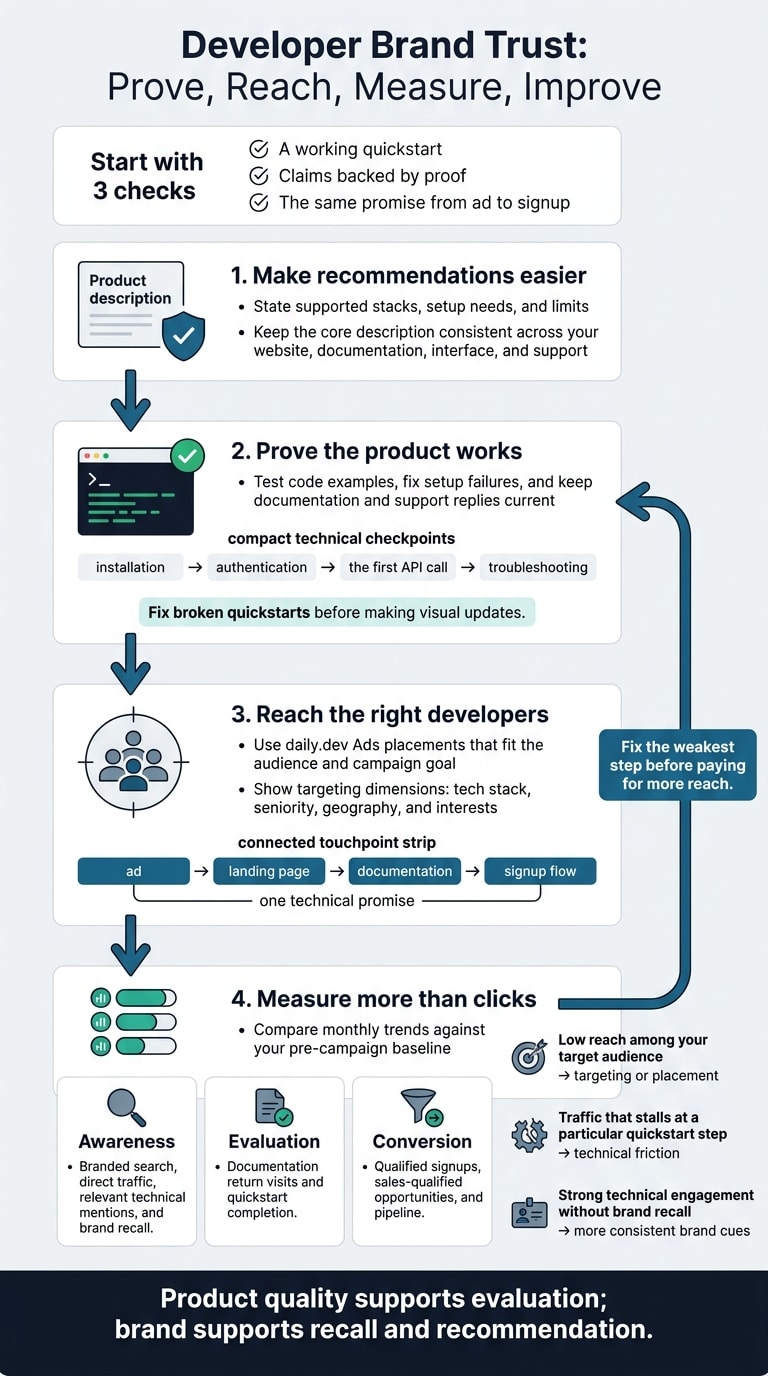
When devtools offer similar features, brand can break the tie - but it can’t make up for a poor product. Start with 3 checks: a working quickstart, claims backed by proof, and the same promise from ad to signup.
Building that trust takes more than a clear message:
- Make recommendations easier. State supported stacks, setup needs, and limits so developers can explain the choice to their team.
- Prove the product works. Test code examples, fix setup failures, and keep documentation and support replies current.
- Reach the right developers. Use daily.dev Ads placements that fit the audience and campaign goal.
- Measure more than clicks. Track recognition, technical engagement, and qualified demand against a pre-campaign baseline.
The rule: fix the weakest step before paying for more reach.
1. Similar features make trust the deciding factor
When products look similar, developers choose the one they can justify to their team. Recommending your product means answering questions about security, maintenance, and migration effort. Your brand should make those answers easier to give. In crowded categories, that’s your brand advantage.
Specific claims help developers assess risk
Spell out the intended workflow, supported environments, prerequisites, and limits. Put rate limits, retry behavior, and beta restrictions next to the capability they affect. These details help developers judge implementation risk better than broad claims like “powerful,” “seamless,” or “enterprise-ready.”
Before launch, have marketing and a technical reviewer check that every claim has supporting evidence across the landing page, documentation, and onboarding. Review those claims again after major releases.
Once you can back up a claim, use it consistently across channels so others can repeat it.
Clear messaging helps developers recommend your product
Keep the core description consistent across your website, documentation, interface, and support. Use the same terms for the problem, intended user, and deployment setup. When the promise changes from one touchpoint to another, developers have more work to do when explaining the product to their team.
Test the message outside marketing. Can someone repeat the value proposition and point an engineering lead to supporting evidence? If not, fix the message before you expand your reach.
2. Build trust through the technical experience
Developer marketing messaging earns the click. The technical experience has to earn the recommendation.
Audit the entire path from ad click to first successful integration. Record broken examples, missing prerequisites, conflicting terms, unsupported integrations, and unmet promises. Give each issue an owner and a fix date.
Fix the places where trust breaks first.
Keep documentation and examples accurate
Begin with installation, authentication, the first API call, and troubleshooting. Ask an engineer who didn’t write the guide to follow it in a clean environment, using the versions and operating systems listed in the instructions.
Include supported versions, expected output, common errors, and clear limitations. Fix broken quickstarts before making visual updates.
Keep runnable examples in version control and test them in CI. Review API references with each product release, and label deprecated endpoints and SDKs. Assign a documentation owner and a fix date for reported errors. A tested setup path helps developers recommend your product without worrying that teammates will get stuck.
Show expertise through code and technical content
Publish integration guides and debugging walkthroughs that cover prerequisites, implementation choices, failure points, and recovery steps. Show how the product works - not just what it promises. Give developers proof they can share when recommending it.
If you maintain open-source projects, review the README, setup instructions, contribution guidance, issue responses, and release notes. Developers should be able to see that the project receives reliable maintenance.
Make these checks routine rather than one-off cleanups.
Make consistent developer communication a team responsibility
Put product or engineering in charge of release notes, DevRel or support in charge of reply standards and escalation, and marketing in charge of campaign updates.
Check documentation before each release, and review gaps in trust monthly to keep these touchpoints current. If support keeps answering the same question, update the guide.
3. Reach relevant developers with daily.dev Ads
Once the technical experience holds up, use daily.dev Ads to reach the right developers. Target by tech stack, seniority, geography, and interests to improve audience fit. But targeting can’t fix a weak product experience.
Choose an ad format that fits the campaign goal
Pick the format based on what the campaign needs to do - not reach alone. Each placement should support a developer brand that lives up to its claims.
| Campaign objective | Recommended format | What to evaluate |
|---|---|---|
| Build category recognition through repeated feed exposure | In-Feed Native Ads | Recognition, technical landing-page engagement, and qualified actions |
| Explain a technical product or use case in depth | Sponsored Post | Brand recall, depth of reading, and resulting demand |
| Build association with a technical topic over time | Engagement Ads | Topic association, relevant engagement, and later demand signals |
| Reach developers around a specific interest | Digest newsletter sponsorships by topic track | Recognition within the track, content engagement, and conversions |
Use Sponsored Post when technical content needs room for detail. It includes guaranteed feed impressions, a read-floor commitment, and canonical republishing. Engagement Ads include Branded Tags, Keyword Spotlights, Custom Upvotes, Tag Page Takeovers, and Stack Placements.
Choose placements with a clear technical connection to your product. For Digest sponsorships, match the topic track to the content instead of choosing the broadest audience.
Keep the same promise from ad to product
Treat the ad, landing page, documentation, and signup flow as one technical promise. Keep the supported stack, use case, and next step consistent throughout. Before launch, check that developers can find the promised detail in one click.
Track audience fit, engagement, and downstream actions together. Pair meaningful reads or clicks with signups, activation, demo requests, and product-qualified actions. A high click-through rate with weak downstream activity points to a mismatch - not brand lift. Use separate brand-awareness measurement to check whether recognition is changing.
Use these signals to decide whether to scale or fix the message before buying more reach.
4. Measure brand signals and decide what to fix
Track recognition, technical engagement and qualified demand
Once your campaign is live, track whether it builds both brand recall and demand. Split your 2026 scorecard into three groups:
- Awareness: Branded search, direct traffic, relevant technical mentions, and brand recall.
- Evaluation: Documentation return visits and quickstart completion.
- Conversion: Qualified signups, sales-qualified opportunities, and pipeline.
These signals help you assess whether developers remember your brand when features look similar - and whether they move forward with evaluation.
Compare monthly trends against your pre-campaign baseline. Keep audience and qualification definitions consistent so you can distinguish a short-term response from lasting brand lift. For a starting point, see measuring developer brand awareness without a six-figure brand study.
Fix trust gaps before expanding ad reach
Use patterns in the metrics to work out whether you have a reach problem, a trust problem, or both. Low reach among your target audience points to targeting or placement. Traffic that stalls at a particular quickstart step suggests technical friction that can weaken trust. Strong technical engagement without brand recall calls for more consistent brand cues - not another product claim.
Product quality supports evaluation; brand supports recall and recommendation. Before expanding reach, ask an engineer to test the quickstart from a clean account and fix any failure points. Stick to one campaign promise, then set your baseline, campaign, and post-campaign measurement windows around the buying cycle.
Review response while the campaign runs, evaluation over the following weeks, and recognition plus pipeline over a longer period. For help connecting this plan to distribution, discuss campaign fit with daily.dev. Direct your next round of fixes toward the weakest step before adding more spend.
FAQs
How should we split our budget between brand and demand generation?
Use daily.dev Ads to keep your brand visible and build awareness, alongside demand-capture efforts that drive bottom-of-funnel conversions. Brand and demand generation work together - you don’t have to choose one over the other.
In crowded categories where features look alike, brand is the tiebreaker. Back that investment with consistent technical content, open source contributions, and reliable documentation to build trust.
How can we separate brand lift from existing demand?
Measure each placement by the product actions it drives, not just clicks. Use view-through attribution and an incrementality holdout to separate the impact of your daily.dev Ads campaigns from baseline organic or search-driven growth.
Track engagement across In-Feed Native Ads, Sponsored Post, and Engagement Ads to see how brand-building activity lines up with changes in conversion volume.
When is our developer experience ready for paid promotion?
In 2026, your developer experience is ready for paid promotion when developers can evaluate it from start to finish without getting stuck. That means accessible, crawlable docs and API references, clear setup and authentication instructions, runnable examples, and troubleshooting guidance. Technical information should be stable, versioned, and accurate.
Once those materials are ready, use daily.dev Ads, such as In-Feed Native Ads or a Sponsored Post, to reach developers by tech stack and seniority.