




Developer marketing should start with proof, not purpose. Show what the product does, which stacks it supports, and how to test it - with a runnable example and a clear first-success goal.
The message order depends on the decision:
- Product evaluation: Lead with the workflow, setup needs, results, and limits.
- Employer branding or community participation: Purpose can lead when employee accounts or user experience back it up.
- Paid campaigns: Match the ad and landing page to the next step, whether that’s reading documentation or trying the product.
To test the approach, compare proof-first and purpose-first copy using one shared outcome, such as tutorial completion or product activation - not clicks alone. Purpose still has a role. It just shouldn’t leave developers searching for technical answers.
2. How purpose-first messaging slows evaluation
Mission-first copy slows technical buyers when it hides the details they need to judge fit. An abstract promise can express ambition without naming the product or its use case. If a landing page doesn’t quickly identify the target user, supported tech stack, and setup requirements, readers have to hunt for the basics. If the documentation leaves those same gaps, they have no clear next step.
That’s a messaging problem - not a rejection of purpose. The fix is earlier proof, not more purpose.
What developers need before they can test fit
Developers need stack compatibility, deployment paths, access needs, limits, configuration details, error handling, inputs, outputs, and operational constraints. Treat these as a checklist, not a sequence they must follow.
Purpose explains why a product exists. It doesn’t prove runtime support or data access. Put those details beside the claim, and clearly state what the product doesn’t support.
A hypothetical rewrite: from mission to mechanism
Hypothetical rewrite
Replace “Empower teams to build the future” with “Validate API requests against your schema before deployment.”
Follow it with a minimal verified example: declared schema, valid request, invalid request, and validation output. If real code is unavailable, label the flow as pseudocode:
load schema → validate sample request → report validation failures. Verify supported schema formats and versions, local or CI execution, required credentials, and failure behavior, then offer a test project that does not touch production.
3. When to bring purpose into the message
Purpose helps once the audience knows the product can work for them. Match message order to the buyer’s decision. Developers and technical buyers use purpose differently from people deciding whether to join a brand or community.
| Campaign situation | Lead with | Evidence needed | Role of purpose |
|---|---|---|---|
| Product discovery | A workflow and a visible outcome | A short demonstration, clear use case, and concrete next step | Add meaning after the product’s value is clear |
| Technical evaluation | Mechanism, fit, and implementation requirements | Documentation, runnable examples, security details, and limits | Explain design choices without replacing technical answers |
| Evaluating an employer | Engineering culture, employee experience, and mission | Employee accounts, engineering write-ups, day-to-day practices, and role details | Can lead when backed by workplace reality |
| User advocacy: deciding whether to participate | Shared results and a clear invitation to participate | User results, community contributions, and firsthand experience | Can lead when users already know the product’s value |
Employer branding and advocacy are exceptions: the audience is evaluating the company or community, not just the product.
But purpose still needs evidence. In employer-brand campaigns, employee stories and daily practices should back up the stated values. For advocacy, give users a specific action and a reason rooted in their experience.
Before approving copy, pinpoint what’s holding the buyer back. If it’s compatibility, data handling, or implementation effort, lead with proof that addresses that concern. Purpose should support the evidence, not replace it.
Test message order while keeping the product claim the same. Track documentation views, trial starts, or another meaningful evaluation action. Use that message order to guide both the ad format and the landing page.
4. Build proof-led campaigns with daily.dev Ads
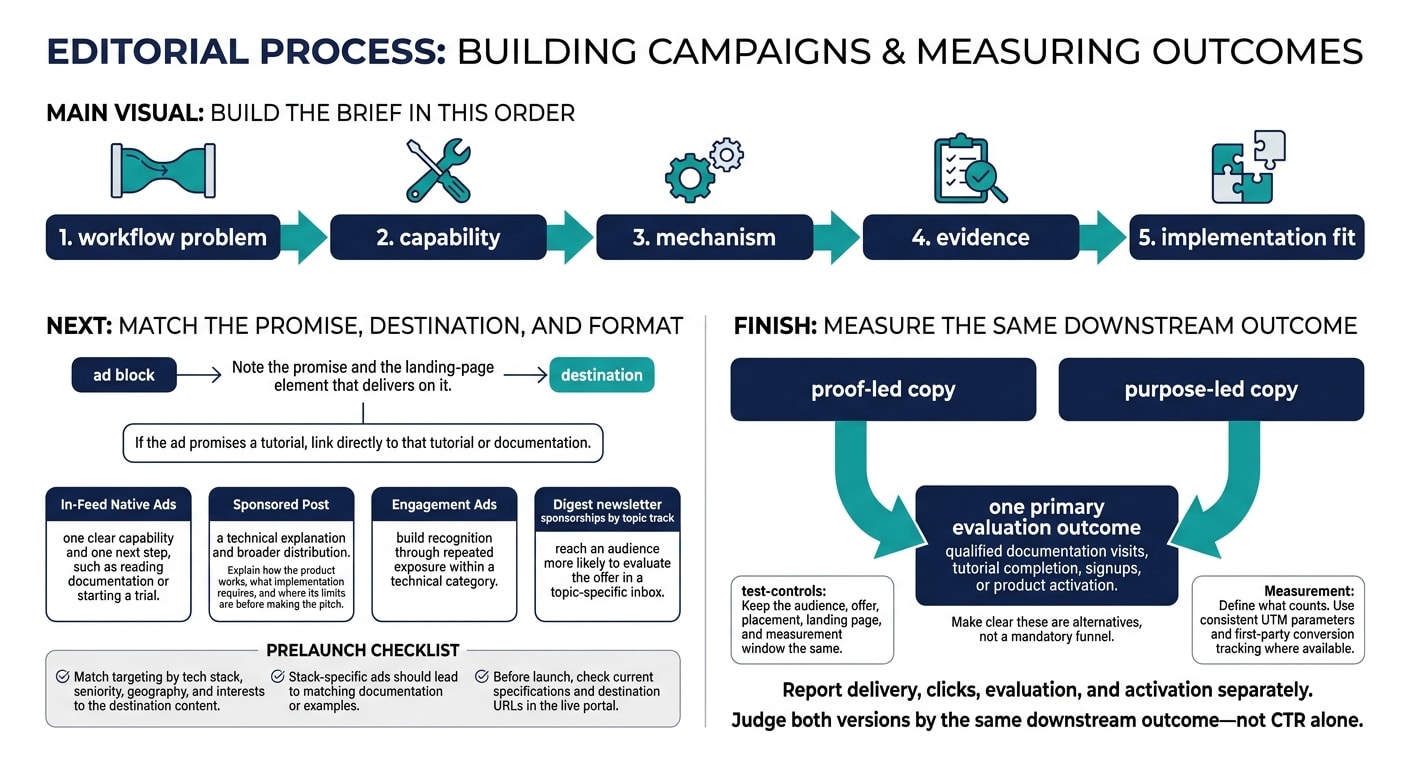
Once you’ve set the message order, match each ad format to the buyer’s task.
Build the brief in this order: workflow problem, capability, mechanism, evidence, implementation fit. Note the promise and the landing-page element that delivers on it. If the ad promises a tutorial, link directly to that tutorial or documentation. Then choose the format that fits the next step.
Match the ad and placement to the evaluation task
Use In-Feed Native Ads for one clear capability and one next step, such as reading documentation or starting a trial. Choose Sponsored Post for a technical explanation and broader distribution. Explain how the product works, what implementation requires, and where its limits are before making the pitch.
Consider Engagement Ads to build recognition through repeated exposure within a technical category. Use Digest newsletter sponsorships by topic track to reach an audience more likely to evaluate the offer in a topic-specific inbox.
Match targeting by tech stack, seniority, geography, and interests to the destination content. Stack-specific ads should lead to matching documentation or examples. Before launch, check current specifications and destination URLs in the live portal.
Measure what happens after the click
Let the task behind each format choice guide one primary evaluation outcome: qualified documentation visits, tutorial completion, signups, or product activation. Define what counts. Then use consistent UTM parameters and first-party conversion tracking where available. Report delivery, clicks, evaluation, and activation separately.
Test proof-led copy against purpose-led copy while keeping the audience, offer, placement, landing page, and measurement window the same. Judge both versions by the same downstream outcome - not CTR alone - to get a cleaner read on whether proof-led messaging moves buyers toward evaluation.
5. Conclusion: let purpose support proven value
Lead with function, mechanism, and evidence. Add purpose only when the product’s value is clear. Purpose can then support employer branding, advocacy, and repeat consideration. Put that rule to work in every live campaign.
Start with one live campaign and review it as a first-time visitor. Are the problem, setup or integration requirements, and proof clear at a glance? Fill the first gap in proof before adding mission language. If the campaign doesn’t pass this test, revise the message before spending more on promotion.
For help turning that review into a proof-led campaign, discuss your next step with daily.dev Ads.
FAQs
How can I show proof before offering a free trial?
Give developers evidence they can test: reproducible code samples, benchmarks with documented methodology, working demos, or case studies that back up your claims. Let them assess your product for themselves before asking them to start a trial or sign up.
Put proof next to the claim it supports. Show the product in use, spell out what it helps developers do in their workflow, and link to technical documentation or a quickstart guide.
How do I balance technical detail with concise ad copy?
Lead with a workflow that solves a developer’s day-to-day problem. Use a headline that names a familiar task, like optimizing an API call or porting an app.
Keep daily.dev Ads copy concise and focused on one clear outcome, backed by one verifiable proof point, such as a benchmark or code sample. Show the product through UI, diagrams, or code so developers can see how it works and have a reason to trust it.
What if proof-first ads get fewer clicks but more activations?
Fewer clicks but more activations likely mean your proof-first ads are reaching high-intent developers who see value in your offer. Evidence like benchmarks or a clear workflow can draw developers who are ready to evaluate your product.
Focus on activation signals, such as sandbox trials or quickstart completions, rather than click volume alone. Make your CTA easy to act on, and target developers with the right seniority and tech stack.