




I build developer marketing OKRs around actions - not clicks. Start with one outcome, assign one owner, and set 2–4 key results using a baseline, a target, and a fixed measurement window.
Here’s what I measure across five types of work:
- Paid acquisition: Cost per activated developer, first value, and return use.
- Launches: First successful product use, time to success, and repeat use.
- Content: Readers who complete a tutorial, reach first value, and return.
- Community: Solved questions, attendee follow-through, and repeat contributions.
- Employer brand: Application completion and candidates who pass recruiter screening.
For Q1 2027, I’d use the rest of 2026 to check tracking and establish baselines. No baseline? Measure first, then set a growth target.
Match ad formats to the action you want. Check early signals weekly and outcomes monthly, and wait for each cohort’s measurement window to close. Above all, keep attributed results separate from proven campaign effects - and change tactics before changing the goal.
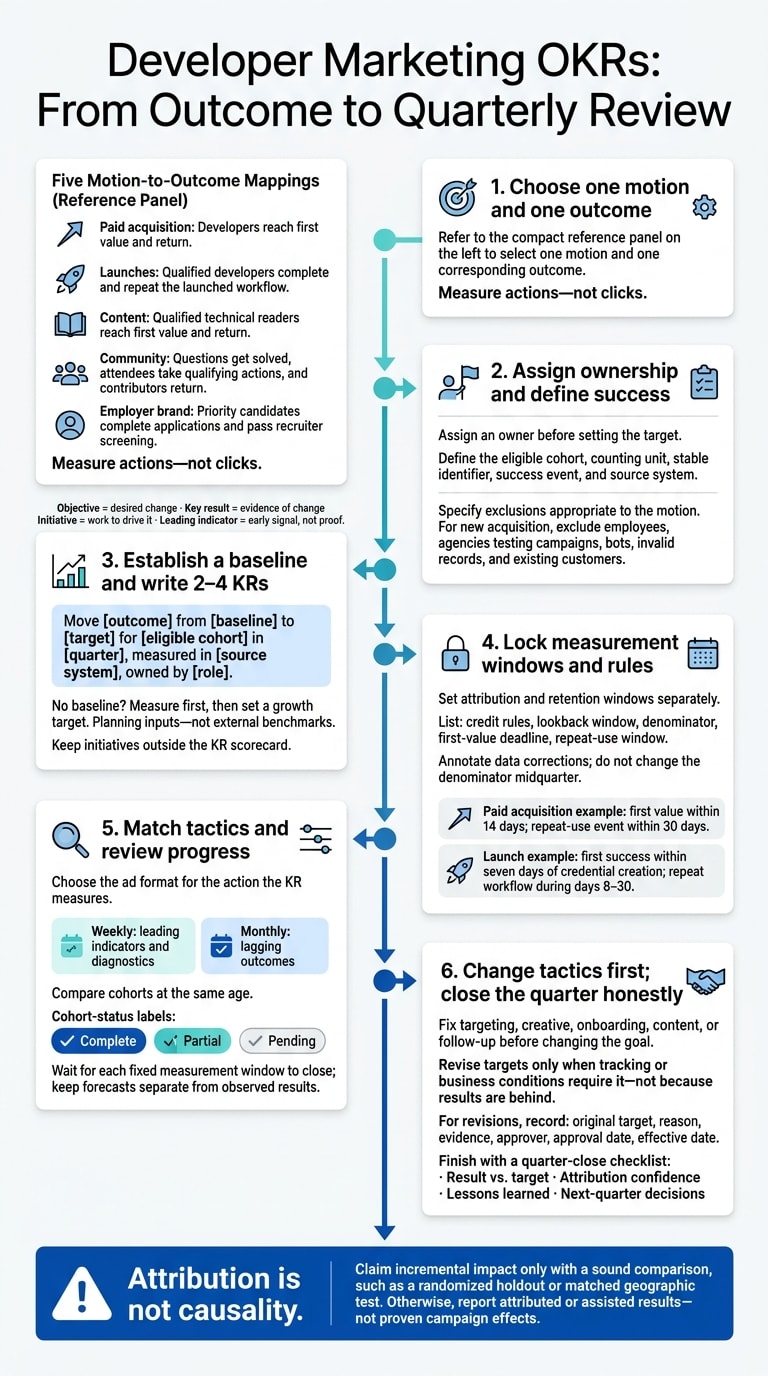
1. Define the outcome before the target
An objective names the change you want. A key result proves that change happened. An initiative is the work meant to drive it. A leading indicator gives an early signal - not proof. Use two to four KRs per objective:
Move [outcome] from [baseline] to [target] for [eligible cohort] in [quarter], measured in [source system], owned by [role].
The bracketed values are planning inputs, not benchmarks. Keep initiatives outside the KR scorecard. Target activation, successful product use, productive community participation, or qualified candidate progression. Apply the same rules across paid, launch, content, community, and hiring OKRs.
For product-value objectives, measure both first-value completion and retained use. Add qualified opportunities only when they’re a valid lagging result for the quarter. Measure activation and retention in product analytics, and qualified opportunities in the CRM.
Before launch, define who counts and what first value means. Record role, geography, account type, and signup date. Specify the event name and required properties that mark first value. For new acquisition, exclude employees, agencies testing campaigns, bots, invalid records, and existing customers. Use one stable identifier and one counting unit.
Then lock the measurement windows. Set attribution and retention windows separately. Before launch, define credit rules, the lookback window, denominator, first-value deadline, and repeat-use window. Annotate data corrections rather than changing the denominator midquarter.
Attribution is not causality. Claim incremental impact only when you have a sound comparison, such as a randomized holdout or matched geographic test. For awareness objectives, follow the guidance on measuring developer brand awareness without a six-figure brand study. Keep observed changes separate from proven campaign effects. The next sections use this measurement frame to build OKRs by motion, then match ad formats to those outcomes.
1. Paid acquisition OKRs for developer activation
Objective and key results
For paid acquisition, the rule stays the same: measure activation and retention, not clicks.
Objective: Acquire developers who reach first value and return. Set three quarterly KRs against the prior-quarter baseline: KR1, reduce paid spend per activated developer to the target; KR2, raise the share of paid signups that reach first value within 14 days; KR3, raise the number of activated developers who complete the repeat-use event within 30 days.
Success event and weekly indicator
Define activation as a product-use event - not account creation.
For example, use a first successful API call.
Track landing-page conversion and median days to first value each week. Target developers by tech stack, seniority, geography, and interests. Report segment results only when samples are large enough to interpret.
Data source and owner
Growth owns the scorecard and budget; analytics reconciles the data. Each week, connect spend data with activation and repeat-use events. Link CRM qualification when identifiers and consent allow.
Calculate cost per activated developer by dividing paid spend by verified activated developers in the matching acquisition cohort. Treat late-quarter cohorts as immature until their activation and retention windows close - even if the final readout lands in January 2027.
Quality guardrail and revision trigger
Higher CTR is no reason to scale if activation or retention drops. Check for broken tracking, lower landing-page conversion, or low-cost users who don't return. Adjust ad copy and assets, targeting, landing pages, or onboarding before revising the objective.
Use a randomized holdout to test incremental activation. Without one, report attributed results only.
The same structure works for launch OKRs, but the success event changes.
2. Launch OKRs for successful product use
Launch OKRs should show that the workflow works - not just that the launch shipped.
Objective and key results
Objective: Help qualified developers complete and repeat the launched workflow. Set three quarterly KRs using agreed baselines:
- KR1: Increase qualified accounts reaching first success within seven days of credential creation.
- KR2: Reduce median credential-to-first-success time.
- KR3: Increase the share of activated accounts repeating the workflow during days 8–30.
Set numeric targets before launch and keep them fixed throughout the quarter.
Success event and weekly indicator
Define first success as a valid product outcome that delivers the promised value. A successful status code alone doesn’t count. Track one weekly diagnostic indicator, such as the share of new accounts completing the quickstart or median time to first success.
Keep these four funnel stages separate, from delivery to repeat use. Treat reach and documentation visits as diagnostics, not outcomes.
- Reach: Launch impressions delivered during launch week.
- Qualified visits: Intended-audience visits to technical docs during launch week and the following week.
- Activation: Qualified accounts reaching first success within seven days of credential creation.
- Retained usage: Activated accounts repeating the core workflow during days 8–30.
Data source and owner
Product marketing and product analytics jointly own the scorecard. Product marketing handles audience qualification and campaign-to-documentation reporting. Product analytics handles credential timestamps, server-side success events, account identity, and retention cohorts.
Where permitted, join campaign and web analytics with product events at the account level.
Quality guardrail and revision trigger
Review quickstart failures weekly, step by step. Look for missing prerequisites, unclear instructions, authentication errors, incompatible environments, and product defects. Fix the failing step, then check completion and time to success.
Exclude internal, duplicate, test, and automated accounts. Keep the objective stable unless the product scope or event definition materially changes. Record any revision in the quarter log. Launch traffic alone doesn’t prove adoption.
3. Content OKRs for product activation
Objective and key results
Launch OKRs measure first success. Content OKRs measure whether education helps readers move into the product.
Objective: Help qualified technical readers reach first value and return. Set three KRs:
- KR1: Increase the share who reach first value within seven days of their first content-assisted visit.
- KR2: Increase tutorial-to-success conversion.
- KR3: Improve repeat use in days 8 to 30.
Track content-assisted activation, not publishing volume.
Success event and weekly indicator
Define qualified readers using documented audience-fit and engagement rules. Use tutorial entrants as the denominator. Each week, review tutorial completion and documentation exits by topic and segment.
Data source and owner
Content marketing owns the journey; product analytics owns event definitions, cohorts, instrumentation, and reporting. Where permitted, connect web and documentation events to product events using stable content IDs, topic labels, and reliable segment data.
Report assisted activation - not causation. Record the tracking window and known gaps on the scorecard, then use it to spot where readers stop moving from explanation to action.
Quality guardrail and revision trigger
Revise tutorials when completion drops, a setup page repeatedly becomes an exit point, or activation increases without repeat use. Fix prerequisites, runnable code, and next-step links before adding more content.
4. Community OKRs for productive participation
Objective and key results
Community OKRs should measure whether participation solves problems and brings contributors back - not just whether people show up.
Objective: Increase productive developer participation, not registrations or reactions. Set three KRs against the current baseline to track question resolution, event-to-action conversion, and repeat contribution:
- KR1: Increase the share of eligible questions that receive a useful accepted answer within 7 days.
- KR2: Increase the share of verified attendees who complete one qualifying action within the chosen 14- or 30-day window.
- KR3: Increase the share of contributors who complete a productive action in two consecutive windows.
Success event and weekly indicator
Count outcomes that help developers move forward, not surface activity.
Qualifying actions include building, deploying, filing a reproducible issue, or helping another developer solve a problem. An accepted answer should provide working code, reproducible steps, linked documentation, or a clear diagnosis. Apply the same qualifying-action rules when measuring repeat contribution.
Each week, review the attendance-to-registration rate, questions still unresolved after the response window, and attendee activation. Keep registrations and reactions out of the outcome total.
Data source and owner
Community leadership owns the scorecard. Verify attendance through event records. Use community records to track answers and repeat contributions, and product data collected with appropriate consent to confirm builds or deployments.
Before launch, publish the eligible-cohort and denominator rules, the answer-response window, and tracking limits. Report retention only after a cohort’s full measurement window has closed.
Quality guardrail and revision trigger
Audit a sample of accepted answers and check that counted issues are actionable. Exclude duplicates and automated submissions, and label incentive-linked contributions separately.
If unresolved questions increase or activation stalls, adjust expert coverage, onboarding, or follow-up. Pause incentives if they reduce contribution quality. Revise the target only when changes to consent, tracking, or workflows invalidate the measure.
5. Employer-brand OKRs for qualified candidates
Use employer-brand OKRs to move developers in priority segments from career content to applications - and then through recruiter screening.
Objective and key results
Objective: Increase qualified technical-candidate progression from priority segments. Set three quarterly KRs using your current baseline:
- KR1: Increase application starts from priority segments.
- KR2: Improve the application-start-to-completion rate for priority roles.
- KR3: Increase the number or rate of candidates from tracked sources who meet minimum role requirements and pass recruiter screening.
Set numeric targets based on your hiring plan, not external benchmarks.
Success event and weekly indicator
Success means a candidate from a priority segment passes recruiter screening and can be linked to a tracked source. Before candidates apply, use career-content views, return visits, and role clicks to understand their activity. Define engagement before launch.
Review application completion weekly. Track screening progression by cohort.
Data source and owner
Employer brand owns content engagement; recruiting operations owns application and screening data. With consent, connect web analytics and applicant tracking system (ATS) records using consistent campaign and source fields.
When sample sizes support it, segment results by role family, seniority, geography, and technical interests. Base interests on what candidates declare or engage with repeatedly - not a single page view.
These KRs depend on consistent ATS source fields and campaign tags.
Quality guardrail and revision trigger
Keep the recruiter-screen pass rate at or above its established baseline. If application completion drops below baseline for two consecutive weeks, inspect the application path. If applications increase but screening quality drops, review targeting and role expectations.
Change how you execute, not how you define success.
3. Match the ad format to the outcome
Choose the format based on the action your KR measures - not the metric that’s easiest to report. Use the mapping below, along with the success event and denominator rules from the prior section.
| Campaign objective | Relevant daily.dev Ads format | Primary KR | Optimization signal |
|---|---|---|---|
| Product discovery | In-Feed Native Ads | Cost per activation | Qualified activation rate after the first-value event |
| Content-assisted activation | Sponsored Post | Qualified reading that leads to first value | Read-floor delivery, qualified read rate, and first-value completion |
| Contextual interaction | Engagement Ads | Qualified downstream actions | Relevant interactions connected to documentation, evaluation, or pipeline events |
| Focused content distribution | Digest newsletter sponsorships by topic track | Reader-to-action conversion | Topic-track fit, qualified clicks, and downstream conversion |
For In-Feed Native Ads, calculate cost per activation by dividing attributable spend by completed activation events. Count an activation only when the first-value event fires. Keep that event the same when testing ad copy and visuals.
Sponsored Post includes guaranteed feed impressions, a read-floor commitment, and canonical republishing. These are delivery guarantees, not proof that someone used your product. Define qualified reading before launch, then measure first-value completion.
For Engagement Ads, choose Branded Tags, Custom Upvotes, Tag Page Takeovers, Keyword Spotlights, or Stack Placements to match the topic, keyword, or stack. Treat interactions as signals, not completed outcomes.
For Digest newsletter sponsorships, select a topic track and give readers one clear next step toward your defined success event.
Test one format against one success event before scaling. Bring these signals into the next review cycle while keeping the KR fixed.
4. Review progress without moving the goal
Once you set a KR, review it as written - not as you hoped it would turn out. Treat each KR as a measurement contract: fix the baseline, target, window, event definition, owner, source system, denominator, and review cadence. Use a separate scoring rule for lower-is-better metrics.
Review leading indicators weekly and lagging outcomes monthly. In weekly reviews, check whether the data is current, where results are headed, and what to do next. Judge leading indicators only against the downstream outcome they’re meant to predict: first value, repeat use, productive participation, or candidate progression.
Check results by cohort age, too - not just quarter-end totals. Group users by signup or first touch, then compare groups at the same age. Label windows complete, partial, or pending, and keep forecasts separate from observed results. Cohorts stay pending until their fixed follow-up windows close, even if the quarter has already ended.
Change tactics first. Change the target only when tracking or business conditions require it. If you revise a target, retain the original and record the reason, evidence, approver, approval date, and effective date. Falling behind isn’t a reason to rewrite the goal.
Close the quarter with result vs. target, attribution confidence, lessons learned, and next-quarter decisions. Explain your confidence based on tracking quality, channel overlap, and lag. Diagnostic metrics can support the assessment, but they aren’t proof. For awareness goals, use the same discipline outlined in measuring developer brand awareness without a six-figure brand study. Use the quarter-close review to choose one motion and one success event for the next plan. Let diagnostics guide the next tactical change - not the target itself.
6. Start with one motion and one success event
For Q1 2027, choose one motion: paid acquisition, launch, content, community, or employer brand. Define success as an action that shows first value or candidate quality - not a click, signup, or application. Write down who qualifies, which action counts, and how long they have to complete it.
With the motion set, assign an owner before setting the target. Growth or demand gen owns activation. Marketing ops supports attribution and data quality, while product or DevRel removes onboarding friction. For employer brand, recruiting validates candidate quality, and talent marketing runs the campaign.
Base the Q1 target on comparable historical cohorts, not a peak week. If you don’t have that history, use Q1 to measure and validate. Keep instrumentation goals separate from outcome targets.
Before adding metrics, review cohorts whose observation windows have closed. Check whether the first signal predicts later product use or hiring progress. Add downstream measures only when you can depend on that first signal.
If you chose paid acquisition, follow the next step below. If your plan includes paid developer distribution, discuss campaign fit with daily.dev.
FAQs
How do I set realistic OKR targets with limited data?
Choose one developer audience before launch, then set one primary metric for each layer: qualified visits, activation (such as a first successful API call), and business outcomes (such as activated usage or pipeline). Use four to eight comparable weeks as your baseline before shifting budget.
Don’t rely on CTR-only targets. Track cost per activated user consistently, use an evaluation holdout when possible, and set expectations based on customer baselines.
How do I avoid double-counting activation across channels?
Run incrementality tests with a holdout group alongside your conversion pixel. Compare activation rates for people who see daily.dev Ads with those who don’t. This helps isolate the channel’s lift instead of relying on overlapping attribution data.
Keep separate channel scorecards for signups and first successful API calls. Use consistent tracking parameters across ad versions, landing pages, and formats so your reporting stays clean.
How should I score OKRs when cohorts are still pending?
Score OKRs based on funnel health during the pilot, not vanity metrics. Track leading indicators like click-through rates and activation milestones - such as first API calls or successful deploys - to estimate future value.
Set baselines and KPIs before launch. Measure cost per qualified lead, and use a conversion pixel to attribute signups to ad formats. Let these signals guide whether to continue, revise, or stop a pilot while cohorts mature.