

Yes, you can buy ad placements tied to AI chat today - but not through a public ChatGPT ads dashboard.
If I strip this down to the part that matters most, here’s the answer:
- OpenAI has tested ads, including reported formats like Sponsored Answers and Sponsored Status Lines
- Most advertisers still can’t buy ChatGPT ads through self-serve tools
- The main way in today is managed inventory, often through publisher or partner networks
- Developer-focused campaigns work best when ads show during work tasks, like debugging, API research, or tool evaluation
- Measurement is still early, so I’d treat CTR, clicks, and conversion data as directional, not final
A few points stand out fast. Reported tests started in early 2026, and some developer-focused AI chat placements have shown CTR ranges of 2.1% to 3.5%. That tells me the channel is active, but still not settled.
If you want the short version: you do not need a public ChatGPT ads manager to start. You need the right buying path, tight audience targeting, ad copy that fits the conversation, and clean tracking from day one.
| Buying route | Can you use it now? | Best use |
|---|---|---|
| Platform-direct | Limited | Large brands with direct access |
| Partner networks | Yes | Most advertisers |
| Developer platforms | Yes, on select platforms | Reaching developers during work |
So this article is less about whether ChatGPT ads exist, and more about how I’d approach AI chat inventory right now without waiting for a public rollout.
How ChatGPT ads work
What OpenAI has announced vs. what is actually available
Published reporting says OpenAI started testing ads in Free and Go tiers in early 2026, but most marketers still can't use a public self-serve ChatGPT ads product yet . OpenAI has also been building campaign management and real-time attribution systems, but that setup is still being developed .
So the toolset is still limited. But the placement logic is already pretty easy to see.
How ads appear inside AI chat conversations
That gap is exactly why ad creative needs to fit the conversation. Reported formats include Sponsored Answers and Sponsored Status Lines .
- Sponsored Answers place a relevant recommendation inside the reply itself.
- Sponsored Status Lines appear in the short pause before the response shows up .
Early tests center on search contexts. In plain English, that means moments when ChatGPT pulls information from the web, not every casual back-and-forth .
A reported example came in December 2025, when OpenAI tested a feature where ChatGPT suggested the Peloton fitness app during a related conversation . That example gives marketers a clear picture of how product suggestions can sit inside the chat flow without feeling jammed in.
The ad itself should sound useful and tied to the user's intent, while still being clearly labeled as sponsored. Because these ads are matched to live conversation intent, buying them today often means going through managed publisher inventory instead of logging into a simple dashboard.
Why there is no stable ChatGPT ads manager for most advertisers yet
A broadly available self-serve buying tool still doesn't exist. Right now, most buyers get AI chat inventory through partner publisher networks and managed buys .
| Route | Access | Status |
|---|---|---|
| Platform-direct buying | Limited, no open self-serve | Internal testing or early rollout |
| Partner publisher networks | Managed buying | Available now |
| Developer platforms | Varies by platform | Available through select networks |
So the main issue isn't whether AI chat ads are real. They are. The practical issue is which path you can buy through today. And that buying route affects how you plan campaigns in AI chats right now.
How to advertise in ChatGPT and other AI chats today
Choose the right route to AI chat inventory
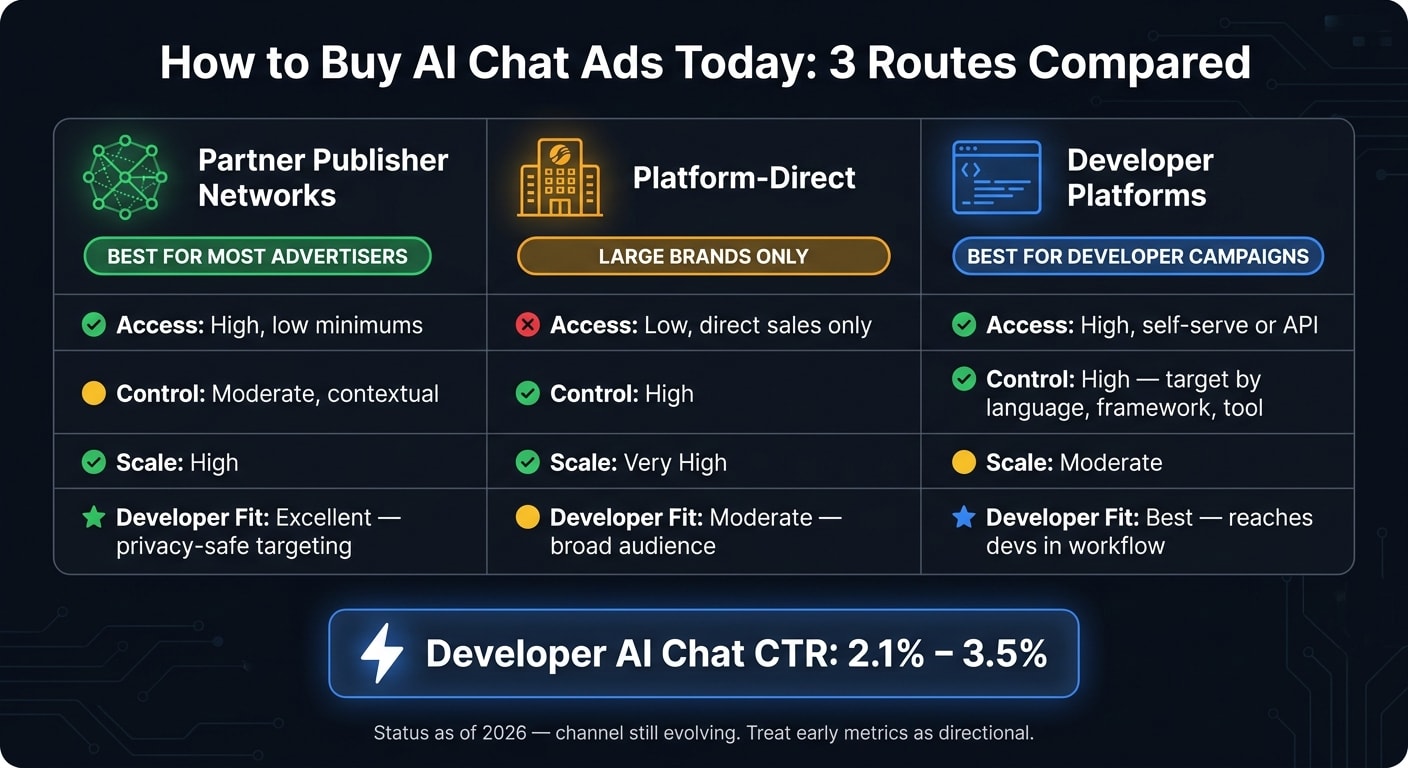
Your first call is simple: how are you going to buy the inventory? Right now, there are three practical paths.
| Route | Access | Control | Scale | Fit for Developer Campaigns |
|---|---|---|---|---|
| Partner publisher networks | High, low minimums | Moderate, contextual | High | Excellent, privacy-safe targeting |
| Platform-direct where it exists | Low, direct sales only | High | Very high | Moderate, broad audience |
| Developer platforms | High, self-serve or API | High, targeting by language, framework, or tool | Moderate | Best, reaches developers in workflow |
For developer products, the route itself matters less than where the ad shows up. What matters is whether that inventory reaches developers while they’re doing actual work.
That’s why, for most marketers, partner publisher networks are the most practical way in to AI chat inventory today.
If you’re running developer campaigns, daily.dev gives you access to verified partner publishers through business.daily.dev. That means you can buy developer inventory inside AI chats without waiting for a public ChatGPT ads manager.
Define your audience and use case before you buy
Broad targeting burns money fast in a channel this new.
Before you launch anything, get specific about who you want to reach and what they’re doing in that moment. For developer products, that usually means work-driven moments like:
- Debugging code
- Evaluating a library
- Asking an AI assistant about an API
Those moments carry much more purchase intent than casual scrolling on a social platform.
Your audience should also map straight to your campaign goal. If you want trial signups, go after developers who are already comparing tools. If you want awareness, focus on seniority and the programming languages or frameworks your product supports.
That clarity affects everything downstream, from the inventory path you pick to the ad copy you write.
Build creative for conversations and measure like a new channel
AI chat ads are not banner ads.
The copy needs to fit the user’s intent in that exact moment, be clearly labeled as sponsored, and add something useful to the exchange instead of cutting across it. A headline like "Reduce latency by 40% in Go apps" works because it’s specific and tied to a real need. A vague line like "Empower your team to build faster" usually gets skipped because it could mean almost anything.
That lines up with daily.dev's don't-interrupt-developers approach: useful, contextual, and clearly sponsored.
Measurement needs the same kind of discipline. Treat AI chat like any new channel and set up tracking early.
- Add UTM parameters to every link
- Track downstream conversions, not just clicks
- Read early performance as directional, not final
Early benchmarks will move as the channel changes. So don’t force old paid social or search targets onto this format. Watch the signals, learn from them, and adjust.
For a worked example of this model, the next section shows how daily.dev reaches verified developer inventory in AI chats.
Using daily.dev to reach developer inventory in AI chats
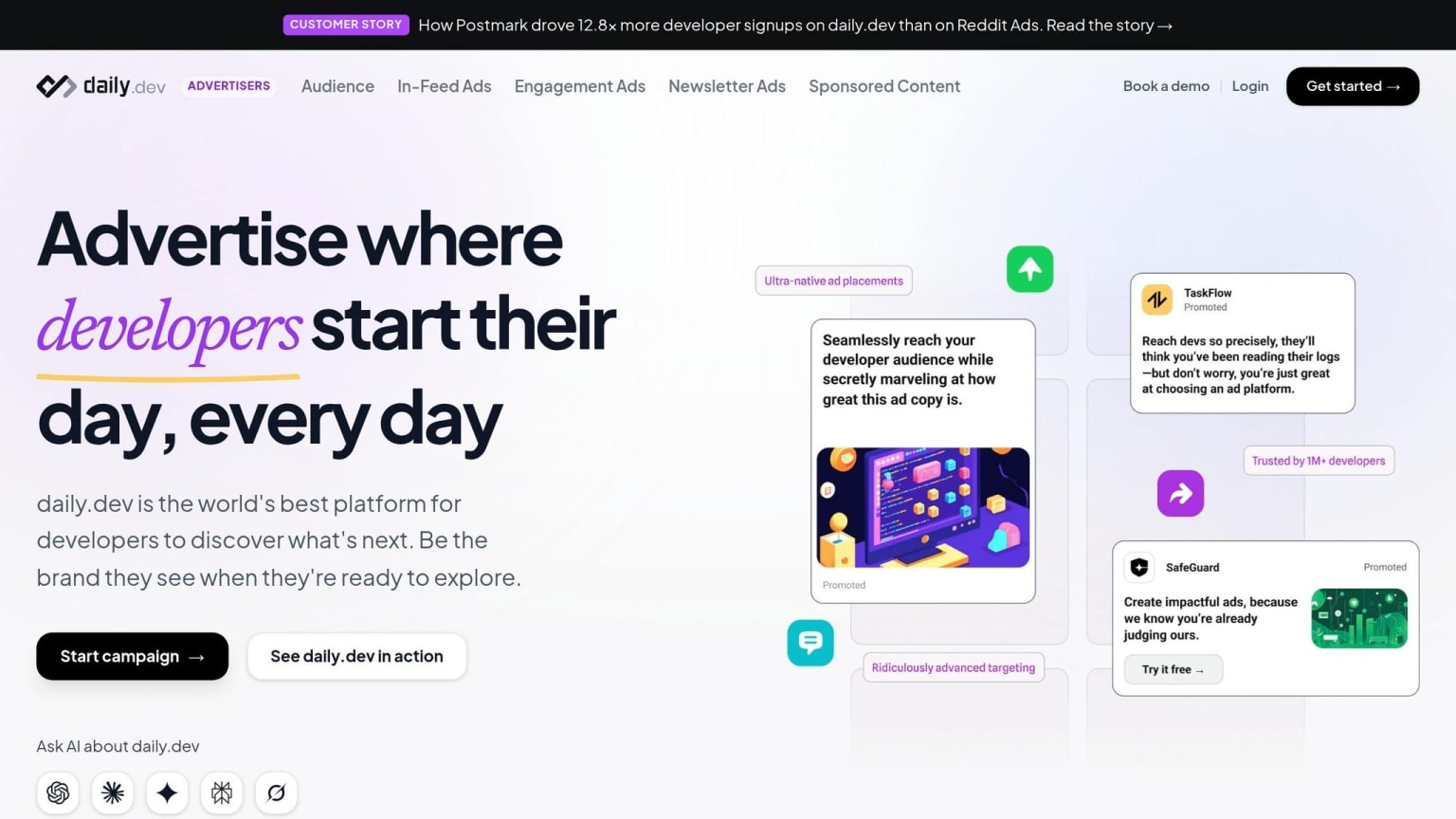
Building on that route, daily.dev gives advertisers a direct way into developer inventory in AI chats through verified partner publishers. It’s a fit for campaigns that need to reach developers while they code, troubleshoot, or work through technical tasks.
When daily.dev fits your media plan
daily.dev makes sense for campaigns aimed at developers who are sizing up tools in a work setting. Reported CTRs of 2.1% to 3.5% point to strong engagement in these placements .
How campaigns reach developers across AI-enabled environments
The buying path is pretty simple: advertisers set up campaigns through business.daily.dev, and those campaigns then extend through daily.dev’s verified partner publishers to reach developer audiences inside AI-driven chat experiences. From there, campaigns optimize in real time toward conversions and pipeline .
That makes daily.dev a practical example of how developer inventory in AI chats is being bought today.
How to reach developers in AI chats today
You don’t need a ChatGPT ads manager to buy AI chat inventory today.
The shortest path into developer AI-chat inventory is daily.dev’s verified partner network through business.daily.dev. That gives campaigns a way to reach developers during actual work moments across AI-enabled environments.
The catch? Your creative needs to fit the conversation. If it feels out of place, people will scroll right past it.
It also helps to read early performance with a bit of caution. In a newer channel like this, early clicks and conversions are best treated as directional signals until there’s enough data to judge performance with more confidence.
For messaging and targeting, read the developer advertising playbook.
FAQs
can you advertise in chatgpt
Not through an official self-serve ChatGPT ad platform today.
OpenAI has said it's looked into ads, but right now there isn't a ChatGPT ads manager or a direct way for businesses to buy ad inventory.
That said, you can still advertise in AI chats through verified partner publisher networks. These placements can show up in developer-focused AI tools and coding assistants.
is there a chatgpt ads manager
No. There’s currently no official ChatGPT ads manager that advertisers can log into and use on their own.
OpenAI hasn’t released a public platform for buying or managing ads directly. Right now, businesses that want ad placements inside AI chat tools need to go through third-party publisher networks that offer access to those spaces.
what do ai conversation ads look like
AI conversation ads are contextual and non-interruptive. They show up as native parts of the information flow, not as pop-ups that cut people off mid-task.
You might see them as sponsored answers, embedded links or rich snippets, shopping or local carousels, or promoted app suggestions.
The idea is simple: give people helpful, relevant information while making it clear the placement is sponsored.
how much do ai chat ads cost
There’s no official self-serve ChatGPT ads product right now. So, there isn’t a standard price list for ads in ChatGPT.
Across AI chats and developer-focused platforms, pricing changes based on the network, targeting, and what the campaign is trying to do. With daily.dev, budgets are flexible and tuned around engagement and campaign goals.
how do i reach developers in ai tools
You can reach developers in AI tools today through partner publisher networks that plug into AI assistants, without waiting for official ad products. Most AI platforms still don’t offer direct ads, so these networks open the door to developer inventory inside places like AI coding assistants and IDEs.
The key is contextual, non-interruptive messaging that lines up with what developers are doing in the moment, whether that’s coding, building, or troubleshooting. If someone is deep in a workflow, the last thing they want is a loud, off-topic pitch. A message that fits the task feels less like an ad and more like a helpful nudge.