

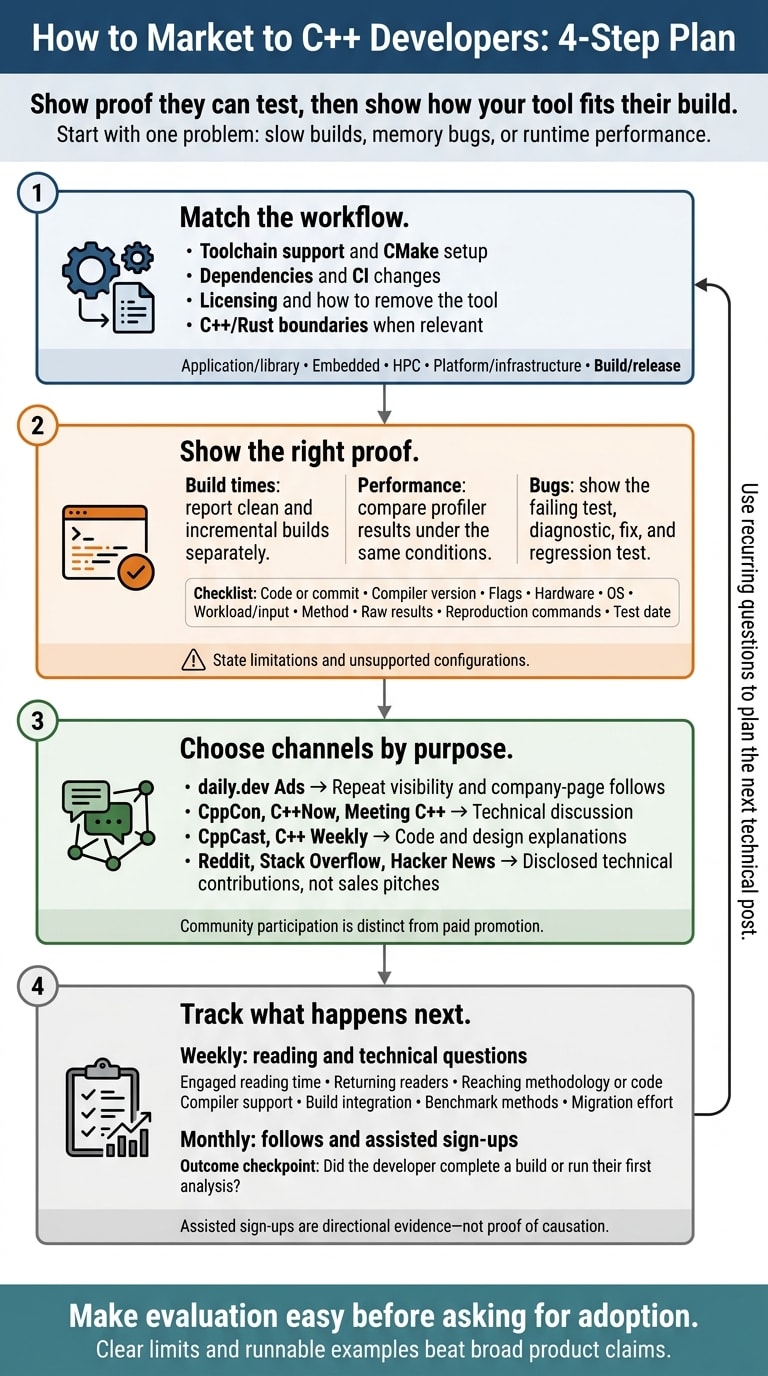
My approach to marketing to C++ developers: show proof they can test, then show how your tool fits their build. Start with one problem - slow builds, memory bugs, or runtime performance - and publish the code, compiler version, flags, hardware, and commands needed to check your results.
I’d build the plan around four steps:
- Match the workflow. Explain toolchain support, CMake setup, dependencies, CI changes, licensing, and how to remove the tool. Cover C++/Rust boundaries when they matter.
- Show the right proof. Report clean and incremental builds separately, compare profiler results under the same conditions, and pair bug reports with fixes and regression tests.
- Choose channels by purpose. Use daily.dev Ads for repeat visibility; CppCon, C++Now, and Meeting C++ for technical discussion; and CppCast or C++ Weekly for code and design explanations. Contribute to Reddit, Stack Overflow, and Hacker News with disclosure - not sales pitches.
- Track what happens next. Review reading and technical questions weekly, then follows and assisted sign-ups monthly. Check whether readers complete a build or run their first analysis.
My rule: make evaluation easy before asking for adoption. Clear limits and runnable examples give developers more to work with than broad product claims.
How do I market my developer tool to C++ developers?
Start with a recurring workflow problem and the developers responsible for fixing it. Then show what your tool changes in their compiler, build system, dependencies, and CI.
Slow builds, dependency management, runtime performance, memory-safety defects, portability, cross-compilation, and debugging each need a different message. Once you know the problem and the audience, choose channels where those developers already learn and compare tools.
Group developers by the work they do
Match your message to the work, not just the language. Each group has different constraints:
- Application and library developers: Focus on test integration, API stability, ABI compatibility, documentation, downstream integration, and supported compiler versions.
- Embedded and bare-metal engineers: Cover cross-compilation, target-device behavior, limited memory, real-time behavior, RTOS integration, and resource overhead.
- HPC teams: Show evidence from their workloads. State the hardware, compiler, optimization flags, and dataset used.
- Platform and infrastructure teams: Show platform coverage and deployment consistency.
- Build and release engineers: Cover dependency resolution, incremental-build behavior, caching, reproducibility, and failure diagnostics.
Document each group’s OS, hardware, compiler, build system, package manager, test setup, and deployment needs.
Plan content around technical proof
Give each post a clear sequence: problem, test environment, method, reproduction steps, integration requirements, and supported edge cases. C++ developers reject tools that disrupt their build, CI, or deployment flow, so show what adoption takes.
- Show the required project-file changes, dependency files, and CI steps.
- Explain which toolchains and platforms aren’t supported, plus the effects on clean, incremental, cross-compiled, or offline builds.
- Ask a C++ engineer who wasn’t involved in the experiment to review the instructions before publication.
Publish artifacts readers can run, such as a reproducer or dependency file, and include a troubleshooting guide where useful. A bug found in real code provides strong evidence.
Address C++ and Rust workflows where relevant, including bindings, shared builds, and gradual migration. Use #c++, #c, #embedded, #performance, #rust, and #linux only when they fit the subject. Ask readers which toolchains or workloads they want tested next.
Use that evidence to decide where each post will be seen.
What is the best way to reach C++ developers?
Use daily.dev Ads to build a verified company page that C++ developers can follow, then support it with conferences and technical content. Your page brings posts, releases, and engineering stories into the feed and newsletter they chose. Aim to build a recognizable brand with technical depth - not just publish a one-off announcement.
The daily.dev team handles the plan from start to finish, including setup and pacing. That leaves your engineers and marketers free to focus on useful content. Coordinate your publishing with appearances at Meeting C++ to keep the same technical story visible between events. Each talk or release can then build on what came before.
Keep a steady publishing rhythm with educational posts, release updates, and engineering stories. Give each piece one job: explain the problem, show what changed, or reveal how the team works. This mix helps buyers judge relevance, product progress, and engineering practices. Employer-brand content should show engineering decisions and practices rather than repeat generic claims. It also helps you place each topic in the channels C++ developers already use.
Match content to language and tool interests
Start with the C++ workflow your tool changes. Establish its fit with C++, then narrow your targeting by tools and workflow. Match each piece to its intended readers instead of using the same targeting for every post. daily.dev supports language, tool, technology-stack, and interest targeting.
Use Target developers by programming language to define language relevance, then Reach developers based on the tools they use to narrow your targeting. Give the daily.dev team the intended workflow, toolchain details, and content purpose so they can distribute each piece where the right C++ readers already look.
Where do C++ developers get their news and discover new tools?
C++ developers look for tools they can test. They inspect code, compare tradeoffs, and check results. To reach them, publish a reproducible performance investigation, a debugging walkthrough, or a migration guide that clearly states its limitations.
Conferences give developers room for deeper evaluation. CppCon covers broad education and technical demos. C++Now focuses on advanced libraries, open source, and language evolution. Meeting C++ combines practical talks with community sessions. Pitch a technical session - not a sales presentation - and keep sponsorship separate from talk selection.
Podcasts and video series support regular learning. CppCast suits engineers who can explain design tradeoffs in guest discussions. C++ Weekly works well for focused code walkthroughs and tooling demos. Pitch a technical topic rather than a product showcase, and keep guest appearances separate from sponsored placements.
Developers also turn to r/cpp and r/C_Programming for peer discussion and review. Read each community’s posting rules, and match the material to the forum: C++ for r/cpp, C for r/C_Programming. Disclose your affiliation, explain the technical finding, and respond to criticism. Paid promotion is separate from community participation and must follow the platform’s labeling rules.
Stack Overflow serves specific programming problems. Answer the question directly, and mention your product only when it helps, with disclosure. Hacker News supports broader technical debate: share an engineering investigation, research, or an open-source release with enough detail for readers to inspect. Treat both platforms as places to contribute - not as ads or endorsements - and avoid coordinated voting and unsupported claims.
What do C++ developers buy, and how do they decide?
Once buyers understand the workflow, they judge tools by how safely they fit into it.
Compatibility beats technical advantage. C++ developers favor tools that preserve control over code, builds, and runtime behavior. Show how your tool fits, what risks it adds, and how you maintain it - including the maintenance cadence. Make integration costs, dependencies, and steps to revert clear. Buyers apply this same test to every category below.
High-performance libraries and SDKs
For libraries and SDKs, API and ABI fit come first. Developers buy tools that work with their existing ownership semantics, ABI constraints, and threading rules. Explain object lifetimes and error handling, and provide a working integration project.
Limit performance claims to tested workloads. Include the hardware, compiler, flags, input data, test method, and raw results so developers can judge the numbers. Spell out dependency requirements and licensing obligations for linking and redistribution.
Embedded and systems tooling
For embedded tools, the test is target support and recovery. Buyers start by checking target and probe support against actual deployment constraints.
Name the supported processors, boards, host operating systems, vendor SDKs, and bare-metal, RTOS, or embedded Linux environments. Document cross-compilation, JTAG or SWD support, and RAM, flash, and timing limits.
Show the full path: install, build, flash, test, and recover after a failure. Keep debugger software, probe, and target requirements separate so buyers know what each part needs.
Memory-safety and migration tooling
For migration tools, the test is what becomes safer - and what still needs review. Developers buy only when the safety gain is clear and the remaining manual review is spelled out.
Document the bug classes the tool catches, distinguish verified findings from recommendations, and explain how to adopt it module by module. Cover C++ and Rust boundaries, including ownership, data layout, bindings, build integration, and integration tests.
State which constructs the tool doesn't support and which migration steps require manual work. Generated bindings and unsafe interfaces still need review; rewriting a component doesn't automatically make its boundary safe.
How do I market compilers, build systems and package managers to C++ developers?
Build-system support often determines whether a C++ developer tries your tool. Publish tested combinations of compilers, operating systems, architectures, build systems, and package managers. Clearly separate officially supported configurations from untested ones, and show every command from installation to a successful build.
The proof needs to match the product. Compilers, build systems, and package managers each have different things to demonstrate.
Compilers, build systems and package managers
For compilers, list supported language modes, standard libraries, and experimental features. Show a diagnostic with the code that triggers it, then show the corrected code. Explain optimization tradeoffs: faster execution can mean larger binaries or longer builds. Include exact flags and known limitations.
For build systems, walk through configuration, generated build files, incremental rebuilds, tests, and packaging. Provide copy-ready CI configuration with cache settings and failure logs.
Back up build-time claims with measurements from one named open-source project. Include the commit, test date, toolchain versions, hardware, build-job count, and cache state. Report clean and incremental builds separately, along with your measurement method and raw output. Tools that inspect runtime behavior need a different way to prove their claims.
For package managers, document transitive dependency resolution, conflicting requirements, platform coverage, and fallback to source builds when a binary package isn't available. Show how manifests, pinned versions, and lockfile data reproduce the dependency graph both locally and in CI.
Don't stop at installation. Explain how dependencies reach the build through toolchain files and find_package(). That's the adoption test C++ developers use before they trust the tool.
How do I market profilers, sanitizers and static analysis to C++ developers?
Start with a defect your tool found in code. Publish the failing test or workload, explain the diagnostic, and show the code change that fixed it. Connect the defect to what it caused: a crash, wasted CPU time, or a security-relevant memory error. Finding a problem isn’t the same as fixing it.
Profilers, sanitizers and static analysis
For profilers, give developers enough detail to reproduce the results. Show the baseline profile and explain why the hot path matters. Document the workload, compiler and optimization settings, operating system, hardware, input size, and measurement method.
After changing the code, rerun the same workload under the same conditions. Label each result clearly: wall-clock time, CPU time, throughput, latency, or memory. A hot function points to where you should investigate - it doesn’t prove a performance gain.
For memory safety issues, skip the performance chart. Show a failing test, a clear diagnostic, and the fix instead.
For sanitizers, follow that same proof pattern. AddressSanitizer finds use-after-free and out-of-bounds bugs in instrumented builds compiled with -fsanitize=address or /fsanitize=address. Document the test target, compilation, linking, runtime options, and required dependency instrumentation. Explain whether it runs locally, in a dedicated test job, or on every pull request.
Verify the fix by showing the failing test, clear diagnostic output, corrected code, and a regression test. Make clear that coverage depends on your build and dependencies.
Static analysis needs a different kind of proof: a finding developers can review, rather than a runtime crash or slowdown. Show the rule, affected code, and verified correction. Don’t treat every warning as a confirmed defect. Document the checks you chose, the baseline for existing warnings, and how developers record intentional exceptions or suppress false positives.
Give developers a clear path to evaluate the tool: a focused local check, broader CI checks, and findings in pull-request review. Document the expected runtime, owner, failure policy, and retry command. End the evaluation path with one action: reproduce the diagnostic, review the finding, or verify the performance change.
How do I build a brand that C++ developers trust?
Make every claim easy to check. Publish each result with its date, commit, versions, hardware, OS, flags, and a runnable reproduction. Be clear about limitations and unsupported platforms. Let that same standard of proof guide your message.
Spell out any build changes developers need to make to try the tool.
Address Rust directly. Show how your tool helps C++/Rust teams, what remains unsafe, and which migration tasks still need manual review.
What should your message say?
For performance, start with the workload and conditions. Then share the benchmark, flags, hardware, and raw results.
For build times, give before-and-after times in seconds for one named project. Report clean builds, incremental builds, and linking separately. Include the source and test date. No proof? Don't publish the number.
For memory safety, start with a real bug. Explain its class, the fix, and the compatibility requirements.
With the message clear, share it in the channels where C++ developers already learn and compare tools.
Which channels work best for marketing to C++ developers?
Choose channels based on the trust you want to build. daily.dev Ads helps build your brand over time. Conferences, podcasts, Reddit, Stack Overflow, and Hacker News each offer a different way to connect through technical content.
C++ developers trust proof they can inspect, discuss, and test. Put that proof where it supports the kind of trust you’re trying to earn.
| Channel | Purpose | Strength | Limitation |
|---|---|---|---|
| daily.dev Ads | Brand building over time through a verified company page and consistent posts | Developers can follow your company’s work | Doesn’t replace live, peer-to-peer discussion |
| C++ conferences: CppCon, C++Now, Meeting C++ | Technical education and direct community contact | In-depth, face-to-face discussion | Short-lived unless you follow up after the event |
| Reddit: r/cpp, r/C_Programming | Peer discussion and finding issues | Direct technical feedback | Community rules and skepticism toward promotion |
| C++ podcasts and video series: CppCast, C++ Weekly | Expert explanation and longer-form education | Room to explain design tradeoffs | Format fit, scheduling, and production effort |
| Stack Overflow Ads | Visibility during active technical research | Relevant programming context | Limited space for explanation |
| Hacker News | Engineering articles, releases, and research | Close technical scrutiny | Selective attention and limited control over discussion |
Assign an engineer to the channel - not just the content. On Reddit, check each community’s rules before posting and disclose your connection to the tool. For podcasts and conferences, pitch a technical question your team can explain well instead of a product overview.
Publish recordings, notes, and follow-up answers on your daily.dev company page.
Once you’ve chosen your channels, track reads, follows, discussion, and assisted sign-ups.
How do I measure developer brand building?
Measure attention and trust, not just immediate product interest. Track whether your technical proof brings readers back. Use your first reporting period as a baseline, then compare similar technical posts over consistent timeframes. Review reading and discussion weekly. Check company-page follows and assisted sign-ups monthly.
For reads, look beyond page views. Track engaged reading time, returning readers, and whether people reach the methodology or code. Compare topics separately, including build times, memory safety, and compiler optimization. One engagement threshold won’t fit every topic.
For company-page follows, track whether readers follow your company on daily.dev and return for later posts. A follow means they want to hear more - not that they’re ready to buy.
Judge technical discussion by what people ask, not the number of comments. Group questions by compiler support, build-system integration, benchmark methods, and migration effort.
Treat assisted sign-ups as directional evidence, not proof that your content caused a sign-up. Where first-party analytics and consent allow, record earlier content interactions and the time between those interactions and sign-up. Also track whether the developer later completes a meaningful action, such as a successful build or first analysis. Developers may encounter several sources before signing up.
Use recurring questions to plan your next technical post. Requests for compiler flags point to a need for clearer benchmark methods. Build-system concerns call for more integration details.
How daily.dev Ads helps you reach C++ developers
daily.dev Ads keeps your technical proof in front of the same C++ developers over time. The daily.dev team runs one plan that brings together your company page, posts, releases, and employer-brand stories. Your verified company page gives developers a place to follow you. Use its description to spell out the problems you solve and the environments you support.
When developers follow your page, your brand stays in their feed beyond the first post. Add tags such as #c++, #c, #embedded, #performance, #rust, and #linux - but only when they fit the subject.
Give each post a clear job. Technical posts explain the problem and the fix. Release posts cover what changed, supported environments, limitations, and documentation. Employer-brand stories show how your team builds and ships the product.
Once the plan is live, daily.dev surfaces each update in the reader’s feed and Digest newsletter. The Digest follows the reader’s chosen cadence. The daily.dev team handles setup and pacing.
Bring your target C++ developer profile, technical material, and release schedule to the planning call.
Schedule a call or review plan information.
Conclusion
Marketing to C++ developers starts with engineering proof, not channel choice. That proof gives developers a reason to trust your technical content across posts, releases, and channel touchpoints. Start by defining your audience’s workload and stack. Then publish results they can reproduce, including compiler flags, the test environment, and your measurement method. Before asking them to try your product, show how it fits their current build and package workflow.
Maintain a consistent presence in the channels C++ developers already use, especially through daily.dev Ads. Address Rust interoperability or migration when it affects adoption. Build trust with proof developers can verify, and stay visible after launch.
FAQs
How do I market a C++ tool without public benchmarks?
If you don’t have public benchmarks, focus on useful educational content that respects developers’ expertise. Explain the technical problem your tool solves, how it works, and what developers gain from using it. Let those details do the work instead of making promotional claims.
Share live coding demos, interactive sandboxes, or candid discussions of current limitations. Clear documentation, hands-on tutorials, and examples showing how the tool fits into existing workflows build trust more effectively than comparative performance data.
How can I simplify evaluation for legacy C++ projects?
Help developers work through migration or modernization challenges. Provide clear technical specifications and explain what your tool can’t do. Skip the sales pitch: share examples of bug classes your tool catches or measured performance gains on open-source projects.
Keep documentation and integration examples easy to follow so developers can test your tool against their workflow requirements without unnecessary setup hurdles.
How do I turn technical feedback into brand trust?
Use technical feedback to improve your product and documentation. Acknowledge issues openly, and share clear updates on what your team is doing to fix them and what developers can do next.
Turn the challenges developers report into tutorials, post-mortems, or documentation updates. Talk to developers as a peer, not a salesperson. Show your expertise by helping solve the problems they face, and build trust over time.