

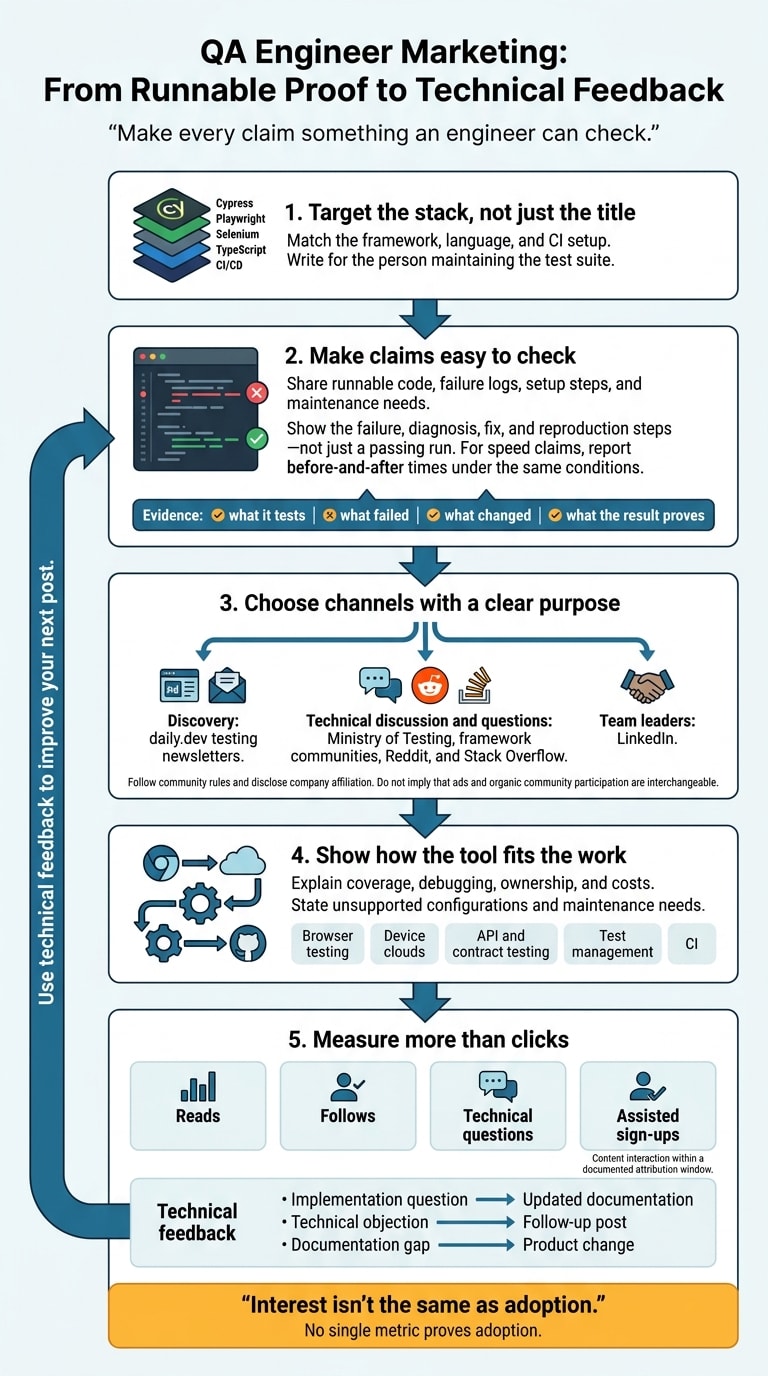
I’d market to QA and test automation engineers with a test they can run - not a product promise. Start with one testing problem, show the failure and fix, and state what your tool doesn’t test.
Here’s the approach I’d use:
- Target the stack, not just the title. Match your message to the framework, language, and CI setup used by whoever maintains the tests.
- Make claims easy to check. Share runnable code, failure logs, setup steps, and maintenance needs. For speed claims, report before-and-after times under the same conditions.
- Choose channels with a clear purpose. Use daily.dev Ads and testing newsletters for discovery, Ministry of Testing and framework communities for technical discussion, and Reddit and Stack Overflow for questions. Use LinkedIn to reach team leaders.
- Show how the tool fits the work. Explain coverage, debugging, ownership, and costs across browser testing, device clouds, API and contract testing, test management, and CI.
- Measure more than clicks. Track reads, follows, technical questions, and assisted sign-ups separately. Interest isn’t the same as adoption.
My rule: make every claim something an engineer can check, then use their feedback to improve your next post.
How do I market my developer tool to QA and test automation engineers?
Match your message to the people who use the results: QA, developers, SREs, PMs, and engineering leaders. Then show the testing problem they face - and the proof that your tool solves it.
Identify the testing problems your tool solves
Build a problem-to-outcome map, not a feature list. Functional and regression tests catch behavior changes. Integration and contract tests catch broken interfaces. End-to-end tests protect critical user journeys. Compatibility tests cover browser and device combinations, while negative tests catch invalid inputs and failure paths.
Spell out what teams need to get started and keep tests running: resettable test data, local/staging/preview environments, CI/CD execution, and regular maintenance. Explain which failure artifacts your tool collects, how teams diagnose flaky tests, and how reports help with debugging and release decisions.
For accessibility, distinguish automated checks from keyboard, manual, and assistive-tech testing. Once the problem is clear, back each claim with a test the team can reproduce.
Match your proof to each evaluation stage
Give evaluators evidence that answers their questions at each stage:
- Discovery: Does the reader recognize the failure?
- Technical evaluation: Can they run the test and inspect the failure?
- Team validation: Can they verify browser and device coverage, CI fit, debugging quality, and maintenance needs?
Document installation steps, environment variables, test data, expected output, and troubleshooting. Show a failing test, not just a passing run.
To help teams adopt the tool, show how it fits their day-to-day work. Define who writes tests, triages failures, maintains environments, and approves release blocks. Document access controls, artifact retention, supported configurations, and migration options.
Offer a pilot that lets teams start small and expand in steps. State unsupported configurations before making coverage claims.
What is the best way to reach QA and test automation engineers?
Reach QA and test automation engineers where they already discuss flaky tests, suite speed, and coverage gaps. Start with daily.dev Ads: build a verified company page developers can follow, then share posts, releases, and employer-brand stories in the feed and newsletter they chose. Join Ministry of Testing and framework communities like Cypress, Playwright, and Selenium to answer testing questions and build trust. Lead with flaky tests, slow suites, and debugging proof - not product features.
Go deeper in community discussions. Answer specific technical questions, disclose your company affiliation, and follow each community’s posting rules. Use Ministry of Testing discussions to spot problems practitioners bring up repeatedly. Connect every post to a specific toolchain, with one clear theme across updates.
With your channels in place, narrow your targeting by stack so each post reaches the right testing audience.
Reach engineers through their tools and languages
Target framework, language, and CI context - not job titles. Browser-test owners may be developers, SDETs, or platform engineers. Write for the person maintaining the test suite, whatever their title. Use the programming-language targeting guide alongside the tool-based targeting guide to match each content theme to its technical context.
Choose tags that fit the post: #testing, #qa, and #automation for general testing; #cypress for Cypress content; #cicd for pipeline topics; and #typescript for TypeScript examples. Don’t put every tag on every post. Keep frameworks separate when their setup, debugging tools, or maintenance needs call for different advice.
Turn each topic into a guide, a short summary post, and a follow-up that answers reader questions. Give one owner responsibility for updating company page posts, releases, and community replies when the product or docs change. Keep terminology, code, and limits aligned across your daily.dev company page and community contributions.
Where do QA and test automation engineers get their news and discover new tools?
Each source serves a different purpose: discovery, evaluation, or troubleshooting. Match the source to what readers need.
daily.dev feeds and the Web Development newsletter track help readers learn and find new releases. Explain what changed, who it helps, and the technical details they need.
Software Testing Weekly focuses on testing knowledge, automation, tools, and news. Ministry of Testing offers deeper learning through articles, talks, courses, events, and community discussions. For newsletters, get to the takeaway fast. For educational pieces, walk through the failure, the investigation, and the limits.
r/QualityAssurance and r/softwaretesting host peer discussions and recommendations. Use them to learn about tradeoffs, objections, and pain points - not as proof that a product works. Cypress, Playwright, and Selenium community channels offer framework-specific discussions. Before joining in, verify behavior through official channels, documentation, and release notes.
LinkedIn covers quality strategy, engineering leadership, and product updates. Back those posts with technical evidence.
Stack Overflow is for implementation and troubleshooting questions. Readers come with setup errors, configuration questions, or unexpected framework behavior. Use recurring questions to improve docs, and provide answers with reproducible steps. Before using a solution, check its date, supported versions, and current documentation. Those search patterns also show which tools readers compare next.
What do QA and test automation engineers buy, and how do they decide?
To reach QA and test automation engineers, show what breaks, what’s covered, and what it takes to maintain the tool. Buying triggers vary by category, but buyers consistently want proof of coverage, debugging support, and maintenance costs.
End-to-end and browser testing frameworks
Teams want browser tests they can maintain. Engineers look at readable assertions, isolated fixtures, browser coverage, retries, parallel execution, and CI support.
Publish runnable test code and failure artifacts, including setup and cleanup. Show how traces help pinpoint failures. Be clear about unsupported environments, shared-state risks, and maintenance work. Address debugging, coverage limits, flakiness, and release risk directly.
Device and browser clouds
These tools help quality owners check releases across environments their teams can’t maintain locally. Buyers assess real-device access, browser and operating-system versions, network conditions, session isolation, queue behavior, and framework support.
Show the release workflow and environment matrix, along with screenshots, video, and steps to reproduce failures. State which environments aren’t available, concurrency limits, how resets work, and the limits of simulated networks. Quality, web/mobile, and platform teams share the buying decision.
API and contract testing
API tools check service behavior directly. Contract tools verify messages against an agreed schema. Service owners assess schemas, authentication, authorization, negative cases, dependencies, and ownership.
Publish contract definitions and failure output, and show how findings reach the team responsible. Explain how this evidence complements UI tests. Spell out which business logic remains untested, where dependency coverage falls short, and how much work it takes to maintain contracts and approve changes. Once coverage is clear, buyers want a direct path from failure to owner.
Test management and flaky-test analytics
Quality leads need failures they can assign and investigate - not just dashboard totals. Buyers look at traceability, failure classification, quarantine workflows, rerun history, and trends.
Walk through one false failure from start to finish: the original evidence, the owner, the fix, and the final status. Explain when classification depends on heuristics rather than confirmed causes. Also disclose missing repository context and the work needed to maintain quarantines.
CI services and test parallelization
Quality owners want faster feedback without sacrificing reliability. They assess worker count and distribution, caching, sharding, retries, artifacts, and upkeep.
Publish a dated, reproducible pipeline comparison that includes runner details, cache state, execution times, and failure artifacts. Explain the tradeoffs: shared-state collisions, uneven shards, resource contention, and cache invalidation. These limits and artifacts affect how much buyers trust the tool.
How do I build a brand that QA and test automation engineers trust?
Show one passing run on a public app, but don't treat that run as proof on its own. Share the pinned commit, dependencies, environment variables with secrets removed, setup and teardown commands, exact test command, test data, browser or device configuration, assertion, expected result, and one failing case.
Name the maintainer and include a last-verified date. Mark broken demos as unavailable. For every claim about reliability, speed, or scope, use the same evidence structure: what it tests, what failed, what changed, and what the result proves.
Flaky tests: show the retry you removed
A retry isn't a fix. A flaky test passes and fails against the same code, inputs, and environment.
Publish the failure, diagnosis, fix, and steps to reproduce it. Explain whether you removed a timing issue, isolated shared data, corrected cleanup, or fixed a product defect. If the failure was a false alarm rather than an application defect, show how the evidence led to that diagnosis.
Reruns can leave the underlying problem unresolved. Before claiming better reliability, disclose the observation period and repeated-run results. Once you've shown reliability, address speed.
Suite time: show before and after
Report before-and-after execution time in minutes for the same real pipeline. Name the suite revision, environment, browser or device matrix, worker count, parallel execution method, cache state, and number of runs. State whether the timing includes setup, and cite every number with its source and date.
Explain any trade-offs: added resource use, less diagnostic detail, or test-order dependencies. A faster run isn't stronger evidence if coverage changed or failures became harder to investigate. Then state the scope so readers know exactly what the result supports.
Coverage limits: state what you do not test
Start with exclusions, then list supported coverage. Distinguish browser behavior from real-device behavior, API responses, contract checks, accessibility, integration paths, and end-to-end workflows.
State whether dependencies are live or mocked, and name the assertions that establish success. Code coverage shows what executed - not whether important behavior was tested.
Which channels work best for marketing to QA and test automation engineers?
Give each channel a clear job. Match the channel to the evidence you can share - not just the audience you want to reach. The table below maps each option to its purpose, content fit, and brand role.
| Channel | Best use | Suitable content | Strength | Limitation | Brand role |
|---|---|---|---|---|---|
| daily.dev Ads | Build a recognizable company presence | Testing guides, releases, and employer-brand stories | A verified company page developers can follow, with content in their chosen feed and Web Development newsletter track | Needs a steady flow of useful content, not a single announcement | Builds a consistent company voice over time |
| Testing newsletters, including Software Testing Weekly | Help readers discover your work in a testing-focused editorial setting | Research summaries, automation lessons, framework updates, and practical resources | Readers seek curated testing news. | Editorial fit and placement availability matter; one mention doesn't build a lasting relationship | Builds familiarity through relevant educational contributions |
| Ministry of Testing | Join professional learning and quality engineering conversations | Testing lessons others can reproduce | Supports practitioner learning and professional exchange. | Needs knowledgeable contributors and patient participation; sales-led sessions can weaken trust | Shows expertise through teaching and answering questions |
| Reddit, including r/QualityAssurance and r/softwaretesting | Understand practitioner concerns and join troubleshooting discussions | Troubleshooting answers and candid postmortems | Direct feedback can reveal gaps in your message or documentation | Subreddit rules vary; undisclosed self-promotion or repeated announcements may be rejected | Earns trust through helpful answers and clear disclosure |
| Cypress, Playwright, and Selenium community channels, including Discord and meetups | Help practitioners check framework-specific technical claims | Integration guides, fixture design, CI troubleshooting, and live demonstrations | Discussions focus on concrete implementation problems | Content must fit the framework and channel rules | Shows that your engineers understand the stack practitioners use |
| LinkedIn Ads | Reach practitioners and organizational stakeholders in quality-engineering and leadership settings | Quality-engineering reports, technical webinars, leadership perspectives, and employer-brand stories | Role, company, seniority, and industry context help address different stakeholders | Job titles can miss quality owners without a QA or test automation title; a quality-engineering or leadership setting doesn't guarantee technical relevance | Builds authority with evidence suited to each stakeholder |
| Stack Overflow Ads | Put technical resources in front of developers solving problems | Focused documentation, integration guidance, technical reports, and sponsored educational content | Supports targeting by skills, tags, interests, roles, historical behavior, and technologies. | Narrow placements need closely matched content and don't replace regular community participation | Connects the company with useful troubleshooting and implementation resources |
Change the format, not the evidence. A newsletter needs a concise lesson. A framework community needs implementation detail. Reddit needs an answer that stands on its own, with product involvement disclosed. For daily.dev Ads, connect related posts and releases so developers can follow the company's work instead of seeing disconnected announcements.
Before committing, check editorial requirements, community rules, and who will answer technical questions. Start with a publishing channel you can maintain and a specialist community where your engineers can contribute. Use a channel only when you can keep supplying useful proof. Once you've picked it, shape the message around the test, failure, or limit you can prove.
How do I market end-to-end and browser testing frameworks to QA and test automation engineers?
Start with a browser failure, not a feature list. Publish the smallest reproducible test against a public application. Name the affected browser, show the error message, and compare the expected and actual results. Stick to one user behavior so readers can follow the setup, action, and assertion without digging through a large suite.
Show why the test produces repeatable results. Use fixtures for isolated state and predictable test data. Choose stable, user-visible labels or dedicated data-* attributes for selectors. Wait for an application condition instead of a fixed sleep, and assert a meaningful outcome - not just that a click happened. Cypress recommends dedicated data-* attributes and condition-based synchronization.
Share the failed assertion, screenshot, and network or console evidence. Include a trace showing the failing action and DOM state. Playwright’s Trace Viewer lets readers inspect actions, DOM snapshots, network requests, and console output. Then show the fix, rather than stopping at a successful retry.
Rerun the fixed test in CI against the same app. Share the repository, pull request or pipeline context, browser or container setup, test command, HTML report, and saved failure artifacts. Give readers what they need to check the result themselves. Spell out the exact browser matrix and excluded combinations, including engines, versions, operating systems, and viewport configurations. Clearly separate mobile emulation from real-device testing. Use this same evidence format when documenting browser matrix coverage and CI runs.
Tailor the evidence to each group responsible for quality. Engineers need the code, fixture model, locator strategy, wait behavior, assertion syntax, and debugging workflow. Quality owners need user-path coverage, gaps, flaky-test handling, and clear test ownership. Leaders need release risk, suite duration, and maintenance effort. Document data cleanup, selector updates, retry policy, and artifact retention so teams can judge the work needed to keep the suite reliable.
How do I market device and browser clouds to QA and test automation engineers?
When buyers ask how the cloud fits their pipeline, show the release flow from start to finish. Walk through how a code change triggers CI, the test suite starts sessions, the application runs across selected browsers and devices, and results return to the pipeline to guide the release decision. Use a sample test matrix that reflects supported users and production requirements.
Then show what happens between a session request and the first test step. Does the service start a browser profile, container, VM, or real device? Explain how it resets cookies, local storage, files, permissions, and network state between runs. Session isolation doesn’t replace separate test data: parallel tests can still clash when they share application accounts or records.
Separate queue time from execution time. Name which tests run in parallel, which run sequentially, and what happens when capacity is full. Show where CI credentials are stored and how engineers access private staging environments, including any tunnels, certificates, or allowlists they need.
Next, walk through debugging a failed session. Explain how session metadata, command logs, timestamps, and recordings help engineers tell an application defect apart from a provisioning or connectivity failure. Specify how long artifacts are kept, how to download them, and what gets redacted. Keep responsive checks, accessibility rules, and network simulations separate from manual accessibility review and real-network testing.
Before buyers start a trial, spell out the platform’s limits. Distinguish real devices from emulators and simulators, and state where each is available geographically. Disclose restrictions on camera access, GPS, biometrics, push notifications, Bluetooth, authentication, and private-network access so buyers can judge whether the platform fits their release workflow.
How do I measure marketing to QA and test automation engineers?
Measure whether the testing problem you wrote about drew technical engagement. Track reads, follows, technical discussion, and assisted sign-ups separately. Reads show that people consumed the content. Follows suggest interest in future updates. Implementation questions, technical objections, and documentation requests show whether your message speaks to actual testing needs. No single metric proves adoption.
Discussion patterns help you distinguish readers evaluating the tool from those just skimming. Compare posts about the same testing problem and framework over time. Review reads and follows after publication, then check discussions weekly. Questions about reproducing a test, requests for supporting documentation, and objections about reliability or CI integration usually tell you more than generic reactions.
Define an assisted sign-up as a sign-up from someone who interacted with your content within a documented attribution window. Treat it as supporting evidence - not proof that one exposure caused adoption. Add an open-ended field to collect remembered recommendations that tracking missed:
How did you hear about us?
Use technical feedback to improve your content
Keep a log with each post’s date, channel, title, framework, testing problem, evidence, intended reader, and relevant tags: #testing, #qa, #automation, #cypress, #cicd, and #typescript. Include the daily.dev newsletter track, Web Development, when applicable. Record reads, follows, discussion themes, and assisted sign-ups so you can compare related posts.
Label detailed technical feedback as an implementation question, technical objection, or documentation gap. Record how you responded: updated documentation, a follow-up post, or a product change. Review the log monthly and use the patterns you find to shape future posts. For every numerical testing claim, keep the metric definition, baseline, comparison period, test conditions, and named source and date.
How daily.dev Ads helps you reach QA and test automation engineers
daily.dev Ads gives you one managed channel for regular developer visibility. The daily.dev team runs the plan and keeps your message focused on technical proof.
The Web Development newsletter track fits browser testing, JavaScript and TypeScript tooling, and CI workflows. The personalized daily.dev Digest puts your content alongside material developers have already chosen to receive.
Use technical posts to show testing proof, release posts to explain product changes, and employer-brand stories to show how your quality team works. Tie each format to the same test failure, fix, or limit. Focus on flaky tests, test suite run time, and honest coverage reporting, not brand claims.
Your team provides accurate technical proof and answers engineering questions. The daily.dev team coordinates the plan and distributes the content. Start with a testing problem you can back up with evidence, then use that evidence across posts, releases, and employer-brand stories. See the plan details.
Conclusion
Market to the person responsible for quality who can judge the test. Start with a runnable test, explain how you handle flakiness, and state coverage limits before making broader claims.
Apply that standard to your proof and publishing checklist. Before publishing, make the environment, reproduction steps, and evidence easy to find so engineers can check your claims quickly.
Give that proof a consistent home. Use daily.dev Ads to build a followed, verified company page and a developer community around it. Track progress through sustained reading, follows, useful discussion, and assisted sign-ups.
Let technical feedback guide what comes next.
FAQs
How do I market a testing tool without public demos?
Use daily.dev Ads, trusted testing newsletters, and problem-focused communities like r/QualityAssurance to share technical proof with QA and test automation engineers. Be clear about what your tests cover - and what they don’t. Focus on the problems these engineers face: retries, false failures, and suite run time.
On daily.dev, use stack and topic targeting to put that proof in-feed. Track developer engagement through reads, follows, discussions, and assisted sign-ups.
How can I turn technical feedback into content ideas?
Use technical feedback to pinpoint the testing problems your content should address. For QA and test automation engineers, address flaky tests head-on, show a green test run as proof, and spell out what your tool does not test.
Distribute this content through daily.dev Ads, technical newsletters, and community discussions that fit how engineers evaluate tools.
What should a QA tool pilot prove?
A QA tool pilot should show how the tool handles actual testing problems: flaky tests, suite run time, and coverage gaps. Show the test it writes, the retry it removes, or the false failure it catches.
Share before-and-after suite times from an actual pipeline, and spell out what the tool doesn’t test. Technical evidence and clear trade-offs build more trust than promotional copy.