

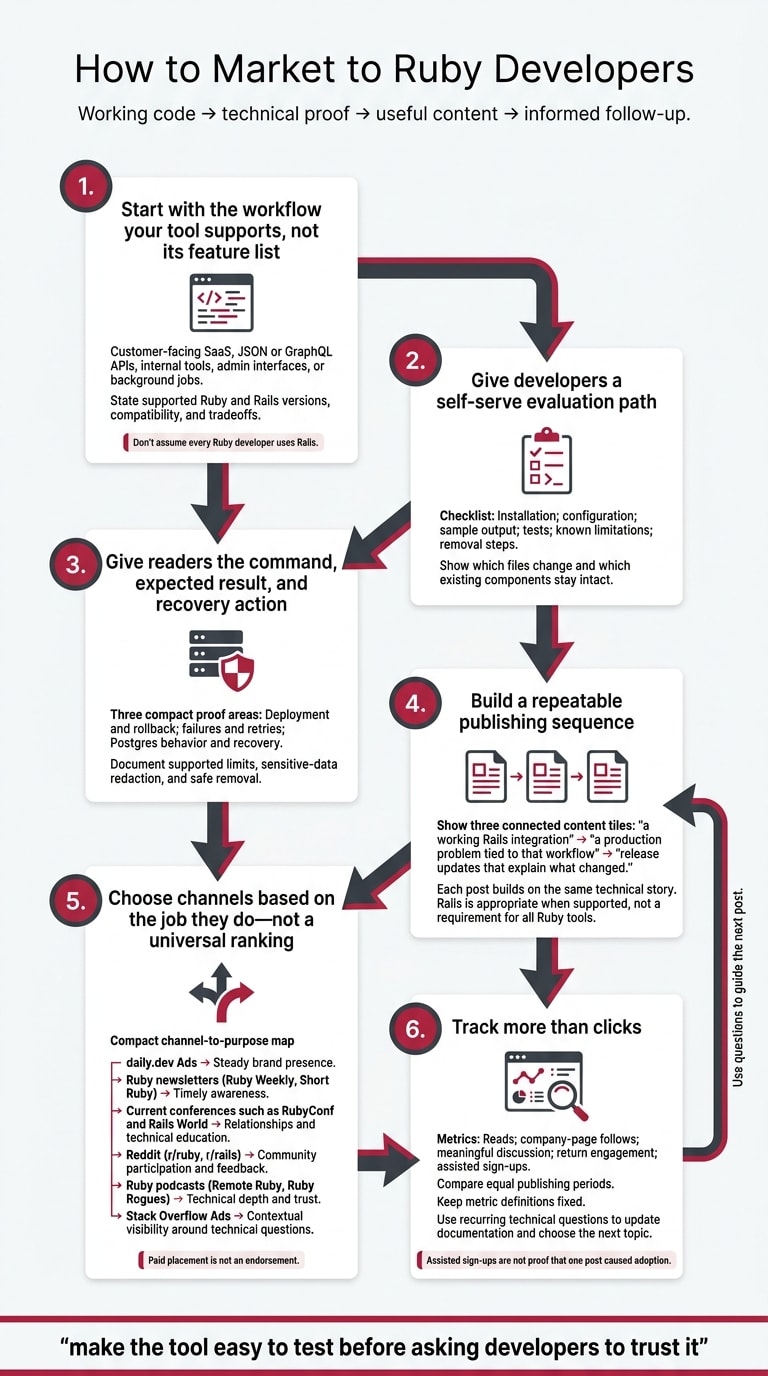
I’d start marketing to Ruby developers with working code - not a feature list. Give readers 3 things: a tested integration, clear production limits, and steps to remove your tool. If you support Rails, show the setup, deployment process, and Postgres behavior. Don’t assume every Ruby developer uses Rails.
Here’s the approach I’d use:
- Show the workflow: Explain how your tool handles deployment, monitoring, databases, frontend work, email, payments, or background jobs - including failures and retries.
- Match the channel to the message: Use Ruby newsletters and developer feeds for discovery, communities for questions, and podcasts and current events for deeper discussion.
- Make each post useful: Connect an integration guide, a production problem, and release updates into one series. I’d use daily.dev Ads to distribute that series through its company page, feed, and newsletter placements.
- Track more than clicks: Compare reads, follows, technical questions, return visits, and assisted sign-ups over equal periods.
My rule: make the tool easy to test before asking developers to trust it. Then use what readers ask to guide the next post.
How do I market my developer tool to Ruby developers?
Start with the workflow your tool supports, not its feature list: customer-facing SaaS, JSON or GraphQL APIs, internal tools, admin interfaces, or background jobs. State supported Ruby and Rails versions, compatibility, and tradeoffs upfront. Buyers need to judge fit, risks in production, and adoption cost. Don’t assume every Ruby developer uses Rails.
Give developers a self-serve evaluation path with installation, configuration, sample output, tests, known limitations, and removal steps. Show which files change and which existing components stay intact. Keep this part focused on the criteria developers need to evaluate your tool.
Use that evidence to show where your tool fits in each product category below.
Monitoring and error tracking
For observability tools, walk through the full debugging process.
Show how a developer investigates an issue from start to finish, tracing an exception from request ID to controller action, release, and first app frame. For failed jobs, document queue names, redacted arguments, retries, and supported job adapters. For slow requests and deployment regressions, show SQL timing and release comparisons.
State exactly what you instrument and what sensitive data you redact. Back up claims of faster debugging and safer instrumentation with evidence.
Managed Postgres and database tools
For database tools, show which decisions your product helps developers make.
Tie each feature to a concrete decision about backup retention, restore procedures, migration safety, connection pooling, or query performance. Explain how web processes and job workers share connection capacity, how developers identify blocking locks, and what a restore cannot prove.
Document how to restore into an isolated instance and check both schema and data. Switch the app only after validation succeeds. Keep the focus on safer database work and clearer recovery steps.
Frontend tools for Rails apps
For frontend tools, show how developers can adopt them a piece at a time within an existing Rails app.
Explain compatibility with the app’s existing asset pipeline, import maps or a JavaScript bundler, Turbo, and Stimulus. Show the required file changes, development and production build steps, and UI behavior during Turbo navigation.
Show that developers can add a component, test it, and remove it without changing the app architecture.
Where do Ruby developers get their news and discover new tools?
Ruby developers find tools through curated newsletters, technical communities, events, podcasts, and developer feeds.
daily.dev gives you a verified company page in developer-selected feeds and the Web Development newsletter track. Share posts, releases, and employer-brand stories, using tags like #ruby, #rails, #backend, #webdev, #postgresql, and #javascript.
Ruby Weekly and Short Ruby are reliable discovery channels. Ruby Weekly curates Ruby articles, tutorials, videos, code, and tools. Short Ruby publishes a Monday summary of community articles, discussions, releases, and news. Before choosing either, review recent issues, editorial rules, and submission options. Talks and recorded sessions offer more technical detail beyond these newsletters.
Conferences give developers room to dig into projects. RubyConf and Rails World offer talks, conversations, and implementation details that help developers evaluate projects. RailsConf is now part of the historical record: Ruby Central identifies its 2025 edition as the final event. Check current schedules before planning outreach, and use recordings as a long-term discovery source.
Remote Ruby and Ruby Rogues suit long-form technical discussions - not product pitches. Focus on lessons from running and maintaining systems. Before proposing a topic, check the latest episodes, current hosts, guest guidelines, and sponsorship availability. Community threads and question archives offer another way to learn about developers’ objections and the problems driving their search for tools.
r/ruby and r/rails surface live questions, objections, and releases. Stack Overflow supports discovery through specific problems. Read subreddit rules before sharing a launch, and answer the question before linking your product. Recurring Stack Overflow questions can reveal setup problems and documentation gaps, helping you test messaging as well as reach developers. Write answers that help even if the reader never buys. Pay attention to those questions - they’re also what developers will ask when judging your documentation and product fit.
What is the best way to reach Ruby developers?
Build a repeatable publishing sequence: a working Rails integration, a production problem tied to that workflow, and release updates that explain what changed. Ruby developers follow tools that show a working path before tackling edge cases. Use daily.dev Ads to put that series in the feed and newsletter developers already use, through one managed plan. Each post should build on the same technical story rather than start over.
Make the integration easy to inspect. In the README, include the Gemfile entry, initializer, environment variables, relevant app code, and a test. Add prerequisites, setup commands, expected output, and troubleshooting guidance. Keep the code aligned with supported Ruby and Rails versions so readers can evaluate your product without fixing the demo first.
Take the next post beyond installation. Walk through the symptoms, diagnosis, fixes, and trade-offs of a production issue tied to the workflow. Connect release updates to that same workflow by documenting compatibility, upgrade steps, and what developers should test. Stick to a publishing pace your team can maintain.
Combine programming-language targeting with tech-stack targeting. Ruby sets the language context; Rails and its supporting tools define the use case. Use #javascript only when frontend behavior is involved. Once your message is clear, choose the channels best suited to carry it. Check out our developer marketing resources for more insights on reaching technical audiences.
Give each post a useful next step: run the integration, inspect its failure behavior, or review the upgrade instructions. Ask a focused engineering question instead of requesting generic feedback. These discussions give your team material for the next post - and give developers a reason to keep following your company.
Which channels work best for marketing to Ruby developers?
Choose channels based on the job they do - not a universal ranking. This table shows where each channel fits.
| Channel | Best use | Strength | Limitation | Suitable content |
|---|---|---|---|---|
| daily.dev Ads | Steady brand presence | A verified company page developers can follow, with posts in their chosen feed and newsletter | Needs useful content and consistent publishing | Technical posts, releases, engineering and employer-brand stories |
| Ruby newsletters (Ruby Weekly, Short Ruby) | Timely awareness | Editorial context focused on Ruby news | Publication schedules and formats limit timing and space | Release announcements, compatibility updates, concise tutorials |
| RailsConf, RubyConf and Rails World | Relationships and technical education | Live conversations, talks, workshops, and demonstrations | Concentrated event windows and extensive preparation | Technical talks, workshops, maintainer discussions |
| Reddit (r/ruby, r/rails) | Community participation and feedback | Discussion of actual development problems | Promotional posts are often removed | Detailed answers, implementation lessons, open feedback requests |
| Ruby podcasts (Remote Ruby, Ruby Rogues) | Technical depth and trust | Room to discuss trade-offs | Host fit and production schedules limit message control | Architecture discussions, incident retrospectives, engineering interviews |
| Stack Overflow Ads | Contextual visibility around technical questions | Relevance to active problem-solving | An ad leaves little room for a continuing story | Documentation, migration resources, focused technical guides |
Paid placement is not an endorsement. On Reddit, disclose your affiliation and answer the question first.
With daily.dev Ads, your verified company page brings posts, releases, and employer-brand stories into the feed and newsletter Ruby developers already chose.
Before committing to a channel, put someone in charge of follow-through. That might mean answering technical questions, supporting a workshop, or preparing a podcast guest to discuss trade-offs honestly. Use only channels where your team can show technical proof and handle follow-up questions well, with code and details about how systems run in practice.
How do I build a brand that Ruby developers trust?
Ruby developers trust tools that show their work. Use your README to show how installation works, how the tool behaves at runtime, where its limits lie, and how to remove it. These are the checks Ruby developers make before trusting a tool in production.
Show how you follow Rails conventions
Publish the generator and initializer in a working sample app. Explain every generated file, default, and override. If installation changes routes, middleware, credentials, or migrations, show the diff. State whether configuration loads at boot and whether changes require a restart.
Test generator output, missing credentials, timeouts, and duplicate delivery where relevant. For each failure, document the actual error and how to recover. Keep secrets out of sample code and logs.
With installation covered, show what happens during deployment and in the database.
Document the path from push to live
Walk through every step from push to live: environment variables, build and release, migrations, web processes, workers, logs, health checks, and rollback. Give readers the command, expected result, and recovery action for each step.
Explain when rolling back to an earlier application release isn't enough. Destructive database changes may require a database restore. Also make clear that editing an applied migration does not rerun it.
Then show how the product behaves with Postgres in actual apps.
Explain how you work with Postgres
State exactly how your product uses the database developers already run. Does it use the primary database, a replica, or a separate database? Explain its tables, queries, indexes, connection pooling, transaction boundaries, required extensions, and supported limits.
Document whether backups include the product's data, how restoration works, and what happens during connection loss or failover. State which Rails setups, database topologies, and failover paths you support.
How do I market Rails hosting and deployment platforms to Ruby developers?
For Rails hosting, the product page is the deploy guide. Ruby developers judge hosting by how clearly it explains the path from repo to production. Provide a repo-backed deployment guide covering Ruby version detection, Bundler installation, Rails environment setup, JavaScript preparation, CSS/JS compilation, and how the platform builds a deployable artifact. Explain support for system packages required by native gems and where developers can diagnose build failures.
Separate build-time configuration from runtime secrets. Show which settings asset compilation needs and which are required at startup. Explain how preview, staging, and production credentials stay separate as releases move between environments. Cover what happens when a build succeeds but a missing secret prevents the app from booting. Apply the same separation to worker and scheduler settings.
Background jobs belong in the release guide, too. Document worker startup, concurrency, retries, graceful shutdown, and what happens to in-flight jobs during deployment. For scheduled tasks, explain time zones, duplicate prevention, and failure alerts. State whether recurring work survives restarts and scale changes.
State the rollback boundary. Explain whether traffic stays on the prior release when deployment fails, how recovery works, and whether web and worker processes return to the same release. Describe how the platform handles schema drift after rollback and who must resolve it. Then address scaling.
Web processes, workers, and Postgres scale separately, but higher worker concurrency puts more pressure on the database. Spell out capacity limits, tuning thresholds, and failure modes, including when connection limits need manual tuning. Ruby teams need these details to assess whether the hosting fits their workload.
How do I market transactional email, payments and background-job services to Ruby developers?
Market the Rails workflow, not the feature list. Ruby teams trust these services when they can check the Rails integration and see exactly what happens when something fails. Include the Ruby library, Rails compatibility, initializer, environment variables, Active Job adapter, and tests. Publish an integration guide covering verification, receipts, billing, webhooks, imports, and completion notifications.
For email, show the Action Mailer action, sender and reply-to settings, templates, development previews, and deliver_later path. Explain where bounced addresses and rejected messages appear in the app. Link each receipt to its order and provider message ID so an operator can investigate a missing email without digging through unrelated logs.
Make retries idempotent. When creating a subscription, save an idempotency key and reuse it on retries. Apply the same duplicate-safe handling to provider callbacks after subscription retries. For webhooks, verify the signature against the raw request body. Store the event in a durable event table with a unique constraint on (provider, event_id), then acknowledge it immediately and process it through the background job queue. Show developers how to replay failed events without applying the same billing change twice.
For imports, prevent duplicate writes with a source-record ID or batch-row key. For notifications, record the recipient, notification type, and source event. Use retry_on for temporary failures and discard_on for permanent ones. Make the distinction clear: provider webhook retries and application job retries are separate paths.
Once the workflow is live, show developers where to find failed events, email bounces, and reconciliation gaps. Trace a request from app entry through the provider callback and queued job to reconciliation. Carry a correlation ID through requests, jobs, and provider calls, but keep sensitive payment data out of logs. Include tests for duplicate events, temporary failures, and safe replay so the guide shows how the workflow behaves instead of just promising reliability.
How do I measure brand and community growth?
After you publish content for Ruby developers, track what they read, discuss, and return to.
Compare reads, company-page follows, meaningful discussion, and assisted sign-ups across equal publishing periods. Record each post’s topic, format, channel, and date. Keep metric definitions fixed, record the source and date of each figure, and flag releases or events that might explain a temporary spike.
Track technical education separately from employer-brand stories. This helps you distinguish developers’ implementation needs from their interest in engineering practices. When you can connect readers to later posts, check whether they engage again.
Judge discussion by its substance, not its volume. Log technical questions, examples from developers, and follow-up replies. If the same question keeps coming up, add the answer to the README or relevant guide, then link to it from the discussion. After the update, track whether people still ask that question.
Treat assisted sign-ups as evidence of a broader buying journey - not proof that one post caused adoption. Define which tracked content interactions qualify, and use a consistent lookback period. Report which content people saw before signing up, while noting that untracked interactions may also have played a part. This shows where education supported their consideration.
Use these patterns to choose the next topic, identify questions that need clearer answers, and shape your next post and release note.
How daily.dev Ads helps you reach Ruby developers
daily.dev Ads helps you put the same technical story in front of Ruby developers over time. It brings your verified company page, technical posts, releases, and employer-brand stories into one plan. The daily.dev team handles setup, cadence, and reporting, while your content appears in the personalized feed and the Web Development track of the Digest.
Make your company page your brand’s home. Explain what your product does for Ruby and Rails teams, link to documentation and working examples, and publish on a consistent schedule. Use technical posts to explain implementation, releases to share changes, and employer-brand stories to show how your engineers build and support the product.
Useful topics include a Rails deployment walkthrough, a production incident retrospective, or an explanation of how your product works with Postgres.
Once your company page is clear, extend that technical story through the newsletter. The Web Development track gives posts and releases a second placement. Confirm timing and editorial requirements with the daily.dev team before publication.
Choose hashtags that match the technical topic. Use #ruby, #rails, #backend, #webdev, #postgresql, and #javascript only where they fit - not to inflate reach.
A Rails hosting platform may emphasize #ruby, #rails, #backend, and #postgresql; a frontend tool for Rails apps may also use #javascript.
With your content plan in place, schedule a conversation to map the rollout with the daily.dev team. Check the plan information page for plan details.
Conclusion
When workflow, channel, and trust line up, marketing to Ruby developers starts with proof: a working Rails workflow, clear setup, and visible Postgres behavior. Name the production problem, then publish a working example with its configuration, expected behavior, and production limits. Show a working example, not a promise.
Choose channels where Ruby developers already find technical posts, and keep the technical standard consistent across them. Review reads, follows, discussion, and assisted sign-ups by topic to decide which technical stories need a follow-up.
Respect Rails conventions, explain the path to production, and make your Postgres behavior clear. Use daily.dev Ads to maintain that presence through a verified company page, posts, releases, and employer-brand stories.
FAQs
How can I reach Ruby developers who don’t use Rails?
Use daily.dev Ads’ in-feed placements and newsletter spots, along with Ruby Weekly and Short Ruby, to reach Ruby developers where they discover content. Broader Ruby discussions on r/ruby and Stack Overflow are also worth considering.
On daily.dev, target by stack, seniority, tools, and on-platform interests. Tailor your message to the tools developers use and how they work - don’t assume they use Rails.
What should I publish before my tool has production users?
Publish detailed posts about Rails conventions, deployment workflows, and database-specific solutions. Give experienced Ruby developers something they can use: a working example with a generator and initializer, a deployment walkthrough, or an explanation of how your tool works with Postgres.
That technical depth helps earn developers’ trust. Use daily.dev Ads to share your posts and build a brand developers can follow.
How can I keep technical examples current as Rails evolves?
Keep your Rails generators and Postgres-focused deployment tutorials in step with Rails conventions as they change. Use working examples that solve specific engineering problems, not generic brand messaging. Be honest, and take an active part in the community.