



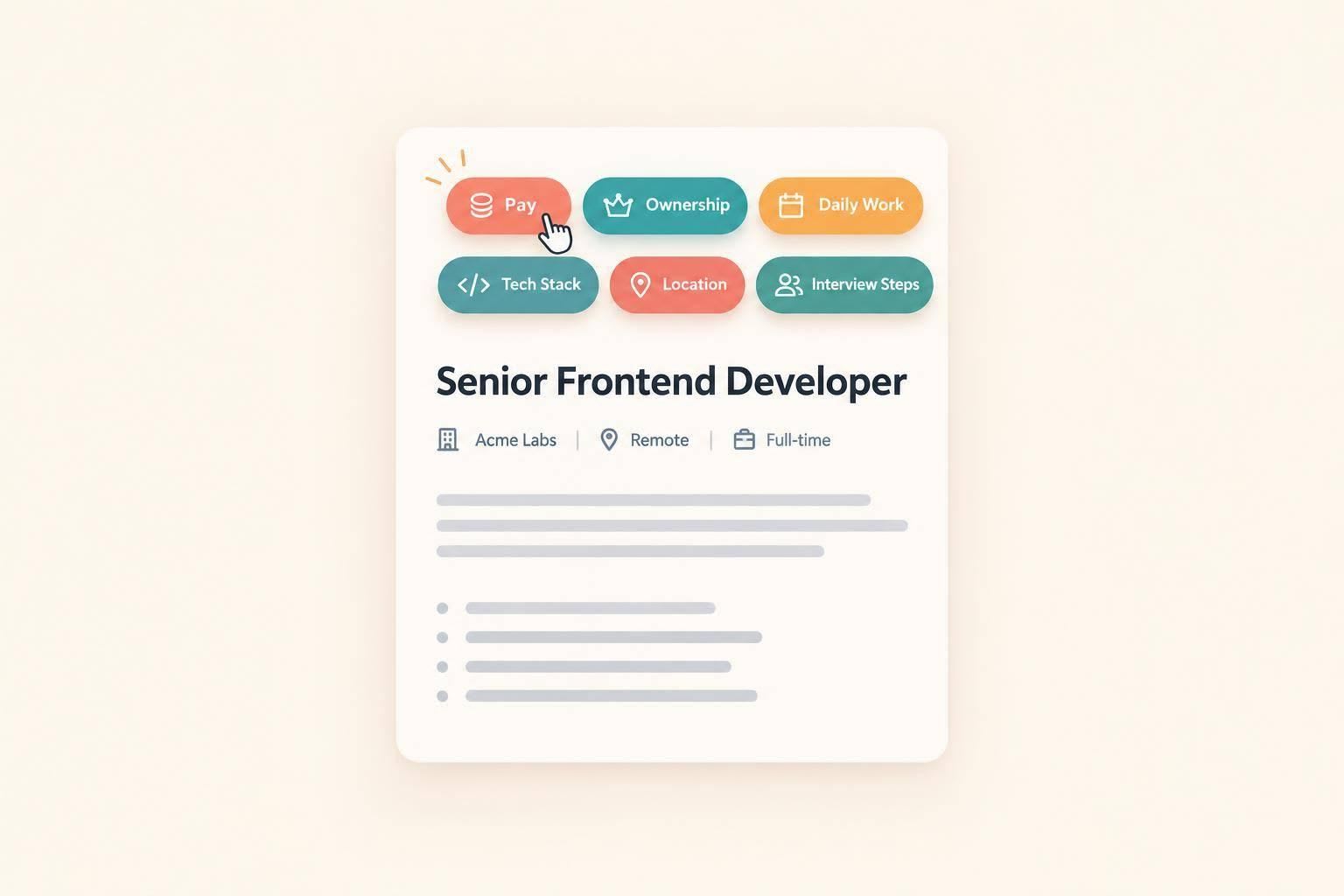
A developer job post should make six things clear: pay, ownership, daily work, tech stack, working conditions, and interviews. Put those details before the company overview so candidates can decide whether the role fits.
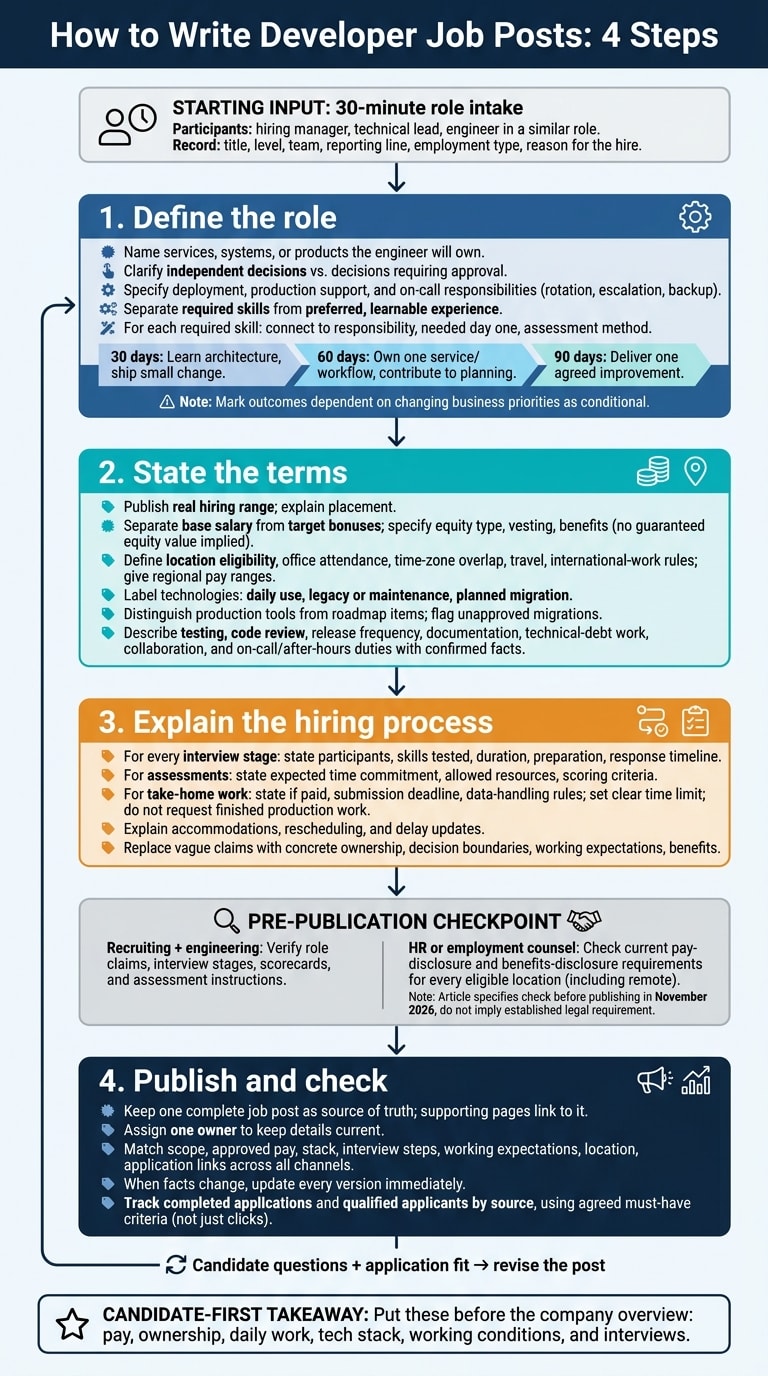
Start with a 30-minute role intake with engineering, then cover four steps:
- Define the role: Set ownership, 30-, 60-, and 90-day goals, and separate required skills from experience candidates can learn.
- State the terms: List salary ranges, location rules, production tools, and on-call duties.
- Explain the hiring process: Give interview stages, time commitments, assessment rules, and response timelines. Replace vague claims with facts.
- Publish and check: Keep one complete job post, match details across channels, and track qualified applicants - not just clicks.
Before publishing, have recruiting and engineering verify the claims and HR or counsel check current pay-disclosure rules for each eligible location.
1. Define the role with engineering
Turn the hiring need into a role spec before writing the job post.
Hold a 30-minute role intake with the hiring manager, technical lead, and an engineer in a similar role. Record the title, level, team, reporting line, employment type, and reason for the hire. Tie each claim to how the team works: code review, release cadence, incident response, documentation, or collaboration with product, security, or support. Use the employer-branding playbook for engineering teams to guide the discussion.
Define ownership and first-90-day outcomes
Name the services, systems, or products the engineer will own. Make decision-making boundaries clear: what can they decide on their own, and what needs approval? Specify whether ownership includes deployment, production support, and on-call duties. Include the rotation, escalation path, and backup support.
Write 30-, 60-, and 90-day outcomes as milestones you can put directly in the post:
- 30 days: Learn the architecture and ship a small change.
- 60 days: Take ownership of one service or workflow and contribute to planning.
- 90 days: Deliver one agreed improvement.
Mark any outcome that depends on changing business priorities as conditional.
With the work defined, separate what the hire needs to know on day one from what they can learn after joining.
Separate required skills from preferred experience
For each required skill, record the responsibility it supports, why it’s needed on day one, and how you’ll assess it. A tool’s presence in your stack isn’t enough reason to require it. Ask engineers what they needed to know when they joined and what they learned on the job.
Put useful but learnable experience in a separate preferred section - and don’t turn it into a hidden screening filter. Accept equivalent experience when a degree isn’t required. Drop fixed years-of-experience thresholds when demonstrated capability matters more, and remove any requirement the team can’t assess.
2. Lead with pay, stack, and working conditions
Put the facts candidates scan first at the top of the role spec: title and level, location and work model, pay, stack, role outcomes, requirements, and interview steps. Place the company overview below them.
State the salary range and location rules
Publish a real hiring range and explain what determines a candidate’s placement within it. List base salary separately from target or discretionary bonuses. Specify equity type and vesting terms without suggesting guaranteed value, and name the benefits offered.
Spell out what remote means: eligible locations, required office attendance, time-zone overlap, travel, and whether employees can work internationally. Provide separate pay ranges where pay varies by region.
Before publishing in November 2026, ask HR or employment counsel to check current official requirements for every eligible location. That check should cover benefits disclosures and rules that apply to remote roles.
Describe the stack and day-to-day work
Label technologies by how they’re used: daily use, legacy or maintenance, or planned migration. Keep roadmap items separate from what’s in production, and flag migrations that still need approval. Publish only approved technical details. When details are confidential, explain the system’s purpose instead.
Describe testing, code review, release frequency, documentation, technical-debt work, and collaboration with product or support teams. Give confirmed frequencies rather than vague descriptions of how often releases or collaboration happen. State any on-call or after-hours duties upfront.
3. Explain interviews and cut vague claims
Once the role, pay, and stack are clear, give candidates the same clarity about interviews.
List interview stages and assessments
Lay out each stage in order: who takes part, what it tests, how long it lasts, what candidates should prepare, and when they’ll hear back. Developers use these details to weigh the time commitment and judge whether the process treats candidates fairly. Explain how to request accommodations, reschedule, and get updates if there’s a delay.
Be specific about assessments. State the expected time commitment, allowed resources, and scoring criteria. For take-home work, include whether it’s paid, the submission deadline, and rules for handling data. Test skills the role requires, and set a clear time limit. Don’t ask candidates to deliver finished production work.
Replace vague claims with facts
Cut wording that hides how much time the job takes, who makes decisions, or what the work involves.
Cut “rock star,” “ninja,” and empty superlatives.
Replace personality labels with concrete criteria: what the hire will own, which decisions they can make, code-review standards, and how the team handles disagreements. Remove tools the person won’t use.
Name each benefit directly. Spell out fixed availability windows rather than promising unlimited flexibility. Be clear about customer-support duties, overtime, and after-hours expectations.
Before publication, have recruiting and engineering check that every interview stage, scorecard, and assessment instruction matches the post. Use those verified details when formatting the post and checking it for consistency.
4. Choose a format and check before publishing
Once the role content is set, choose a format that keeps every fact in one place.
Choose the right publishing format
Keep the job post as the source of truth. Supporting content should add detail - not send candidates searching for pay, scope, or interview information.
| Choice | Use when | Include |
|---|---|---|
| Standard job post | Filling one defined opening | Ownership, pay, location rules, stack, requirements, working expectations, interviews, and application steps |
| Employer-brand landing page | Presenting multiple engineering openings or a broader team story | Team principles, employee stories, and direct links to complete role descriptions |
| Engineering team series | Explaining technical work across several pieces | Architecture, development practices, production challenges, and links to relevant openings |
| Recruiter-supported posting | Sourcing specialized candidates or coordinating follow-up | A complete job post, recruiter contact, screening expectations, and response timeline |
For broader planning, use the employer-branding playbook for engineering teams.
Check consistency and track qualified applicants
Use the same brief for every page and message, with one owner responsible for keeping it current.
Before publishing, check that scope, approved pay, stack, interview steps, and working expectations match across careers pages, campaign copy, recruiter messages, and interviewer guidance. Confirm that location eligibility and application links are consistent, too. When facts change, update every version immediately.
Track completed applications and qualified applicants by source, using the agreed must-have criteria. Record recurring candidate questions and revise the post when those questions reveal missing details. Review early applications for fit - don't treat clicks or application volume alone as success.
FAQs
How can I make a developer job post easy to scan?
Start with the technical workflow, stack, team size, and engineering problems - not a generic company overview. Give developers enough detail to judge whether the role fits.
Use concise, descriptive headings that name the problem and state a measurable outcome in industry-standard terms. Keep claims verifiable, and be clear about technical decisions, trade-offs, and day-to-day expectations, including on-call duties.
How should I describe a role with evolving responsibilities?
Be clear about how your team works. Match the job description to your current team structure and engineering playbook. Focus on the problems and projects the engineer will own, not generic titles, and describe what they’ll do day to day.
When your team, stack, or on-call setup changes, update your public messaging so candidates get a consistent, accurate picture of the role.
Why is my job post attracting unqualified applicants?
Unqualified applicants often point to a gap between your job post and your engineering team’s daily work. Vague slogans and sales language can draw candidates who don’t understand what the role involves.
Your current engineers should recognize the job you describe. Spell out your tech stack, team setup, on-call workload, and technical challenges - including legacy systems and technical debt. Support your claims with engineering examples, and explain the actual problems the new hire will solve.