




I’d start with what stays the same - not a growth campaign. On day one, tell users what’s confirmed about access, pricing, the roadmap, and data handling. Give each open question an owner and a next-update date.
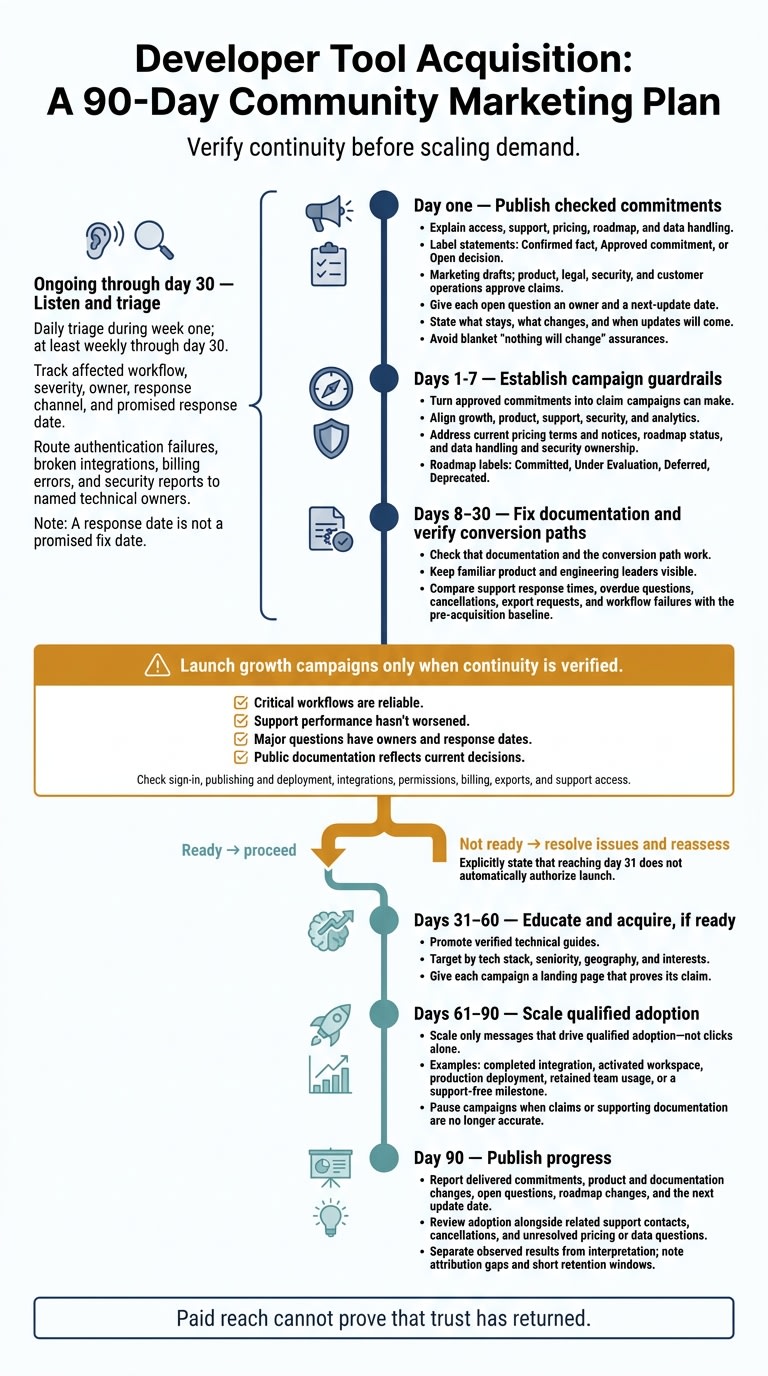
I’d organize the first 90 days around four steps:
- Publish checked commitments. Separate confirmed facts from promises and decisions still under review.
- Answer pricing, roadmap, and data questions. Explain current terms, planned changes, and who’s responsible.
- Listen through day 30. Keep familiar technical leaders involved, track community concerns, and check that core workflows and support still work.
- Plan campaigns and report results. Once the product is stable, use days 31–90 for education and acquisition through channels such as daily.dev Ads. Measure completed setups and retained use - not clicks alone.
My rule: verify continuity before scaling demand. Paid reach can bring developers to your tool. It can’t prove their trust has returned.
1. Confirm the acquisition and publish day-one commitments
Day-one promises must be accurate. Marketing drafts the announcement, but product, legal, security, and customer operations must approve commitments in their areas. Product checks technical and roadmap statements. Legal checks licensing and terms. Security checks data-handling claims. Customer operations checks support and account details.
Close any approval gaps before publishing, then separate facts from commitments in the draft.
Separate confirmed facts, promises, and open decisions
Check the announcement against the acquisition facts. Label each statement as a confirmed fact, an approved commitment, or an open decision, and name the approver beside each commitment.
A proposed roadmap item isn't a launch promise. Make sure those labels match what users will see on day one.
State what stays, what changes, and when to expect updates
Lead with what the community needs to know: access, support, pricing, and data handling. Check what will stay available across repositories, documentation, APIs, integrations, support, licensing, accounts, and access.
Spell out immediate changes and link to pricing, roadmap, data, support, and account details. When a decision is still open, give a specific date for the next update. This gives the community one clear source of truth before launch campaigns resume.
Make specific promises instead of blanket assurances
Avoid “nothing will change” unless you can guarantee every part of that claim. Say what remains available, define the scope of each commitment, and explain what's still under review. If future pricing is undecided, say so. Don't imply a permanent price freeze.
To protect community trust, pause celebration and growth campaigns until these details are public. Check scheduled ads, emails, and landing pages against the approved announcement.
2. Address pricing, roadmap, and data concerns
After the day-one announcement, address the community’s next three questions: price, roadmap, and data. Use these disclosures to answer what the initial announcement left unsettled.
Explain current pricing terms and future pricing notices
Developers need to know what they’ll pay and when prices could change. Have billing or customer operations teams document current entitlements, trials, credits, licenses, and cancellation or refund terms.
If future pricing is undecided, name an owner and publish the next update date. Explain how and when customers will receive notice of approved pricing changes.
Distinguish roadmap commitments from proposals
Make it clear what will ship and what’s still undecided. Have product and engineering label features, APIs, and integrations as Committed, Under Evaluation, Deferred, or Deprecated. Give each item an owner, status, review date, and feedback channel.
Keep proposals out of launch messaging and paid campaigns. For deprecated items, provide a formal migration notice and a clear timeline. Use the same status labels in support replies and public updates.
Clarify data handling and security ownership
Explain what happens to developers’ data when responsibility transfers to the acquiring company. Have privacy and security leads state who processes the data, who can access it, who owns security after the acquisition, and whether data use or storage will change.
Assign an owner and a review date to unresolved questions. Give privacy assurances only if access, processing, and storage are unchanged. Use the same language in support docs and account notices.
3. Choose spokespeople and listen during the first 30 days
Keep familiar technical leaders involved
Marketing coordinates; product, engineering, billing, privacy, and security owners answer questions. The executive sponsor should explain the acquisition and how often updates will come. Keep the acquired tool’s product and engineering leaders visible to answer questions about workflows, reliability, and the roadmap. If a leader changes, publish who’s taking over and how to contact them.
Track questions and route urgent issues
Review support tickets, community posts, docs searches, issue trackers, and cancellation or export requests. Track questions in one register, with the affected workflow, severity, owner, response channel, and promised response date. Publish answers without sharing customer details. A response date isn’t a promise to fix the issue by then. It keeps the question from slipping through the cracks.
Hold daily triage during week one, then review at least weekly through day 30. Separate authentication failures, broken integrations, billing errors, and security reports from general feedback. Assign each incident a named technical owner and an update schedule. Move sensitive evidence into private support or security channels.
Use these patterns to tell messaging problems apart from product problems before you scale demand.
Check product continuity before launching growth campaigns
Compare support response times, overdue questions, cancellations, export requests, and workflow failures against the tool’s pre-acquisition baseline. Look for patterns across channels. Repeated integration complaints paired with failed documentation searches, for example, may point to something blocking adoption - not unclear messaging. Review affected plans and workflows instead of relying on overall averages.
Don’t scale demand until the community sees stable product behavior and knows who’s responsible. Launch growth campaigns only when critical workflows are reliable and support performance hasn’t worsened. Major questions must have owners and response dates, and public documentation must reflect current decisions. Check sign-in, publishing and deployment, integrations, permissions, billing, exports, and support access with the responsible teams.
At day 30, publish which issues changed product plans, which remain open, who owns each issue, and the next review date. Use that day-30 readout to decide which campaigns can start next.
4. Plan and measure 90 days of campaigns with daily.dev Ads
Move from continuity updates to education and acquisition
Once the community response settles during the first 30 days, shift from reassurance to education and acquisition. Keep continuity notices in your docs, FAQ, and changelog. Give growth ownership of audience selection, ad copy and design, pacing, and distribution. Product and technical teams should check campaign claims, while analytics defines qualified adoption: a completed integration, activated workspace, production deployment, retained team usage, or a support-free milestone.
Use days 1–7 to turn approved commitments into campaign guardrails. Get growth, product, support, security, and analytics aligned on which claims campaigns can make. During days 8–30, fix the docs and check that the conversion path works.
During days 31–60, promote verified technical guides, targeting readers by tech stack, seniority, geography, and interests. In days 61–90, scale ONLY messages that drive qualified adoption - not clicks alone. Campaigns shouldn't create confusion or add to the support team's workload.
Match ad formats to goals and landing-page proof
Give each campaign one landing page that backs up its claim. Then measure whether readers take the intended next step. Choose the ad format based on the proof that page can provide.
| Objective | Format | Targeting | Landing-page proof | Primary measurement | Main risk |
|---|---|---|---|---|---|
| Teach a working workflow | In-Feed Native Ads | Tech stack and interests | Technical guide and working example | Qualified adoption rate | Clicks without successful setup |
| Explain a technical change | Sponsored Post | Stack, seniority, geography, and interests | Canonical post with documentation and next step | Read-floor delivery and qualified adoption | Treating guaranteed distribution as restored trust |
| Reach a relevant topic audience | Digest newsletter sponsorships by topic track | Relevant topic track | Proof page matched to the track | Qualified conversions by topic | Message-to-audience mismatch |
| Build category recognition | Engagement Ads | Relevant stack, interests, or product category | Category page or glossary backed by evidence | Assisted adoption, branded search, or direct visits | Visibility mistaken for product value |
A Sponsored Post includes guaranteed feed impressions, a read-floor commitment, and canonical republishing. These commitments cover distribution, not adoption. Impressions and clicks don't prove that trust has returned. Check downstream activation and retained use, and pause campaigns when their claims or supporting docs are no longer accurate.
Publish a 90-day progress report
On day 90, publish the commitments you've delivered, product and documentation changes, open questions, roadmap changes, and the next update date. Review adoption alongside support contacts tied to the promoted claim, cancellations, and unresolved pricing or data questions. Keep observed results separate from your interpretation, and note attribution gaps and short retention windows.
FAQs
How do we rebuild trust after breaking a commitment?
Publicly acknowledge the broken commitment. Explain what happened without making excuses, and lay out a clear plan to fix the problem and keep it from happening again. Have the product or engineering team explain the fix directly, and show how community feedback turns into product changes.
Over the next 90 days, let the work speak for itself: ship fixes, share honest updates, and take part in community discussions with useful answers - not promotional messages or more promises.
What if our tool isn't stable by day 30?
If your tool is still unstable by day 30, be clear about what’s broken and focus on fixing it. Document known issues in a public changelog or status page instead of hiding them.
Improve your documentation, quickstarts, and support to make the first 15 minutes work as well as possible, even while advanced features are still taking shape. Build trust by showing your work through technical deep dives and migration guides.
How can we measure trust beyond adoption?
Track technical content reads, follows on product updates, and the volume and depth of technical discussions, along with assisted signups. Growth in branded searches and your share of voice in AI answers can also help show whether developers see your brand as a reliable resource.
Build trust with reproducible benchmarks and up-to-date documentation. Focus on activation, documentation engagement, and successful API calls rather than vanity metrics.