

I’d start with three answers: what stays open, what costs money, and what changes for users. Publish those answers before running ads, with links to licenses, affected versions, billing terms, and migration steps.
Then I’d keep project promotion and paid-product marketing separate:
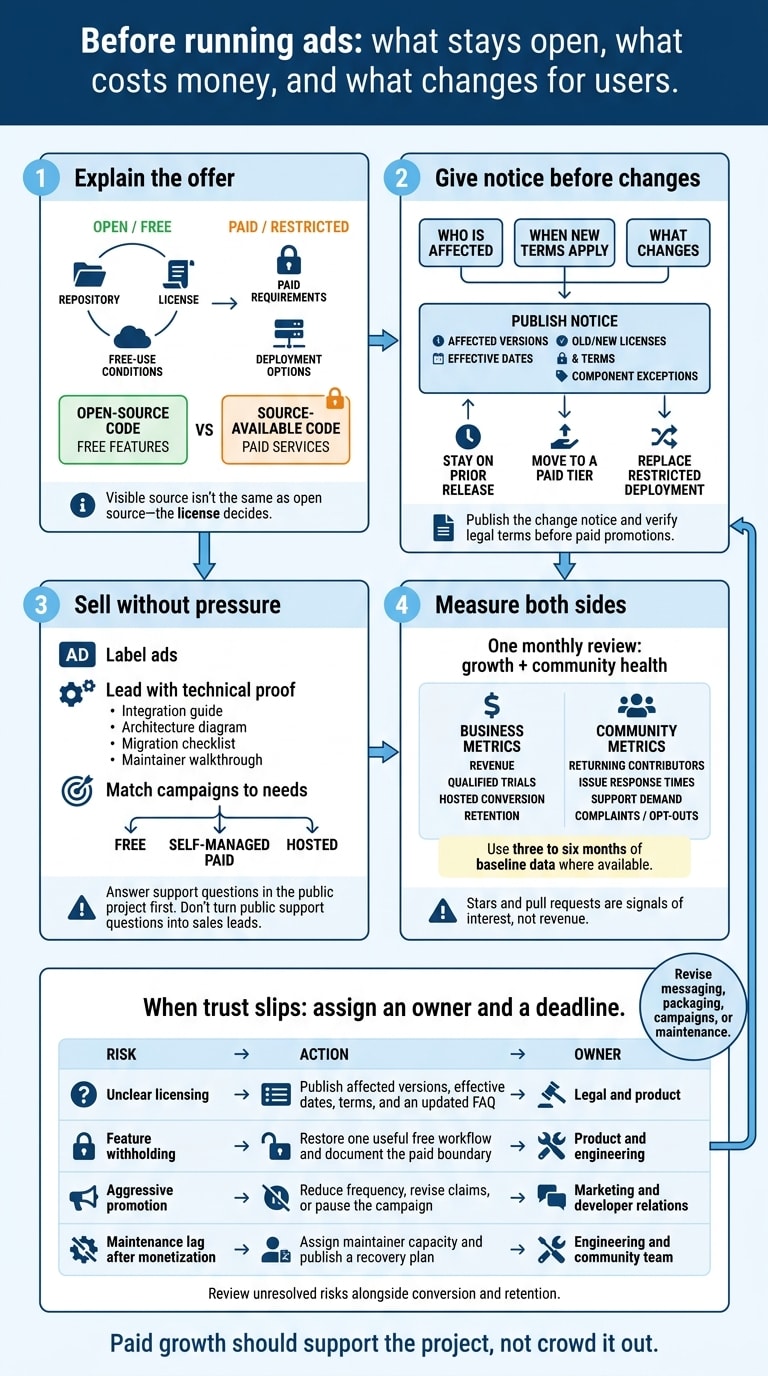
- Explain the offer: Is the buyer paying for features, hosting, or support? Keep the free option visible and useful.
- Give notice before changes: State who is affected, when new terms apply, and how users can stay on an older release or move elsewhere.
- Sell without pressure: Label ads, lead with technical proof, and match campaigns - including daily.dev Ads - to the reader’s needs. Don’t turn public support questions into sales leads.
- Measure both sides: Review revenue, retention, contributor activity, issue response times, complaints, and opt-outs together each month. Use three to six months of baseline data where available.
My rule: paid growth should support the project, not crowd it out. When trust slips, assign an owner and a deadline - then fix the messaging, packaging, or maintenance gap.
Explain what stays open and what costs money
Once you’ve separated the offers, make the boundary public. Map each major component to its repository, license, free-use conditions, paid requirements, and deployment options.
Distinguish open-source code, source-available code, free features, and paid services. Visible source isn’t the same as open source - the license decides. Open-source code requires an OSI-approved license. Link directly to license texts and feature documentation so readers don’t have to guess their rights from marketing copy.
Compare open-source, open-core, and hosted models
A simple comparison helps readers separate licensing, delivery, and support.
| Model | License status | Free and paid features | Deployment responsibility | Support | Governance | Intended users | Revenue sources | Main community risks |
|---|---|---|---|---|---|---|---|---|
| Open source | OSI-approved project license | No paid feature gate; services may cost extra | Self-hosted or company-hosted | Free community support; optional paid support | Transparent governance that welcomes contributions | Developers, teams, companies, redistributors | Hosting, support, consulting, training, donations | Maintainer burnout, underfunding, company control of infrastructure or trademarks |
| Open core | Open-source core; source-available or proprietary additions | Free core; paid security, compliance, administration, or enterprise controls | Self-hosted core; paid features may require a subscription or license key | Community support; paid support and SLAs | Community governance and company control may differ | Developers, teams, organizations needing enterprise controls | Paid tiers, subscriptions, support, hosting | Core stagnation, unclear licenses, previously open features moved behind a paywall |
| Hosted | Open-source, proprietary, or mixed underlying code | Self-hosted project may remain free; paid managed operations | Provider manages infrastructure, upgrades, backups, scaling, and availability | Paid provider support and SLAs | Company-controlled service; separate project governance | Users seeking convenience, reliability, and less infrastructure work | Usage-based hosting, subscriptions, support, add-ons, enterprise contracts | Lock-in, feature disparity, unclear data portability, neglect of self-hosted options |
State what buyers are paying for: features, managed infrastructure, or contractual support.
Connect paid features to customer needs
With the boundary clear, explain the problem each paid feature solves. Put the customer’s problem before the feature.
Role-based access controls help larger organizations manage permissions; audit logs and compliance reports support regulated environments; high availability, backups, and scaling reduce operational work; priority support offers faster response windows.
Document free alternatives and their limits. Publish measurable paid commitments: uptime targets, support response windows, backup policies, and data-export procedures.
Keep the free core useful for real projects. Provide installation instructions, API documentation, security advisories, and an upgrade path.
If you claim subscription revenue funds something, say what it funds - or remove the claim.
Show how GitLab explains its open-core model
GitLab describes its model as open core, with paid capabilities including advanced security, compliance, enterprise planning, and reliability features. Treat this as an example of packaging discipline, not evidence of community endorsement. Recheck license files, tier names, feature availability, and self-managed versus SaaS terms before publication; they can change.
Explain license and packaging changes before advertising
A license change affects trust, not just pricing. Before running paid promotions, publish the change notice and verify the legal terms. Give every open question an owner, a published answer, and a clear path for escalation.
State what changes, who is affected, and when
Use a version-and-user-impact matrix rather than vague claims like “the product is no longer open source.” The matrix should help prevent surprise paywalls, unclear redistribution rights, and broken upgrade paths. Name the old and new licenses or commercial terms, explain what stays free, and spell out separate rules for APIs, SDKs, providers, plugins, libraries, and integrations.
| Area | Clear communication | Unclear communication |
|---|---|---|
| Timing | Gives the effective date, affected versions, and scope for future releases | Says changes are coming soon |
| Scope | Lists affected components and exceptions | Refers only to the platform |
| Rationale | Ties maintenance funding, security, or competitive-service costs to specific commitments | Makes a funding claim without commitments |
| User impact | Details free use, paid restrictions, redistribution rights, and upgrade options | Claims users are unaffected |
| Documentation | Links to license texts, version history, and migration instructions | Links only to the announcement |
| Support | States maintenance periods and security coverage | Leaves support for older versions unclear |
Keep a licensing hub with the announcement, both license texts, a component inventory, version history, FAQs, compatibility guidance, machine-readable license files, notices, and support contacts. Include instructions for staying on a prior release, moving to a paid tier, or replacing a restricted deployment. HashiCorp’s 2023 announcement shows how specific this information needs to be.
Review HashiCorp's August 10, 2023 announcement
On August 10, 2023, HashiCorp announced that future releases of its core products would move from MPL 2.0 to BSL 1.1, while APIs, SDKs, and almost all other libraries would remain under MPL 2.0. Before publication, verify current repository licenses, affected releases, change-of-license dates, additional-use grants, and component exceptions - including Terraform providers - against the latest documentation and FAQs.
Promote paid products without pressuring free users
Once the free and paid boundary is clear, promote the paid tier without suggesting the free project is incomplete. After a license or packaging change, update your messaging to match that boundary. Sell paid help for specific operational needs - not a rescue from the free project. Focus on managed hosting, centralized administration, or support SLAs. Don’t imply that free users are unsafe or irresponsible.
Label commercial content in documentation, newsletters, sponsored articles, and events. Disguised ads weaken trust in technical guidance. Keep upgrade prompts out of routine troubleshooting, and separate product announcements from newsletter release notes and tutorials. At events, disclose sponsorship before the session and teach something useful beyond the product demo.
Answer support questions in the public project first. Mention paid help only when it fits the person’s stated need. Don’t scrape issue reports for leads or send unsolicited sales messages.
Lead with technical proof
Back up the offer with technical evidence: an integration guide, architecture diagram, migration checklist, or maintainer walkthrough. For benchmarks, publish versions, configs, data size, hardware, scripts, and limits - not just the result. Link claims to docs, changelogs, and issue threads.
Carry that proof through to the landing page. Clearly distinguish free, self-managed paid, and hosted options. Show the included features, operations, support, and usage terms, making sure they match the disclosed licensing and packaging boundary. Keep the free option visible. Offer a low-pressure next step, such as reading the guide or running the example.
Match daily.dev Ads campaigns to developer needs
Match paid messaging to the channel. Target by interests, seniority, languages, and tools so the resource fits the audience. Send in-feed or post-page clicks to a relevant guide, event, or workflow - not a generic sales page.
Clearly disclose the ad, and keep feature descriptions and licensing terms consistent between the ad and its destination. Targeting can improve relevance, but it can’t guarantee trust.
Track tutorial completions, doc visits, and event attendance alongside complaints and opt-outs. Use engagement and complaint data to spot messaging that feels like a bait-and-switch. Revise campaigns that blur the line between free and paid.
Conclusion: Review growth and community health together
Once campaigns are live, check whether growth is helping the project - not just filling the pipeline. Review revenue and community health in the same monthly meeting, with marketing, sales, product, support, engineering, and community leadership.
Track business results and project health
Use one monthly scorecard to track developer reach, documentation visits, qualified trials, hosted conversion, and retention alongside returning contributors, issue response times, support demand, and community reaction. Record three to six months of baseline data where available.
Changes in participation, response times, and community reaction can show whether monetization is hurting the project’s reputation. Treat stars and pull requests as signals of interest, not revenue. Check changes by edition, channel, and release before crediting - or blaming - a campaign.
GitLab said nearly 900 people submitted more than 3,000 merge requests to its core product in 2024.
Track both contributors and merged work, rather than relying on raw activity counts alone.
Assign fixes for community trust risks
Act on those signals. Give each trust risk one accountable owner, a deadline, and the evidence needed to close it. Review unresolved risks alongside conversion and retention. Strong sales shouldn’t excuse a growing maintenance backlog.
| Trust risk | Corrective action | Responsible team | Evidence to monitor |
|---|---|---|---|
| Unclear licensing | Publish affected versions, effective dates, terms, and an updated FAQ | Legal and product | Repeated licensing questions; community reaction |
| Feature withholding | Restore one useful free workflow and document the paid boundary | Product and engineering | Setup success; free adoption; contributor feedback |
| Aggressive promotion | Reduce frequency, revise claims, or pause the campaign | Marketing and developer relations | Complaints; opt-outs; qualified trial activation |
| Maintenance lag after monetization | Assign maintainer capacity and publish a recovery plan | Engineering and community team | Issue age; review times; release cadence |
Give the review group authority to change messaging, packaging, campaign frequency, or maintenance funding.
FAQs
How do we decide which features should stay free?
Build community trust without sacrificing long-term growth. Keep core functionality free so individual developers get a high-quality tool that solves a specific workflow problem - not a stripped-down version. Reserve paid tiers for enterprise needs, such as advanced security, compliance, support, and managed infrastructure.
This approach gives users room to upgrade as their needs grow. Explain paid offerings clearly, and avoid misleading “free forever” claims.
How much notice should we give before a license change?
Give users as much advance notice as possible to help maintain community trust. The timing depends on the scale of the change. Explain why you’re making it before it takes effect, and avoid sudden shifts that catch users off guard.
Treat the community as partners. Share how you reached your decision, acknowledge how the change may affect users, and invite honest, two-way conversation. Keep users informed and respected throughout the transition.
When should community backlash make us pause paid ads?
Pause paid ads when repeated negative feedback suggests your messaging or pricing has damaged community trust. Pay attention when people say your ads feel fake, too polished, or out of step with what the community cares about.
Keeping ads running despite that feedback can drive customers away, hurt your reputation, and limit long-term growth. Put transparency and community sentiment ahead of immediate reach.