

I’d start with 1 book and 1 newsletter - not a long reading list. Pick resources that help you solve a current problem, then apply a lesson to your messaging, a tutorial, or developer onboarding.
Here’s how I’d choose:
- Books: Adam DuVander’s books for positioning and technical content; SlashData, Caroline Lewko and James Parton, and Mary Thengvall for audience research and developer programs; Ask Your Developer and Working in Public for developer and maintainer perspectives.
- Newsletters and guides: Developer Markepear, Newslepear, DevRel Weekly, DeveloperRelations.com, and EveryDeveloper for tactics, examples, and technical content.
- Podcasts: Changelog for how developers talk about tools and tradeoffs.
- Communities and lists: Developer Marketing Community, Developer Marketing Alliance, Awesome Developer Marketing, and Awesome Dev Marketing for peer feedback, courses, and resource discovery.
- Direct guidance: Draft.dev, Zach Goldie, and the daily.dev agency program as starting points when you need help with content or positioning.
My rule: choose by the task, not the format. Check activity and access before joining or subscribing, and measure what you change - for example, how long developers take to run their first working example.
Books to learn developer marketing
Developer Marketing and Relations vs. Developer Relations
Use SlashData to research developer audiences and adoption trends . Turn to Caroline Lewko and James Parton for program design and day-to-day management.
| Book | Primary focus | Ideal reader | Practical use |
|---|---|---|---|
| Developer Marketing and Relations: The Essential Guide - SlashData | Developer audiences and adoption trends | Marketers who need research to guide strategy | Test audience assumptions against developer research |
| Developer Relations: How to Build and Grow a Successful Developer Program - Caroline Lewko and James Parton | Developer program planning and management | People building or managing a developer program | Organize the work behind a developer program |
The books approach strategy from two angles: understanding your audience and running your program.
The Business Value of Developer Relations, Ask Your Developer, and Working in Public
Mary Thengvall’s The Business Value of Developer Relations covers business value, trust, and alignment across teams . It’s a practitioner reference for explaining how developer relations supports the business.
Jeff Lawson’s Ask Your Developer examines developers’ role in product and business decisions. Nadia Eghbal’s Working in Public looks at open-source communities and maintainer needs. Together, they help you understand how developers make decisions and what maintainers prioritize.
For hands-on guidance on positioning and technical content, turn to the next two books.
Adam DuVander’s books on positioning and technical content
Developer Marketing Does Not Exist: An Authentic Guide puts helpful, sincere engagement ahead of promotional tactics . Technical Content Strategy Decoded covers technical content planning and signature content, including ways to address the “we can build this ourselves” objection .
| Book | Main contribution | Best for | Practical application |
|---|---|---|---|
| Developer Marketing Does Not Exist: An Authentic Guide | Sincere engagement and a non-promotional approach | Founders and marketers building developer-focused businesses | Replace promotional claims with helpful tutorials, guides, and blog posts |
| Technical Content Strategy Decoded | Technical content planning and signature content | Teams struggling with the build-it-yourself objection | Explain implementation, maintenance, and support costs - not just product features |
For current tactics and practitioner commentary, move next to newsletters, blogs, and podcasts.
Newsletters, blogs, and podcasts to follow
Books give you deeper frameworks. These feeds help you stay current on how developers discover, evaluate, and adopt tools.
Developer Markepear, Newslepear, and DevRel Weekly
Developer Markepear is a resource hub for dev tool founders and marketers. Its weekly newsletter, Newslepear, is curated by Jakub Czakon. DevRel Weekly shares curated reading on developer relations.
| Publication | Editorial focus | Ideal reader | Starting article or issue |
|---|---|---|---|
| Developer Markepear | Practical advice on developer tool discovery and evaluation | Dev tool founders and marketers | Developer marketing guide (by a dev tool startup CMO) |
| Newslepear | Curated developer marketing resources | Practitioners seeking current tactics for discovery and adoption | Start with the guide, then browse the newsletter |
| DevRel Weekly | Curated reading on developer relations | Marketers learning how DevRel supports adoption | Browse the official archive |
When you need a structured reference rather than weekly updates, turn to a topic-based guide library.
DeveloperRelations.com guides
DeveloperRelations.com offers structured learning on developer journeys, advocacy, enablement, community planning, and measurement.
For small teams, map discovery → evaluation → onboarding → adoption. Remove friction at each step, from documentation and a sandbox to the first successful example and regular use. Track time to first hello world to see how long developers take to reach that first milestone.
Changelog podcasts on developers and their work
Podcasts add context beyond marketing by letting you hear how developers discuss tools and tradeoffs.
Use Changelog’s official podcast archive for firsthand context on developer needs and tool evaluation. Pull out the language they use, the objections they mention, and the workflow details that can help you improve your documentation and messaging.
Communities and resource lists for peer learning
These sources show how practitioners share tactics, resources, and feedback from hands-on work.
Developer Marketing Community and practitioner groups
Developer Marketing Community is a private Slack group where members swap go-to-market playbooks for developer tools. Check its access rules before joining. Do the same for Developer Marketing Alliance, which offers certification, templates, and networking.
Use marketer-specific groups to learn from peers. In technical communities, listen first. On Slack, Discord, and Reddit, ask focused questions, share useful findings, and skip unsolicited promotion.
Awesome Developer Marketing and Awesome Dev Marketing
Start with what you want to learn, then follow links to the original sources. Inclusion is not an endorsement. Check recent commits and confirm each resource’s availability, author, and technical depth.
| Repository | Verified coverage | Organization | Best use | Verification requirement |
|---|---|---|---|---|
| Awesome Developer Marketing | Community-curated tools and content | daily.dev | Finding resources to investigate | Check commit and pull-request activity; verify linked sources |
| Awesome Dev Marketing | Broad directory of developer marketing resources | Marketinguys | Browsing resource categories | Check original sources and cross-reference practitioner guidance |
When curated lists and self-serve resources leave you stuck, turn to named practitioners for more direct guidance.
Learning from agencies and consultants
Start with practitioner-led guidance. Specialist firms such as Draft.dev and consultants such as Zach Goldie can help you learn about technical content and positioning. Look for named authors, technical detail, and honest tradeoffs - not vague promises.
This guidance may help when your positioning is still unclear or your team needs a workable technical-content plan. The daily.dev agency program is another place to start your research. It’s not an endorsement of services or a suggestion that the authors mentioned here are members.
Conclusion: Plan your developer marketing learning
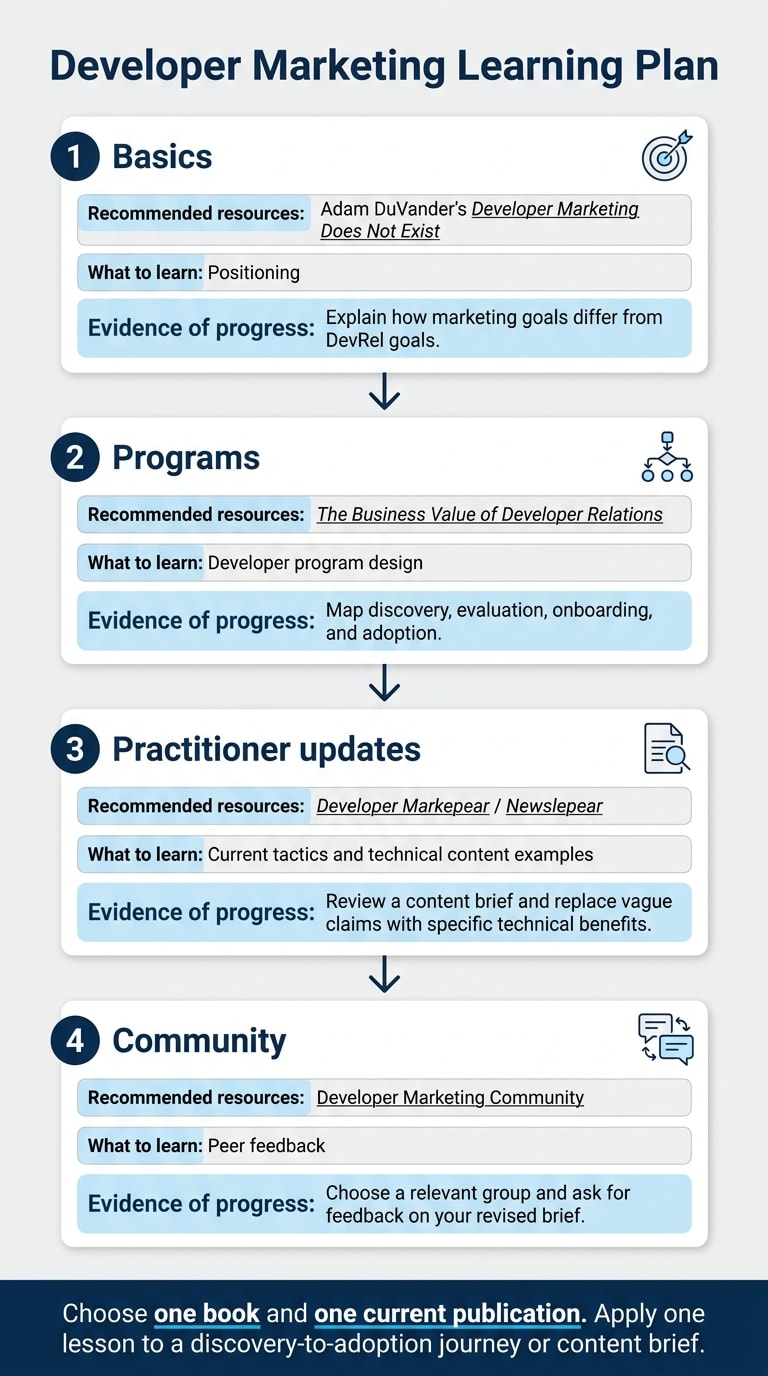
Start with positioning. Then learn how to design developer programs and use current practitioner tactics.
Put your learning into practice
Follow this sequence to turn the roundup into a simple learning plan.
| Stage | Recommended resources | What to learn | Evidence of progress |
|---|---|---|---|
| Basics | Adam DuVander’s Developer Marketing Does Not Exist | Positioning | Explain how marketing goals differ from DevRel goals. |
| Programs | The Business Value of Developer Relations | Developer program design | Map discovery, evaluation, onboarding, and adoption. |
| Practitioner updates | Developer Markepear / Newslepear | Current tactics and technical content examples | Review a content brief and replace vague claims with specific technical benefits. |
| Community | Developer Marketing Community | Peer feedback | Choose a relevant group and ask for feedback on your revised brief. |
Choose one book and one current publication. Apply one lesson to a discovery-to-adoption journey or content brief.
FAQs
Do I need coding skills to learn developer marketing?
You don’t need to be a software engineer to get started, but coding skills matter more and more for success. Start with positioning, content strategy, and community engagement, then build your comfort with code.
That comfort helps you work faster, build prototypes, and earn the trust of engineers and technical audiences. AI tools like Cursor and GitHub Copilot can make learning those skills easier.
How does developer marketing differ from DevRel?
Developer marketing and developer relations (DevRel) both help developers succeed, but they focus on different outcomes. Developer marketing drives business results and demand through positioning, messaging, campaigns, and content planning.
DevRel builds trust and community through advocacy, documentation, developer experience, and feedback loops. It connects the company with developers, helping both sides understand each other and building confidence in the company’s technical expertise.
How can I practice developer marketing without a budget?
Focus on organic strategies that offer technical value, not standard advertising. Build relationships by helping people in communities like Reddit, Discord, or Slack. Aim to give nine times for every ask.
Write tutorials, guides, or deep dives that solve real problems. Share them where your audience spends time, such as Dev.to or Hacker News. Build trust by contributing helpful integrations or pull requests to popular open-source repositories.