




Product use is not permission for a sales call. Marketing and sales should agree on what shows product value, what counts as buying intent, and which contact preferences allow follow-up. An SDK install may show evaluation; a request for procurement help calls for a buying-support response.
A clear handoff agreement should cover:
- Lead rules: Keep product qualification, buying role, and sales readiness separate.
- Routing: Send buying requests to the right owner, keep support requests with support, and honor contact restrictions.
- Context: Pass along the technical need, account details, prior interactions, and a response deadline.
- Measurement: Track accepted leads, opportunities, revenue, retention, and unwanted contact - not just signups. Compare results over consistent windows, such as 30, 90, and 180 days.
- Policy checks: Test routing before launch, review returned leads, and update the agreement quarterly.
The goal is simple: help developers evaluate the tool without unwanted outreach, and connect buyers with help when they request it.
2. Define lead stages and sales readiness
Turn the evaluation and buying-role fields into shared stage rules. Give each stage one entry rule and one owner. MQL and PQL are different signals - not required steps in a sequence.
| Stage | Entry criteria | Owner |
|---|---|---|
| Inquiry | Identifiable interest | Marketing ops |
| Marketing-qualified lead (MQL) | Agreed audience fit plus repeated engagement with technical content | Marketing |
| Product-qualified lead (PQL) | A user or account reaches a proven product-value milestone | Growth |
| Sales-accepted lead (SAL) | Sales accepts the handoff, names an owner, and takes responsibility for the next action | Sales rep |
| Sales-qualified lead (SQL) | Sales confirms a relevant need, buying stakeholders, workable timing, and an agreed next step | Sales |
| Opportunity | A commercial evaluation has a defined use case, stakeholders, next step, and a realistic path to purchase | Account executive |
Identify product usage that shows value
Choose milestones that show users are getting value from the product.
Examples include completed integration, repeated core-feature use, or team adoption.
A signup alone does not make someone a PQL. Track individual PQLs separately from account PQLs so one person's activity doesn't look like account adoption.
Test each threshold against historical cohorts. Compare later paid conversion, retention, and requests for buying assistance between accounts that reached the milestone and those that didn't. Use the same observation window for both groups, based on your buying cycle - not a universal usage threshold borrowed from elsewhere.
Confirm buying intent before a sales handoff
A PQL has experienced product value, but that doesn't mean they've asked to speak with sales. Pair account fit with a clear request for a demo, procurement support, a security review, or implementation help. If someone makes a genuine buying request, don't make them complete extra product steps before responding.
Keep these three paths separate:
- Self-serve conversion: Growth owns the path when no human help is requested.
- Sales assistance: Sales or a technical owner takes over when buying help is requested.
- Account review: Growth or revenue ops monitors the account when adoption is strong but intent is unclear.
For each path, record the next action, response-time SLA, and exit condition. Base routing rules and ownership on these shared definitions, and keep account review separate from a sales-call trigger.
3. Set routing rules and prevent unwanted sales calls
Use the lead-stage rules above to decide which leads belong with sales - and which don’t.
Route leads by intent, fit, and contact preference
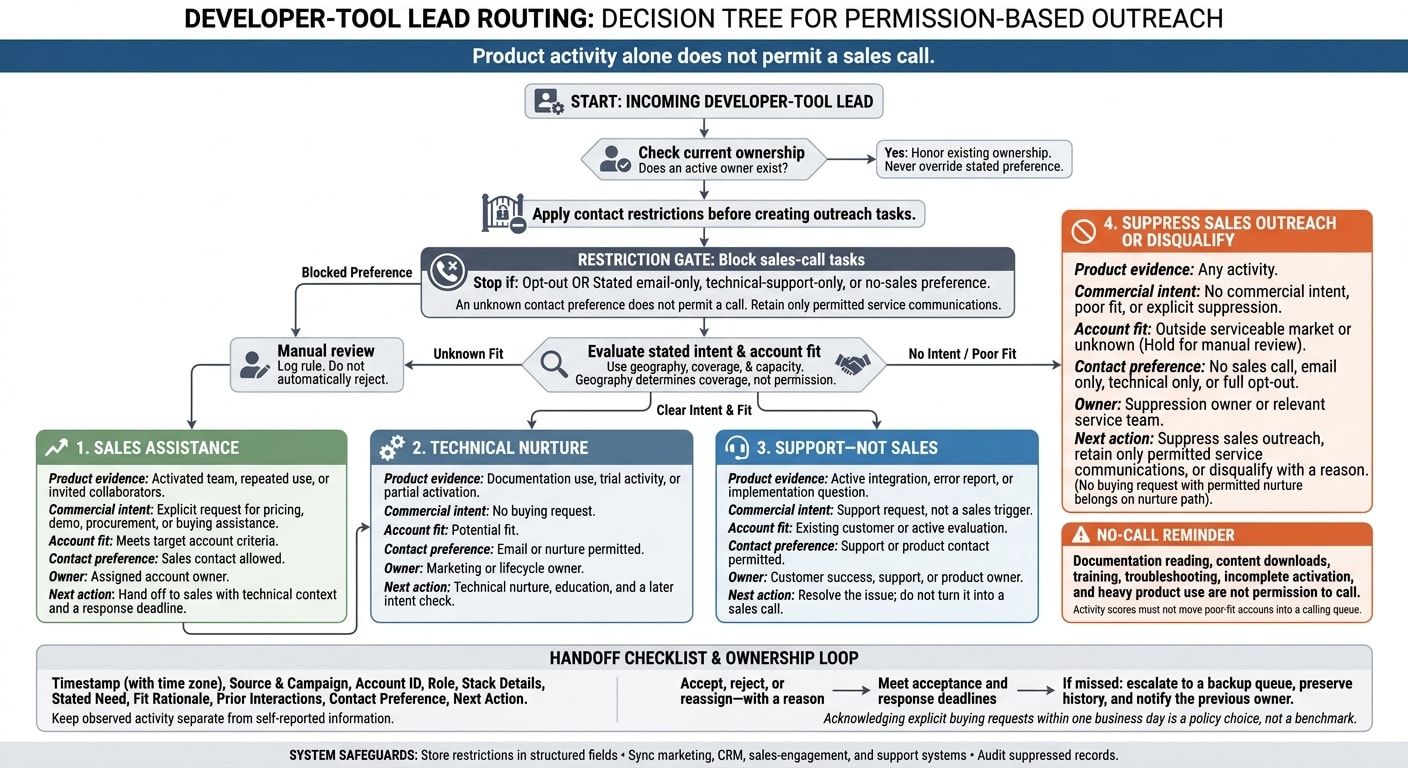
Route leads to sales only when they show a buying signal. Check current ownership first, then apply contact restrictions before creating outreach tasks. Base routing on stated intent, account fit, geography, specialist coverage, and team capacity. Product activity alone does not permit a sales call. Log the rule behind each assignment.
| Product evidence | Commercial intent | Account fit | Contact preference | Owner | Next action |
|---|---|---|---|---|---|
| Activated team, repeated use, or invited collaborators | Explicit request for pricing, demo, procurement, or buying assistance | Meets target account criteria | Sales contact allowed | Assigned account owner | Hand off to sales with technical context and a response deadline |
| Documentation use, trial activity, or partial activation | No buying request | Potential fit | Email or nurture permitted | Marketing or lifecycle owner | Technical nurture, education, and a later intent check |
| Active integration, error report, or implementation question | Support request, not a sales trigger | Existing customer or active evaluation | Support or product contact permitted | Customer success, support, or product owner | Resolve the issue; do not turn it into a sales call |
| Any activity | No commercial intent, poor fit, or explicit suppression | Outside serviceable market or unknown | No sales call, email only, technical only, or full opt-out | Suppression owner or relevant service team | Suppress sales outreach, retain only permitted service communications, or disqualify with a reason |
Use geography to select coverage and a reasonable contact window - not to override preferences. Send accounts with unknown fit to manual review rather than rejecting them automatically. An unknown contact preference does not permit a call, and existing ownership never overrides a stated preference.
Set rules for when developers must not receive sales calls
Block sales-call tasks after an opt-out or a stated email-only, technical-support-only, or no-sales preference. Reading documentation, downloading content, attending training, troubleshooting, leaving activation incomplete, or using the product heavily is not permission to call. Activity scores must not move poor-fit accounts into a calling queue.
Store restrictions in structured fields, not just notes. Sync them across marketing, CRM, sales-engagement, and support systems. Keep marketing opt-outs separate from permission to respond to a requested service interaction. Audit suppressed records so a later campaign cannot restart unwanted outreach.
Assign an owner and pass on technical context
Require a timestamp with time zone, source and campaign, account ID, role, stack details, stated need, fit rationale, prior interactions, contact preference, and next action. Keep observed activity separate from self-reported information.
Set acceptance and response deadlines. Acknowledging explicit buying requests within one business day is a policy choice, not a benchmark. Require the owner to accept, reject, or reassign the lead, with a reason such as a support issue, existing owner, or location outside the covered geography. When a deadline is missed, escalate to a backup queue, preserve the history, and notify the previous owner.
Track routing accuracy, response speed, and handoff quality in the next section.
4. Measure acquisition and handoff results together
Use one funnel: acquisition → activation → PQL → sales acceptance → opportunity → customer. Sales acceptance means a seller has reviewed the lead and committed to follow-up. An opportunity requires a documented business problem, buying process, and next step.
Report counts alongside rates, and keep account, person, and opportunity metrics separate. This shows whether the routing rules above send the right leads to sales - and keep teams aligned after the handoff, not just before it.
Track conversions, response times, and routing errors
Show the denominator beside every conversion rate: activation-to-PQL, PQL-to-sales acceptance, sales acceptance-to-opportunity, opportunity-to-customer, and PQL-to-customer. Track acquisition cohorts over consistent windows, such as 30, 90, and 180 days. Label incomplete windows rather than comparing them with older cohorts.
Measure trigger-to-acceptance and acceptance-to-human-response times using the median and 90th percentile. Count a meaningful response as a relevant human reply, not an automated acknowledgment.
Review returned leads, unwanted contact, false positives, and missed buying intent weekly. Log each error’s cause, owner, and correction date. Break results down by source, role, company size, and use case only when sample sizes support comparison.
Once you measure the funnel consistently, connect the results to campaign source.
Connect campaign results to lead quality
daily.dev Ads supports targeting by tech stack, seniority, geography, and interests. Use these dimensions for acquisition targeting only.
Carry campaign, audience, creative, and landing-page IDs through product analytics and sales reporting. Follow each campaign cohort through activation, PQLs, opportunities, and customers. In monthly or quarterly reviews, assess engagement and pipeline separately. Pair impressions, clicks, and signups with downstream conversion rates and spend where available.
If PQL volume grows but opportunity conversion falls, check cohort age, qualification rules, technical context, and sales capacity before changing budgets or source allocation. Marketing supplies acquisition context, product validates activation, and sales validates commercial progression. Use those inputs to base spending decisions on downstream lead and handoff quality.
5. Conclusion: Put the handoff agreement into practice
Once the routing and measurement rules above are in place, use this seven-point handoff checklist:
- Product value confirmed
- Buyer role confirmed
- Intent threshold met
- Contact preference honored
- Owner assigned
- Context documented
- Outcome measured
Measure accepted leads, opportunities, revenue, retention, and suppressed contacts - not lead volume.
Launch, test, and update the policy
Start with a cross-functional launch review. Get sign-off from marketing, sales, product, customer success, and revenue operations. Each team should check its own rules:
- Marketing: Confirm attribution, qualification, and suppression rules.
- Sales: Confirm buying-intent thresholds and service levels.
- Product: Verify value events.
- Customer success: Block prospecting on customer accounts and confirm ownership rules.
- Revenue operations: Test CRM fields, automation, reporting, and fallback queues.
Assign a policy owner and backup so leads don’t stall.
Before launch, test routing and suppression in a controlled queue. Include no-call contacts, duplicates, existing customers, missing account matches, and unavailable owners. Hold unclear records for human review.
Run a pilot. Review accepted and returned leads weekly during launch, then monthly afterward. Every returned lead must include a reason and a next owner.
Give the agreement an effective date, version number, change log, and next review date. Review it quarterly and whenever product behavior, pricing models, or target accounts change. Re-test affected routing and suppression rules before releasing revisions.
If acquisition planning is your next priority, you can discuss developer acquisition with daily.dev Ads using the same lead-quality standards.
FAQs
How do we define PQLs without historical data?
When you don’t have historical data, define Product-Qualified Leads (PQLs) around one observable “aha moment” - a clear sign that a developer has gotten value from the product. Before launch, agree on a measurable action: a successful API request, a completed deployment, or a defined usage threshold.
Only qualify accounts as PQLs and hand them to sales after they reach that milestone. Give sales context about each account’s technical progress, not just a lead score.
How should we handle conflicting contact preferences within an account?
Put the developer’s self-service experience first. Respect individual opt-outs. During evaluation, guide developers through the product with quickstarts and docs - not sales outreach. Call a technical champion only after they cross a predefined activation threshold that signals purchase intent.
Once a lead qualifies, give sales the evaluation context: activated features, use case, integration stage, and remaining technical blockers. That way, outreach addresses what the developer needs instead of delivering a generic pitch.
How can we tell whether sales assistance improves conversion?
Choose a primary activation event, such as the first successful API call, deploy, or build. Use a conversion pixel to tie that event back to ad placements. Then run an incrementality test: split comparable product-qualified leads (PQLs) between sales assistance and a holdout group that receives no assistance.
Compare activation rates and downstream qualified leads, not just clicks or signups. If sales assistance increases volume without improving activation, that doesn’t count as better conversion.