



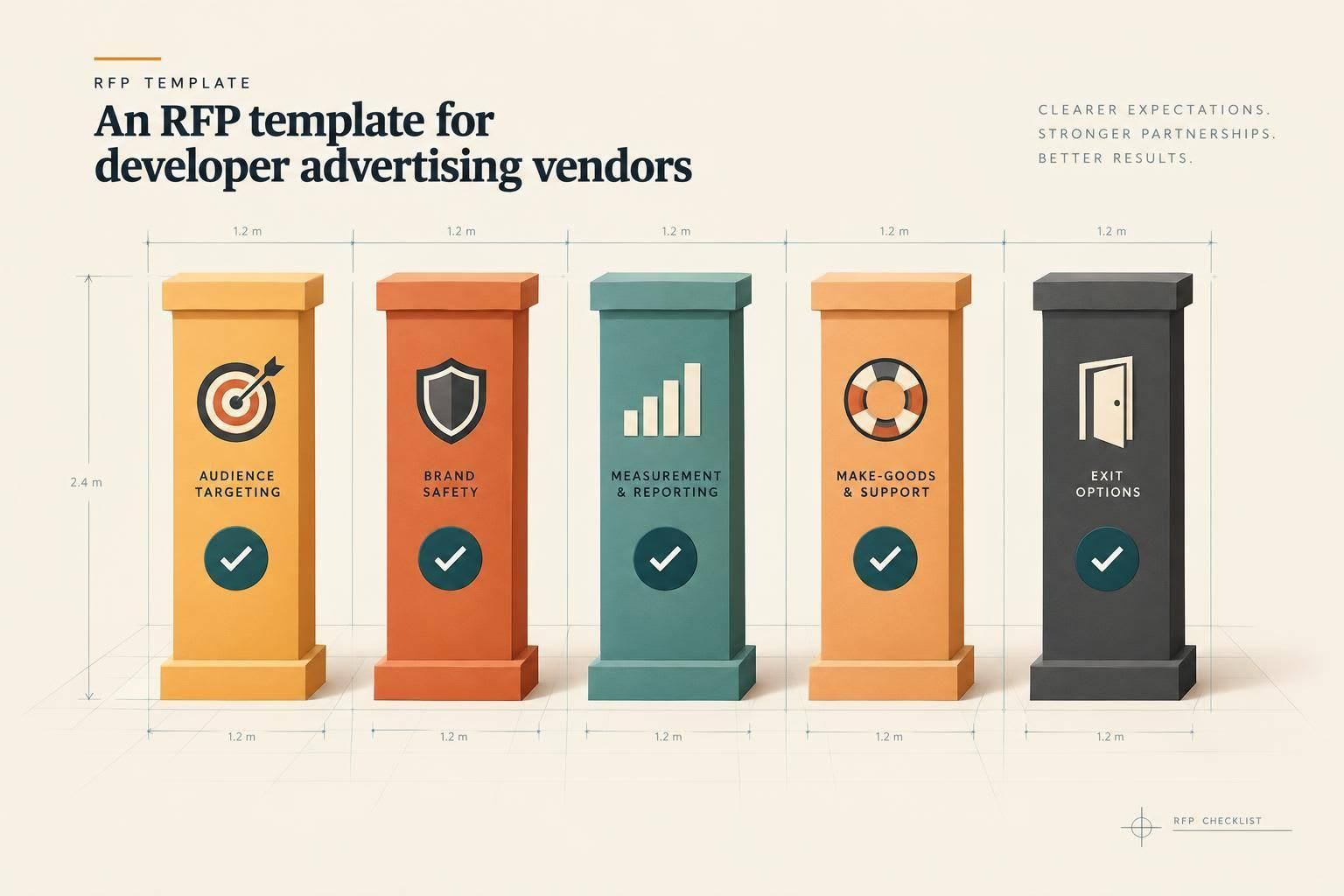
I use a developer advertising RFP to get written commitments before approving spend. Start with 1 primary goal, define success, and require answers across these areas:
- Audience and inventory: Who you’ll reach, how targeting works, and where ads will appear.
- Formats and delivery: Ad requirements, launch approvals, placement commitments, and any guaranteed impressions or reads.
- Safety and moderation: Content exclusions, rules for user responses, and incident contacts with response deadlines.
- Measurement: Metric definitions, attribution limits, tracking tests, reporting dates, and data access.
- Contract terms: Remedies for missed delivery, cancellation rights, data ownership, and renewal rules.
- Vendor checks: Customer references, supporting records, and an owner for each unresolved requirement.
My approval rule: every mandatory requirement must pass before launch. Past results can inform the choice, but they’re not a delivery promise.
2. Set brand safety and UGC requirements
Review content policies and moderation
Request the vendor’s current policies for your daily.dev Ads campaign. Treat brand safety and brand suitability as separate requirements. Ask which prohibited and restricted categories apply, then document campaign-specific exclusions for political content, controversial social issues, competitor mentions, adult language, and minors. Get written answers to each requirement, line by line.
Next, map where user-generated content (UGC) can appear around each ad format. Cover feed posts, comments, reactions, tag or topic pages, newsletters, and any verified partner publishers.
Have the vendor document supported exclusions for topics, keywords, domains, geography, and audience segments. For each control, confirm whether it uses exact matching, semantic matching, context, or manual review - and whether it applies before, during, or after delivery.
For engagement features connected to the ad, ask how comments, reactions, replies, and other responses are moderated. Confirm who can post, whether comments can be disabled, how abusive or unsafe responses are flagged, and what limits still apply.
Agree on incident handling and policy notices
Once the policy rules are set, define what happens when live content breaks them.
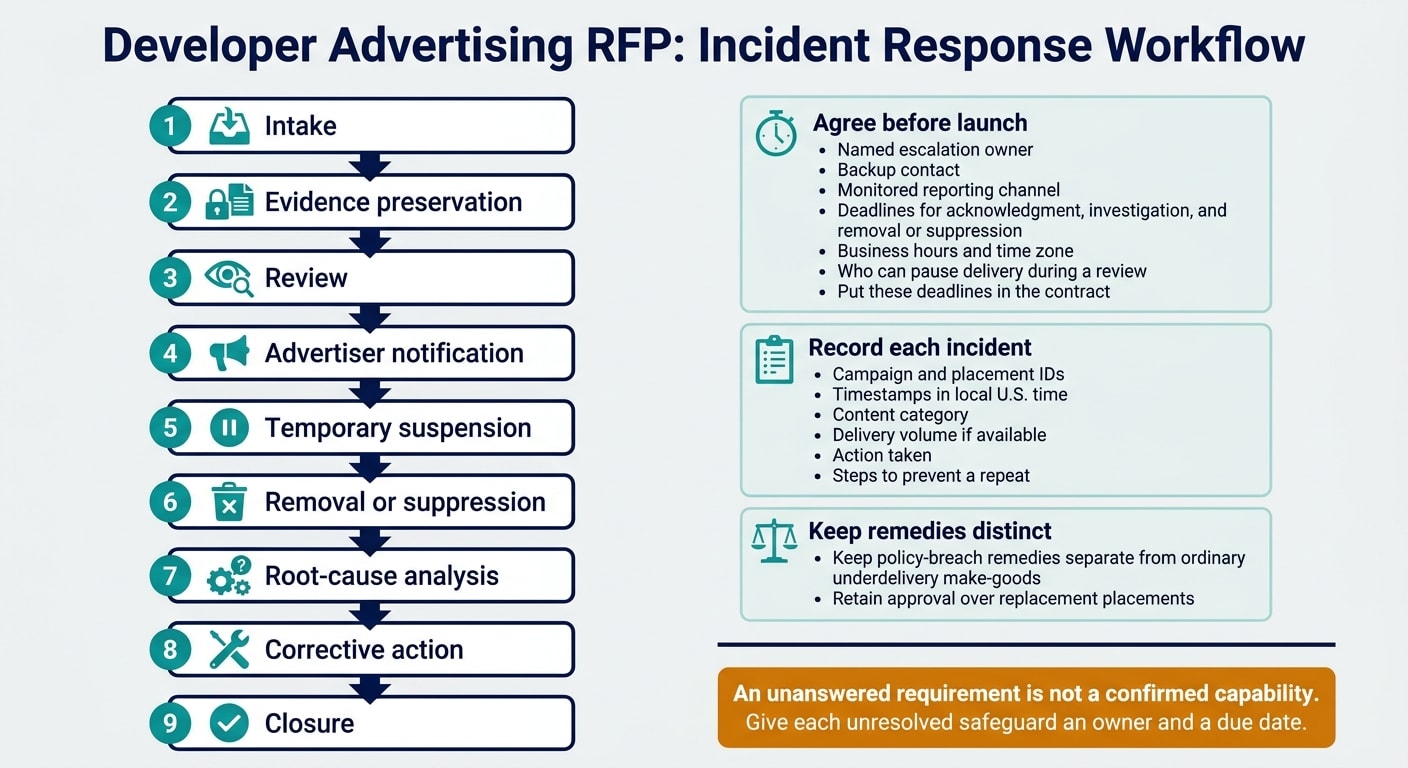
Require a named escalation owner, a backup contact, and a monitored reporting channel. Set deadlines for acknowledgment, investigation, and removal or suppression. State business hours and the time zone, and confirm who can pause delivery during a review. Put these deadlines in the contract.
Get a written workflow for live campaign incidents that covers intake, evidence preservation, review, advertiser notification, temporary suspension, removal or suppression, root-cause analysis, corrective action, and closure.
Each incident record should include campaign and placement IDs, timestamps in local U.S. time, the content category, delivery volume if available, action taken, and steps to prevent a repeat. Keep policy-breach remedies separate from ordinary underdelivery make-goods, and retain approval over replacement placements. Use the rate cards and make-goods guide as a negotiation framework.
Agree on written notice for material changes to moderation, inventory eligibility, or policies. Specify advance notice for planned changes, urgent-notice procedures, and your right to pause affected placements. Track gaps with the developer ad platform evaluation checklist. An unanswered requirement is not a confirmed capability. Give each unresolved safeguard an owner and a due date.
3. Define measurement, attribution, and reporting
Define metrics and attribution rules
Once format and policy approvals are in place, lock measurement definitions before launch. Require a written metric dictionary that states each metric’s counting rule, denominator, reporting source, duplicate handling, and invalid-traffic exclusions.
For Sponsored Post, document guaranteed feed impressions separately from the read-floor commitment. Define what counts as a read and how canonical republishing is counted. Keep delivery obligations separate from optimization signals and outcomes, such as signups and pipeline.
Name the primary business outcome that defines success, then identify the supporting signals used only for diagnosis. Specify attribution models, click-through and view-through windows, cross-device handling, and deduplication across campaign reports, analytics, and CRM. Confirm supported integrations and export options, and name owners for implementation and QA. Before launch, require approved UTM parameters, a validated test conversion, and a reconciliation check. Attribution credit is a measurement output - not proof of causation.
Confirm how consent choices, blocked cookies, browser restrictions, and missing identifiers affect conversion visibility. Require disclosure of collected fields, retention periods, and measurement gaps by browser, device, or geography, where available. Reports must separate observed, modeled, and unattributed conversions. Label unavailable data clearly rather than treating it as zero.
Set reporting schedules and owners
Require sample launch, weekly, and final reports, along with CSV exports. Confirm which breakdowns are available by date, campaign, ad, format, audience, geography, placement, and device. Reports should have separate fields for delivery commitments, pacing, engagement, conversions, spend, and tracking limitations.
Assign primary and backup owners for reporting, pacing, optimization, and troubleshooting. Name who approves changes, and confirm whether custom reporting or integrations cost extra.
Put explicit calendar dates, data cutoffs, delivery deadlines, correction deadlines, and a final data-lock date in the agreement. Agree on a U.S. time zone and en-US formatting: comma-separated thousands, decimal points, dollar signs, and stated percentage rounding. Define how current the data must be; don’t accept “real-time” without a definition.
Set an authoritative source for each metric, a discrepancy threshold, and an investigation deadline. Require versioned corrections that show the reason for the change, the affected period, and both original and revised values. Use these definitions to judge underdelivery and make-goods in the next section.
4. Agree on make-goods and exit terms
Once measurement terms are set, turn delivery promises into enforceable remedy and exit clauses.
Define underdelivery and make-good terms
Spell out what counts as a missed impression total, read-floor target, placement, or delivery date. Include any agreed audience or topic track. Tie remedies to the written delivery commitment - not downstream results.
Require notice as soon as a shortfall looks likely. That notice should explain the cause, expected shortfall, corrective action, and deadline for the buyer’s decision.
Require written approval for replacement delivery, extensions, or rescheduled sponsorships. If a replacement changes the targeting, format, topic, or timing, get buyer approval before accepting it. Set a credit or refund process for cases where no acceptable replacement is available. Don’t accept open-ended extensions.
Ask for sample remedy language and a closeout summary that shows shortfalls, accepted remedies, and final status by format and date. Assign responsibility separately for tracking failures, invalid traffic, and advertiser-caused delays. Use the negotiation and make-goods checklist to draft these clauses.
Confirm cancellation, data ownership, and renewal
Next, settle the exit terms. Ask for separate notice periods for pre-launch cancellation, in-flight cancellation, rescheduling, pauses, and renewal. Define termination rights for repeated underdelivery, material breach, repeated brand-safety failure, and unlawful data use.
Document what happens to reserved dates, unfinished Sponsored Post materials, production work already commissioned, and unresolved remedies. Require affirmative approval for renewal unless you accept automatic renewal with a clear opt-out deadline.
Address ownership separately for buyer-supplied creative, commissioned content, campaign reports, and raw audience data. Set deadlines for final exports, record return or deletion, and deletion confirmation, subject to privacy limits.
Include confidentiality and security duties that remain in effect after termination. Require written permission before anyone publishes your name, logo, creative, or campaign performance data. That approval must cover the exact claims, metrics, and channels.
5. Check evidence and complete the RFP
Check references and supporting evidence
Once you’ve defined targeting, safety, measurement, and remedies, check whether references support those commitments. Request published customer stories that match your objective, including campaign dates, audience, format, metric definitions, and limits. Ask whether customers who have agreed to serve as references can verify reporting quality, approval workflows, and responsiveness.
Historical results are not delivery commitments. For a 2026 campaign, confirm that the evidence is current and fits your audience and policy requirements.
Review submissions against acceptance criteria
Use the acceptance criteria from earlier sections for this final approval check. The developer ad platform evaluation checklist can help you confirm that each mandatory requirement has evidence, an owner, and a written exception if it remains unmet.
| Review status | Required action | Approval rule |
|---|---|---|
| Pass | Attach supporting evidence and name the accountable owner. | Approve. |
| Needs clarification | Record the missing answer, owner, and deadline. | Keep open. |
| Fail | Document the unmet requirement and buyer’s decision. | Block approval if mandatory. |
Score preferences only after all mandatory requirements pass. Keep assumptions and deviations in the approval record - not buried in email threads.
Confirm open requirements before launch
Assign an owner and deadline for tracking parameters, conversion events, ad approval, privacy checks, reporting access, brand-safety controls, and the UGC escalation path. Don’t mark the RFP launch-ready if an open issue could change delivery, measurement, or remedies.
If anything still needs confirmation, discuss the completed brief with daily.dev Ads before authorizing spend.
FAQs
Which RFP requirements should be mandatory for my campaign?
For daily.dev Ads in 2026, require written terms that separate guaranteed deliverables from non-guaranteed metrics. Include Sponsored Post minimum-read commitments, audience targeting parameters, conversion-pixel tracking, and defined attribution terms.
The agreement should also specify brand safety standards, invalid-traffic filtering, and privacy protections for tracking and reporting. Require monthly reports and a wrap report within 10 business days of campaign completion, with feed impressions reported separately from guaranteed reads.
Require prompt notice of any expected underdelivery. Allow an extension of up to 30 days to meet the commitments, followed by make-good placements and credits for any remaining shortfalls.
How can I measure success with limited conversion tracking?
Measure outcomes beyond clicks. Use a conversion pixel to attribute signups and activations, including view-through conversions that show impact even when someone doesn’t click right away.
For Sponsored Post, use the read-floor commitment to confirm engagement. For Engagement Ads, track category coverage and follow-on actions, such as branded searches or profile follows.
Use incrementality tests or holdout studies to check whether the ads drive adoption, rather than relying only on platform-reported metrics.
How do I set fair make-good terms for a pilot campaign?
Set make-good terms in your insertion order before the pilot campaign goes live. For guaranteed deliverables, such as a Sponsored Post’s read-floor commitment, standard practice is that you don’t pay for guaranteed volume that isn’t delivered.
Review the full advertising terms and conditions so both sides know what to expect. For help structuring the agreement, see our resource on negotiating developer media sponsorships, rate cards, and make-goods.