
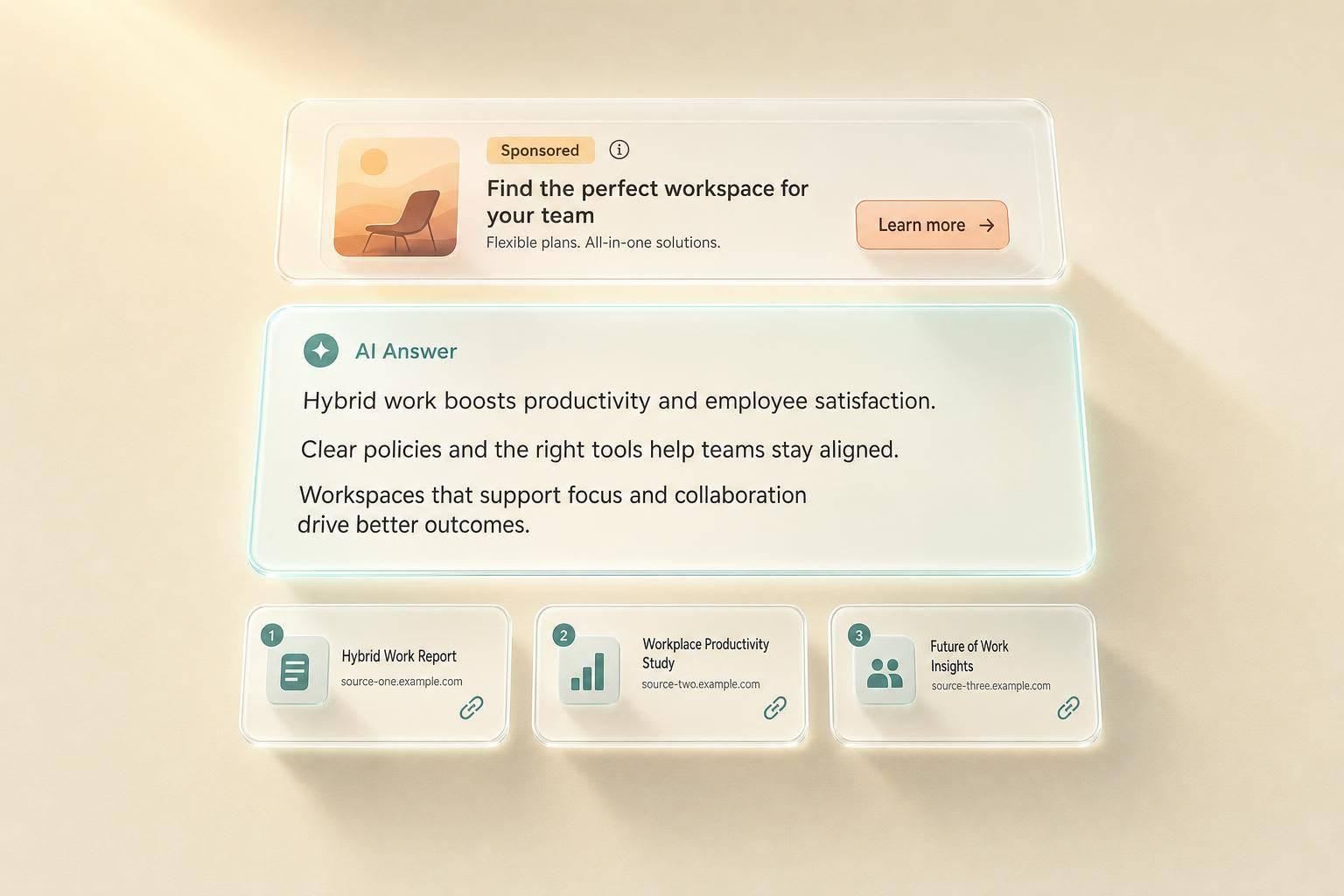
If you market to developers, don’t bet on AI ads alone. The short version is simple: ads in AI assistants may get attention, but organic citations inside the answer will matter more for traffic, trust, and reach.
Here’s what I’d take from this:
- People are wary of AI ads. 63% of U.S. adults say ads in AI search results make those results feel less reliable.
- Many high-value users won’t see ads anyway. ChatGPT Plus, Pro, Team, and Enterprise are ad-free.
- Paid placement sits around the answer. The response itself still leans on cited sources.
- Developer audiences check claims fast. Generic copy will lose to pages with specs, sources, and direct answers.
- Organic AI visibility can outlast ad spend. One cited source can show up across free and paid tiers.
- Some content patterns help more than others. Expert quotes, stats, and source-backed claims were linked to higher AI visibility.
- You should track citations now. Check your top queries each week across ChatGPT, Perplexity, Gemini, and Copilot, and log who gets cited.
If I were building a plan today, I’d do two things at once: tighten pages that AI systems can quote easily and use paid distribution only as short-term support where it makes sense.
That means updating:
- comparison pages
- docs
- tutorials
- migration guides
- benchmark pages
- pricing pages
- FAQ and glossary pages
Quick comparison

| Platform | Ad status | Where ads appear | Who may not see them | Main takeaway |
|---|---|---|---|---|
| ChatGPT | Live self-serve ads | Below the answer | Plus, Pro, Team, Enterprise users | Paid reach is limited; citations still matter |
| Perplexity | Sponsored formats tested, then pulled back | Around answer flow / sponsored prompts | Varies by product changes | Shows how fast trust issues can shape ad formats |
My view: use AI ads as a test channel, not the center of your developer marketing plan. Put most of your effort into pages that are easy to cite, easy to verify, and easy to scan.
Now let’s get into what that means in practice.
What ads inside AI assistants actually are
AI assistant ads are paid placements that show up around generated answers. They are not just search ads with a new coat of paint. Usually, the placement appears beside or below the response, with a clearly labeled sponsored unit. For technical audiences, the big issue isn't only where the ad sits. It's whether that sponsored message can hold up when someone takes a hard look at it. OpenAI and Perplexity are already showing how this works in practice.
Search and social ads lean on keywords, audiences, or product feeds. AI assistant ads work differently. They use the topic of the conversation and the user's recent turns to judge when a placement fits. So instead of bidding on a keyword and hoping timing lines up, you're trying to meet someone inside a live decision-making moment. That's a big shift.
For developer marketers, the main change isn't placement by itself. It's the trust burden that comes with being placed next to an answer the user may already accept.
How in-answer ads differ from search and social ads
The biggest structural change is simple: the funnel gets compressed into one conversation.
On a search results page, a user might click one link, skim a page, back out, open another, compare options, and slowly form a view. Inside an AI assistant, discovery, comparison, and evaluation can happen in the same thread. By the time a sponsored unit shows up, the user has often already cut the list down.
That changes attribution too. Search ads can give you detailed click-level data. AI assistant ads are still measured more broadly, without access to private chats .
Why labeling, sourcing, and context matter more for developers
Developers check sources fast. If a claim looks weak, vague, or inflated, it gets dismissed almost on sight. Inside an AI assistant, that reaction gets even stronger because the sponsored unit appears right under a response the user may already see as authoritative.
"Your creative competes with an answer, so specifications and verifiable claims can do more work than persuasion." - Ming Zhu, CEO, KongfuSEO
A clearly labeled placement can still get attention. But it has to earn it. The page or message behind the ad needs to be accurate, specific, and sourced. If the AI answer is technically precise and the sponsored unit feels generic, the gap in credibility shows up fast. The label says "sponsored." The content has to say "accurate."
That's why OpenAI's ad plans and Perplexity's sponsored answers matter so much right now for developer marketers.
What OpenAI and Perplexity already show about AI assistant ads
The first live examples point to the same thing: ads can show up, but trust still decides whether anyone cares. OpenAI and Perplexity are already showing two very different paths for AI assistant ads.
What OpenAI's ad plans mean for marketers
OpenAI launched a public, self-serve Advertise in ChatGPT Ads Manager on July 22, 2026 . These ads appear as labeled cards below the generated answer, not inside the answer itself. OpenAI also says the ads will not shape ChatGPT's answers .
For developer marketers, one detail stands out: who you can actually reach. Right now, ads are limited to the Free and "Go" tiers, while Plus, Pro, Team, and Enterprise stay ad-free . So if you're trying to reach paid users, organic citations still do the heavy lifting.
What Perplexity's sponsored answers revealed about trust
Perplexity makes the trust issue easier to see. Its Sponsored Questions showed that even the query itself can become ad space, but the company said it would end ads by late 2026 .
That gap matters. OpenAI is building a paid ad slot. Perplexity, by stepping back, shows the credibility limit that comes with sponsored placements in answer-driven products, especially when the audience is technical and skeptical. A paid placement can buy visibility. It can't do the job of being cited inside the answer.
For developer marketers, organic citation still looks like the safer long game.
Why developer marketers should build organic AI citations now
Paid spend stops the moment the budget runs out. Citations don’t. Organic citations can keep sending attention your way across free and paid users, including Plus, Pro, and Enterprise tiers .
There’s another reason this matters: most AI platforms still keep ads labeled and placed around the response. The recommendation inside the answer usually comes from earned sources instead . That puts organic citations in a strong spot while answer ads are still being figured out.
Off-page authority work can also lead to more generative AI traffic. In one reported program, that work led to a 354% increase over 12 months .
What makes content more likely to be cited in AI answers
SEO aims at rankings. AEO aims at the answer.
That changes how you write. Your content has to be easy for an LLM to pull from and trust at a glance.
A few traits help more than most:
- Answer-first formatting: start with a direct 2–3 sentence response, then add detail
- Verifiable claims over persuasive copy
- Expert attribution
A Princeton University study found that including expert quotations increases AI visibility by 41%, adding statistics improves the likelihood of being cited by 33%, and using authority citations lifts visibility by 28% . Put simply, specs and checkable technical claims do more work than polished marketing copy. That’s a big part of why cited content works as a practical hedge when ads sit around the response, not inside it .
Independent validation matters too. AI models don’t just read what you say about your product. They also pick up how other sources describe it. That means citations are more likely when your brand shows up in independent reviews, technical forums, and comparison roundups .
It’s also worth checking robots.txt so GPTBot and Google-Extended can crawl your site .
Once the page is set up for citation, the next job is tracking where it shows up.
How to track AI visibility before ad formats stabilize
Right now, there isn’t one dashboard you can trust to track citations across ChatGPT, Perplexity, Gemini, and Copilot all at once . So for now, the manual route is still the cleanest one: run your top 5–10 target queries across each platform every week, log whether your brand appears, and note which sources get cited instead .
Perplexity is usually the fastest place to test citation changes. It has the highest citation density, often 5–15 references per answer, and a first-citation feedback loop of 30–60 days . The internal share-of-voice measurement framework shows how to set up that tracking while AI reporting standards catch up.
What to fix in your developer content and media mix next
Which pages to update for AI visibility
Once you know where you show up, focus on the pages most likely to shape AI answers. Put your time into pages AI assistants can quote without extra work.
Start with comparison pages, documentation, tutorials, migration guides, and benchmark pages. Then clean them up so the writing is clear, the structure is easy to scan, and the details are current.
Update pricing pages with current tiers, exact prices, and a current dateModified tag .
Add glossary and FAQ pages with FAQPage schema so AI assistants can pull short, direct answers .
A next step for teams that need trusted developer reach now
If you need reach before organic citations start to stack up, paid placement can work as a short-term boost. AI assistant ad formats are still taking shape, so it makes sense to build your organic base now while paid options keep changing.
Think of AEO as the base layer and paid placements as short-term support for high-intent moments. Organic citations can reach every tier, including Plus, Pro, and Enterprise users who never see ads . Paid placements can still protect your brand when other companies bid on your name, but that visibility ends as soon as the budget runs out .
For immediate developer reach, use daily.dev Ads to reach more than 1 million developers. You can target by seniority, programming language, and tooling, with native placements that match how developers already browse and compare tools. It’s a practical way to get in front of the right audience while citation-driven visibility builds.
FAQs
How do AI ads and AI citations work together?
AI ads and organic citations are two separate, complementary layers in the same interface.
Organic citations come from structuring content so AI models can find your brand and cite it on merit. AI ads are clearly labeled sponsored placements that appear beside or below the answer.
They work on separate tracks. Paid placements do not affect organic retrieval or answer generation.
For marketers, organic visibility is the base. Ads can help cover gaps when your organic content hasn’t shown up yet.
Which developer pages should I update first?
Start with the pages most likely to be extracted and cited as organic answers:
- Core getting-started docs and onboarding guides
- Framework- or language-specific integration pages with prerequisites, steps, working code, and clear summaries
- High-intent pricing, plans, and “X vs. Y” comparison pages with concrete, verifiable details
Why does this matter? Ads can affect whether a sponsored card shows up. But organic answers and citations depend on something else: page structure, extractability, and crawlability.
How can I measure AI citation visibility now?
Track organic and paid visibility separately. Paid placements don’t affect organic model selection, so ad clicks shouldn’t hide shifts in organic authority.
Start by measuring your baseline with repeated manual queries across major engines like ChatGPT, Perplexity, and Gemini. Then use platform dashboards and reporting tools to track brand mentions, citation rate, impressions, clicks, and conversions.