

No - you can’t buy ads in Codex. OpenAI does not sell ad space inside Codex, and Codex sessions in the CLI, IDE, desktop app, and web tool are built for coding work, not promotion.
Here’s the short version:
- Codex has no ad placements
- OpenAI makes money from subscriptions and usage credits
- ChatGPT ads are separate and appear in ChatGPT web and mobile for some users, not in Codex sessions
- Codex users are still worth reaching, because many of them influence tool buying for engineering teams
- The best time to reach them is between sessions, when they’re reading docs, browsing GitHub, and checking technical sites
One number stands out: Codex reached 7 million active users on July 13, 2026, after 10x growth in six months. But that growth happened in a work setting where ads would get in the way.
| Topic | Short answer |
|---|---|
| Can you advertise in Codex? | No |
| Does Codex have sponsored placements? | No |
| Do ChatGPT ads appear in Codex? | No |
| Where can you reach Codex users? | Outside Codex, between work sessions |
If I want to reach Codex users, I should think less about in-product ads and more about where developers go before and after they code.
What Codex is and who uses it
Codex is OpenAI's agentic coding tool for writing, reviewing, and shipping code . It’s built for delegated work and connects straight to repositories, not casual prompting.
Codex is built for delegated engineering tasks
Developers use Codex for substantial tasks like bug fixes, refactors, unit test generation, and implementation work. Record & Replay turns a one-time macOS workflow into a reusable agent skill, while Developer mode gives Codex browser debugging access through the Chrome DevTools Protocol .
It also runs across the tools professional engineers already use:
- a CLI
- a VS Code-compatible extension
- a desktop app in Codex mode
- a web interface
That setup makes Codex a focused engineering workspace, not a general browsing surface.
That usage pattern also helps explain why this audience matters so much from a business point of view.
The audience is made up of experienced, high-value developers
Codex is aimed at professional engineers, so its audience leans toward experienced developers and the teams around them. These users often shape buying decisions for cloud, database, security, and monitoring tools.
So while Codex users are highly valuable, they’re also hard to reach. They’re deep in task-driven work, and interruptions are easy to ignore.
Why there are no Codex ads today
OpenAI does not sell ads in Codex, and Codex has no sponsored placements. That means Codex works like a workspace, not an ad surface.
Codex runs on a subscription and credit model, not ad placements
Codex access is tied to ChatGPT plans and shared usage credits . In plain English, the money comes from subscriptions and credits, not from ad inventory. So there isn't a sponsored slot for someone to buy inside a session.
ChatGPT ad reporting does not apply to Codex
OpenAI began rolling out "Sponsored Recommendations" inside ChatGPT on February 9, 2026 . Those ads show up as labeled boxes below AI-generated answers in the ChatGPT web and mobile interfaces .
Codex sessions in CLI and IDE tools do not show those ads . So even though OpenAI is testing ads in ChatGPT, there is no published sign that those tests reach Codex.
That split matters. The actual chance sits outside the session, when developers are moving between tasks.
Why Codex users are hard to reach and worth reaching
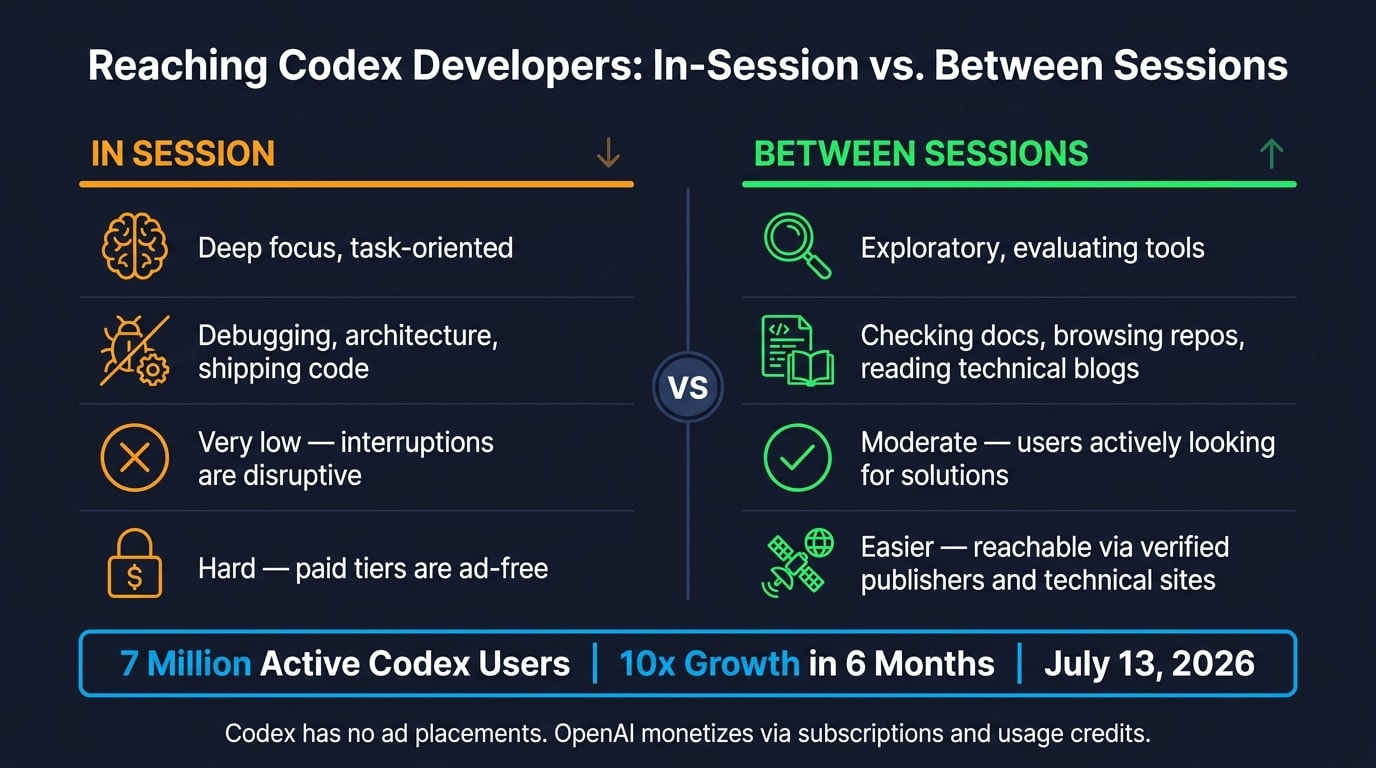
Codex hit 7 million active users on July 13, 2026. That's 10x growth in six months. But here's the catch: that growth comes from work sessions where interruption-based ads don't belong. That's why some of the hardest users to reach can also be the ones you most want to reach.
Codex sessions happen during critical work
Developers use Codex when they're debugging, refactoring, migrating code, and trying to ship before a deadline. These are heads-down sessions. Focus is tight, and interruptions tend to land badly.
In a session built for concentrated engineering work, even small distractions can cost time and momentum. On top of that, Pro, Business, and Enterprise users don't see ads. So the engineers with the most value are often the least interruptible.
Discovery happens around the session, not inside it
The useful window shows up between sessions, not during them.
When a Codex session ends, or when a developer is waiting on a long-running task, attention starts to shift. They look up documentation, browse GitHub repos, read technical blogs, and compare tools for whatever comes next. That's when discovery happens. It's also when people are more open to finding something new.
| In session | Between sessions | |
|---|---|---|
| User mindset | Deep focus, task-oriented | Exploratory, evaluating tools |
| Primary tasks | Debugging, architecture, shipping code | Checking docs, browsing repos, reading technical blogs |
| Ad receptivity | Very low; interruptions are disruptive | Moderate; users are actively looking for solutions |
| Reachability | Hard; paid tiers are ad-free | Easier; reachable via verified publishers and technical sites |
The opportunity isn't inside the session. It's in the moments around it.
How to reach Codex developers today
Codex users are easiest to reach around the workflow, not inside the tool.
Reach developers in discovery mode between sessions
daily.dev reaches developers when they’re reading, learning, and weighing tools between coding sessions. That’s the moment when attention is easier to earn, because you’re not interrupting active work.
With business.daily.dev, advertisers can use native in-feed and post-page placements, with targeting based on seniority, programming languages, and the tools developers use. For a broader primer, see /blog/how-to-advertise-to-developers.
That same timing also makes verified publisher inventory useful.
Use verified publisher and AI chat inventory without placing ads inside Codex
Through verified partner publishers, daily.dev reaches developer inventory in AI chats and other platforms without placing ads inside Codex .
See the broader category view in one related article
For the broader category view, see Can You Advertise in AI Coding Tools?.
Conclusion: Codex is not an ad channel, but its users are reachable
No, OpenAI does not sell ads in Codex, and there is no ad placement inside Codex. Codex runs on a usage-based model, not an ad-supported one . But that doesn't mean the people using it are out of reach.
Codex users are still worth reaching. The window that matters is between sessions: when they're reading, comparing tools, and figuring out what to build next. Reach them there, not inside Codex, so your message stays useful instead of intrusive.
FAQs
does codex have ads
No. OpenAI does not sell ads in Codex, and there’s no ad placement inside the coding agent.
Sponsored recommendations are described for the ChatGPT interface, not for Codex agent output. Even when Codex is accessed through ChatGPT plans, that ad behavior applies to ChatGPT, not Codex.
can you advertise in openai codex
No, OpenAI does not sell ads in Codex. There’s no ad placement inside the coding agent.
The ads OpenAI has introduced show up in ChatGPT as clearly labeled sponsored cards below answers, not inside Codex workflows.
And if you’re using Codex CLI through the API, those sessions also do not return any advertising payload.
how do you reach developers who use codex
No, OpenAI does not sell ads in Codex. There’s no ad placement inside the coding agent, and you can’t buy ad inventory directly from OpenAI in Codex, its CLI, or its IDE extensions.
If you want to reach this audience, the better move is to show up in non-interruptive, context-aware placements between sessions. That’s where attention is easier to earn.
For example:
- daily.dev reaches Codex users while they’re in discovery mode
- business.daily.dev lets advertisers access developer inventory inside AI chats and platforms through verified partner publishers