




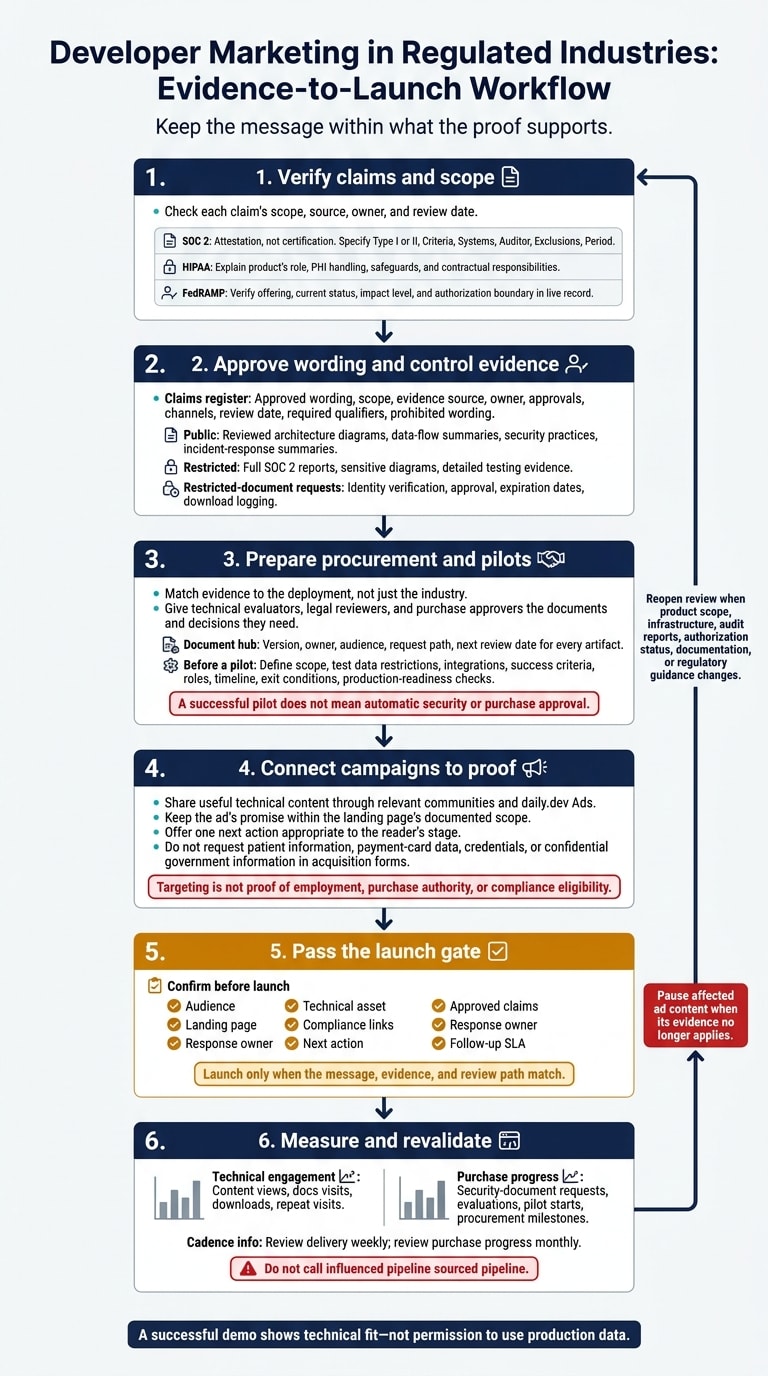
I treat developer marketing in regulated industries as two jobs: explain the product and back every compliance claim with proof. Before launching, I check each claim’s scope, source, owner, and review date. A successful demo shows technical fit - not permission to use production data.
For fintech, healthcare, and government campaigns, my checklist is simple:
- Check the claims: SOC 2 is an attestation report, not a certification. Explain HIPAA responsibilities and verify the exact offering’s current FedRAMP status.
- Prepare for purchase reviews: Match documents to the buyer’s deployment, protect restricted files, and set pilot conditions before testing.
- Reach the right readers: Use technical communities and daily.dev Ads to share expert insights and industry trends, then link to pages with supporting proof and one clear next step.
- Measure and review: Track technical engagement separately from purchase progress. Update or pause claims when their supporting documents no longer apply.
My rule: keep the message within what the proof supports - from the first ad through the final contract.
Write accurate compliance content
Define SOC 2, HIPAA and FedRAMP scope
SOC 2 is an attestation report, not a certification. Specify Type I or Type II, the Trust Services Criteria covered, the systems and services in scope, the auditor, exclusions, and the report period. Type I addresses controls at a specified date. Type II addresses how effectively those controls operated over a stated period. Publish the applicable date or period - not just a badge.
For HIPAA, follow HHS guidance to explain the product’s role, the protected health information (PHI) it may create, receive, maintain, or transmit, and the safeguards and contractual controls that apply. For FedRAMP, check the exact offering, current status, impact level, and authorization boundary in the live record before publishing.
Separate public content from restricted documents
With the scope defined, decide what can be public and what needs a review process. Publish reviewed architecture diagrams, data-flow summaries, security practices, and incident-response summaries. Keep full SOC 2 reports, sensitive diagrams, and detailed testing evidence behind a controlled request process. That process should include identity verification, approval, expiration dates, and download logging.
Before publishing health-product claims, check privacy, advertising, breach-notification, and medical-device obligations using the FTC’s health-app guidance. Being outside HIPAA does not mean being outside regulation.
Document approved claims and wording to avoid
Next, set clear limits on the language marketers can use. Keep a claims register that records approved wording, scope, evidence source, owner, approvals, channels, and review date. Include required qualifiers and prohibited wording for each claim so even short ads retain those limits.
Avoid “SOC 2 certified,” blanket “HIPAA compliant,” and undefined public claims such as “secure,” “government approved,” or “enterprise-ready.” SOC 2 does not establish HIPAA compliance. NIST alignment does not establish FedRAMP authorization. Customer logos do not prove regulatory approval. Treat “FedRAMP Ready” as a status to verify - not another way to say authorized.
Reopen approvals whenever hosting, data flows, scope, or authorization boundaries change. Use the register to keep ads, landing pages, and procurement materials aligned.
Prepare content for procurement reviews
Once public claims are approved, package the evidence procurement teams will request.
Choose evidence for each buyer's use case
Match evidence to the deployment, not just the industry. Ask what data enters the service, where it runs, which systems it connects to, and what the buyer’s contract requires. Use the table to set the review scope.
| Buyer | Evidence priorities | Review risks | Content owners | Escalation path |
|---|---|---|---|---|
| Fintech | Audit report, penetration-test summary, encryption, access controls, resilience, data residency, and audit rights | Unclear financial-data flows or shared responsibilities; claims that exceed audited coverage | Security, product, compliance, legal | Security for control questions; product for deployment scope; legal for contract commitments |
| Healthcare | PHI data flows, applicable safeguards, business associate agreement requirements, incident obligations, and interoperability evidence where relevant | Undefined PHI handling; unsupported medical-device or interoperability claims | Privacy, security, legal, product specialists | Privacy or legal for business-associate responsibilities; qualified product owners for device and integration questions |
| Government | FedRAMP status and authorization boundary, inherited controls, agency requirements, records-management support, and accessibility evidence | Treating FedRAMP status as agency approval or an ATO; deployment outside the assessed boundary | Public-sector compliance, security, contracts, accessibility owners | Public-sector team for authorization questions; contracts or legal for agency terms |
With the scope set, give each reviewer the documents and decisions they need:
- Technical evaluators: Maintained client libraries, integration instructions, deployment requirements, and support policies.
- Legal reviewers: Data processing, retention, subprocessors, incident-notification terms, and a contract contact.
- Purchase approvers: Scope, cost, responsibilities, and open conditions.
Map each document to the right reviewer using the enterprise versus startup marketing playbook.
Define pilot conditions before testing starts: scope, test data restrictions, integrations, success criteria, roles, timeline, exit conditions, and production-readiness checks. A successful pilot shows that the product met agreed technical results. It does not mean automatic security or purchase approval.
Build a procurement document hub
Keep supporting evidence in one controlled, indexed hub: audit reports, pen-test summaries, security questionnaire responses, data-residency details, subprocessor lists, incident-response plans, and business continuity and disaster recovery plans.
Give every artifact a version, owner, audience, request path, and next review date. Include healthcare-device, interoperability, government-records, or accessibility documentation only when it applies to the product and intended use.
Make the hub part of the review process. Assign a named response owner to each evidence category. Require authenticated access and least-privilege permissions for restricted files, and retire superseded versions. Track buyer questions alongside their source document, owner, status, and review date.
For healthcare contracts, route PHI-use, safeguard, and incident-reporting questions to privacy or legal through the business associate agreement process.
Reach developers in regulated industries
Once you’ve organized procurement evidence, share it where developers in regulated industries discuss implementation problems.
Find communities around technical problems
Look for standards groups, open-source threads, and meetups focused on specific problems: payment authorization and fraud controls, healthcare interoperability and identity matching, or public-sector supply chains and infrastructure controls.
Before posting, check participation rules, disclosure limits, moderation policies, and promotion rules. Have security, privacy, and regulatory reviewers check community posts before you publish implementation notes.
Choose daily.dev Ads formats by campaign goal
Once you’ve identified the right topics, choose a format that fits your goal. Use daily.dev Ads to bring technical content to more readers within its approved scope.
- In-Feed Native Ads: Share guides and implementation explainers.
- Sponsored Post: Get guaranteed feed impressions, a read-floor commitment, and canonical republishing.
- Engagement Ads: Support topic discovery and interaction through Branded Tags, Keyword Spotlights, Custom Upvotes, Tag Page Takeovers, and Stack Placements.
- Digest newsletter sponsorships by topic track: Distribute content by topic.
Target by tech stack, seniority, geography, and interests. But targeting isn’t proof of employment, purchase authority, or compliance eligibility. For healthcare campaigns, use only professional context and technical interests. HIPAA generally requires written authorization before covered entities use or disclose protected health information for marketing.
Link campaigns to pages with supporting evidence
Send each campaign to a page that explains the technical problem your product solves, how it integrates, its deployment requirements, and the evidence behind its compliance claims. Keep the ad’s promise within that documented scope.
For example, an access-control guide should link to implementation details - not a blanket claim that the product makes every customer compliant. Use the enterprise versus startup playbook to match the page to the buyer’s review process.
Offer one next action that fits the reader’s stage, such as reading documentation or requesting security materials. Collect only the business contact and qualification details you need. Don’t request patient information, payment-card data, credentials, or confidential government information in acquisition forms. Route sensitive exchanges through an approved secure process, using the same approved scope, supporting evidence, and review path as the landing page.
Measure results and keep campaigns current
After launch, apply the same evidence checks to results and claim updates. Campaigns in regulated industries need proof that stays current - not just a one-time approval.
Separate engagement from buying progress
Use two reporting layers: technical engagement and purchase progress. Measure engagement through content views, docs visits, downloads, and repeat visits. Measure purchase progress through security-document requests, evaluations, pilot starts, and procurement milestones.
State your attribution model, and report sourced, assisted, and influenced impact separately. Do not call influenced pipeline sourced pipeline.
Review delivery weekly and purchase progress monthly. Update dashboards after product, documentation, or regulatory changes. Track each evidence request by account, owner, date, and next action. Log tracking failures, page changes, unavailable documents, and delayed procurement responses - and use those signals to trigger claim reviews.
Review claims before launch and after changes
Assign owners by claim type: product marketing, security or legal, privacy or clinical, and government or compliance. Maintain a controlled claim register with the approved statement, source document, owner, approval date, review date, affected campaigns, and customer-permission checks. Use it to keep ads and landing pages within the scope the evidence supports.
Ban unsupported absolute claims and language that implies government endorsement.
For 2026 campaigns, review claims whenever product scope, infrastructure, audit reports, authorization status, documentation, or regulatory guidance changes. Pause affected ad content when its evidence no longer applies. Treat FedRAMP authorization and monitoring evidence as current documentation, not a permanent badge. Connect this workflow to the enterprise versus startup developer marketing playbooks.
Check campaign readiness before launch
Before each launch, run a final evidence check. Confirm the audience, technical asset, approved claims, landing page, compliance links, response owner, next action, and follow-up SLA.
Launch only when the message, evidence, and review path match. When ready, discuss campaign fit with daily.dev Ads.
FAQs
How can we market while compliance reviews are pending?
Use verifiable, non-sensitive content to help prospects evaluate your product - not push them to commit. Publish your support policy, data residency details, and certifications early on your company page so compliance teams can find and reference them.
Use daily.dev Ads targeting and formats to bring qualified visitors to your docs and quickstarts. Measure activation events, such as a first successful API call, with holdout groups rather than relying on CTR. Keep sponsored content claims specific and backed by evidence.
How can we share compliance proof without exposing sensitive details?
Publish your SOC 2, HIPAA, and FedRAMP status on your daily.dev verified company page, along with high-level controls such as data residency and your public support policy. This gives developers information they can share internally.
Use only factual statements and public artifacts in campaigns. Keep audit reports and sensitive scope details out of ad copy and landing pages. Direct requests for more details through your standard procurement contact flow.
How can we identify procurement bottlenecks in our campaigns?
Map each campaign’s decision path to measurable delivery and acceptance criteria, and review placement terms before launch. Procurement often slows when terms are unclear - whether that’s guaranteed delivery, read-floor commitments, make-goods, cancellation windows, or measurement requirements.
Use a conversion pixel, and agree upfront on attribution and a success metric: signups or qualified activations, not clicks. This gives legal and finance concrete reporting deliverables to review.