

Developers don’t trust slogans. They trust proof. The article’s main point is simple: companies earn engineer interest by showing public proof in 4 clear ways - open source work, deep engineering write-ups, public postmortems, and engineer-led community presence.
If I had to sum up the whole piece in a few lines, it would be this:
- Public code lets developers judge how a team works.
- Technical write-ups show system choices and trade-offs.
- Postmortems show how teams handle failure.
- Conference talks and community work show whether engineers teach peers or just sponsor events.
The article uses 10 company examples to show those patterns in practice: GitLab, Microsoft, HashiCorp, Shopify, Stripe, Etsy, Airbnb, Netflix, PostHog, and PagerDuty.
It also explains how I’d track employer brand with engineers using signals like:
- GitHub stars, forks, and external PRs
- Brand search volume and direct traffic
- Stack Overflow tag activity
- CTR and qualified traffic
- Qualified apply rate, offer-accept rate, and retention
- Candidate feedback after interviews
One data point stands out: Stripe shared that its internal coding agents ship 1,300 automated PRs per week. Another: Atlassian reported developer satisfaction moving from 70% to 82% after its merge queue work across 70+ repositories.
Quick Comparison
| Company | Main signal developers see | What it shows |
|---|---|---|
| GitLab | Public handbook | How the company works day to day |
| Microsoft | Public repos like VS Code and TypeScript | Maintainer behavior and open development |
| HashiCorp | Widely used open source tools | Engineering judgment through products |
| Shopify | OSS work plus engineering blog | Long-term thinking and community care |
| Stripe | Deep post on internal tooling | Strong engineering depth |
| Etsy | Detailed engineering blog | Clear reasoning behind system choices |
| Airbnb | System design posts plus OSS roots | Scale, architecture, and shipped work |
| Netflix | Engineering blog and Netflix OSS | Public technical depth over time |
| PostHog | Public response after a supply-chain issue | Openness when things go wrong |
| PagerDuty | Engineer-led talks and retrospectives | Respect earned through teaching peers |
Bottom line: if you want developers to respect an employer brand, I’d focus less on brand copy and more on public proof people can inspect for themselves.
The four mechanisms behind strong developer employer brands
Companies that earn respect from developers give engineers something concrete to inspect, test, and learn from. It’s not about polished messaging. It’s about signals people can verify for themselves.
Those signals tend to fall into four mechanisms.
Open source contributions and visible community behavior
When a company ships code in public, engineers can judge the work directly. They can look at the code, watch how maintainers respond, and see how the project is run.
That kind of repo activity gives developers plain, first-hand evidence of how a team works.
Deep engineering content
Deep engineering content shows the choices behind a system, not just the end result. It explains architecture decisions and the trade-offs that came with them.
When a team shares why it built something a certain way, developers often read that as proof of technical depth and clear thinking under real production constraints.
Transparent postmortems
When an engineering team lays out what failed, what they tried, and what changed after the fact, developers read that closely.
It signals psychological safety and intellectual honesty. Put simply, it shows the team can talk about mistakes without hiding behind spin.
Developer-first community and conference presence
Conference talks from engineers build credibility. Sponsorship by itself doesn’t.
Developers tend to trust teams that teach peers, share what they’ve learned, and show up in practitioner-led spaces.
| Mechanism | What engineers inspect | Why it builds trust |
|---|---|---|
| Open source contributions | Code quality, maintainer behavior, community governance | Direct evidence of engineering standards |
| Deep engineering content | Architecture decisions and trade-offs | Shows technical depth and real-world thinking |
| Transparent postmortems | What went wrong, what they tried, what changed | Signals psychological safety and intellectual honesty |
| Developer-first community presence | Technical talks, practitioner-led events, teaching peers | Credibility earned through knowledge sharing |
The examples below show how each mechanism looks in practice.
8–10 employer brand examples developers respect
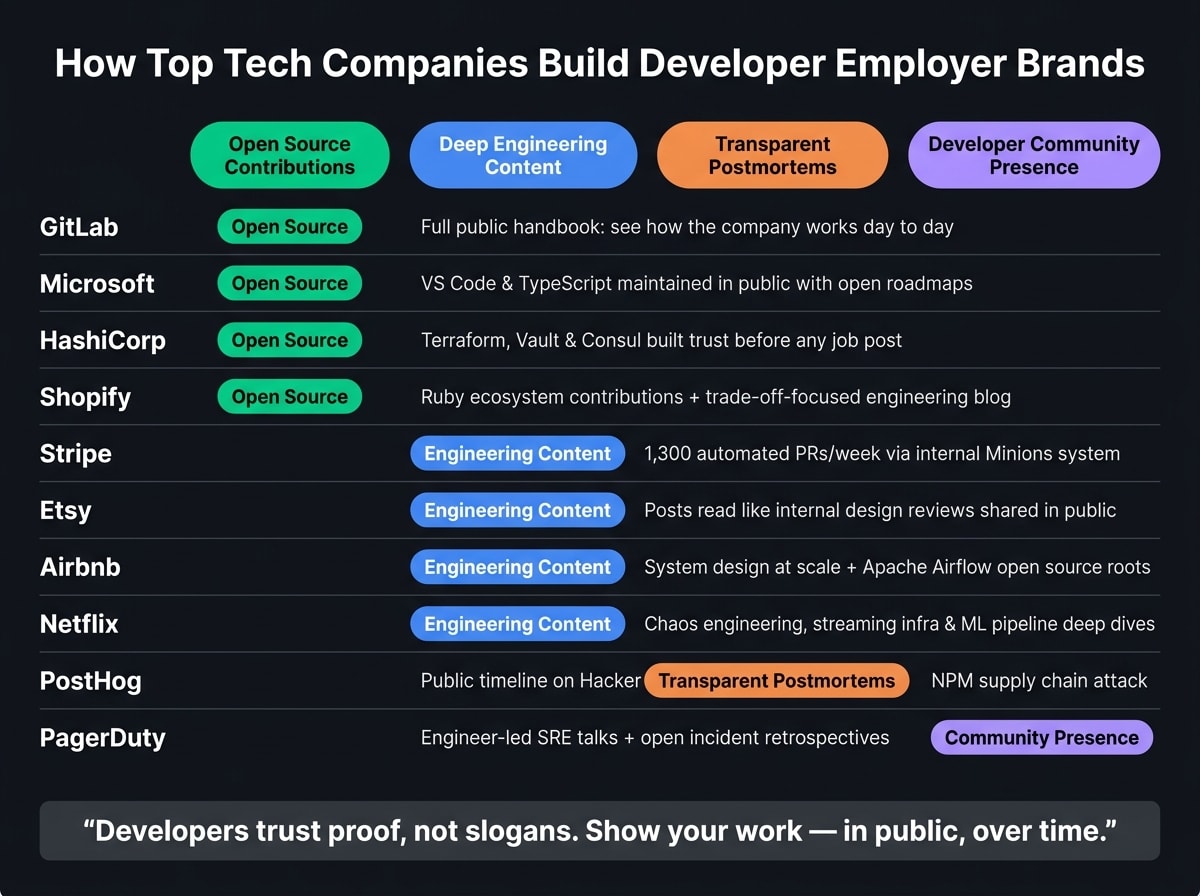
The strongest examples in public don't come from polished messaging. They come from visible proof: engineering work people can inspect, public process, and plainspoken responses when things break. Each example below shows one of those signals in action - engineering depth, public transparency, open source work, or community presence.
Open source-led example: GitLab
GitLab runs its full company handbook in public, including engineering processes, decision-making frameworks, and team norms that anyone can read. Developers can see how the company works, not just how it wants to look from the outside. That kind of openness turns the handbook into a recruiting signal. Engineers get a view of the culture before they even apply.
Open source-led example: Microsoft
Microsoft's shift into one of the biggest open source contributors on GitHub changed how many developers see it as an employer. Projects like VS Code and TypeScript are maintained in public, with active issue triage, open roadmaps, and community contributions merged at scale. Developers watch how maintainers act in those repos and make judgments about engineering culture based on what they can see.
Open source-led example: HashiCorp
HashiCorp built much of its employer brand through the tools it released in public - Terraform, Vault, and Consul - before those tools became industry standards. Engineers who used HashiCorp products in their own jobs formed opinions about the company's engineering judgment long before they ever saw a job post. In this case, the open source work did the brand-building on its own.
Open source-led example: Shopify
Shopify contributes heavily to the Ruby ecosystem and maintains several widely used open source libraries. Its engineering blog walks through the trade-offs behind those contributions, which gives developers a clear look at how the team thinks about long-term maintainability and responsibility to the community.
Engineering content-led example: Stripe
In March 2026, Stripe described its "Minions" system, which ships over 1,300 automated pull requests per week running in isolated devboxes through a centralized Toolshed server . That kind of write-up gives developers direct proof of engineering depth.
Engineering content-led example: Etsy
Etsy's engineering blog has covered large-scale infrastructure migrations, A/B testing frameworks, and deployment tooling in enough detail that developers can follow the reasoning behind each decision. The posts feel less like marketing and more like internal design reviews shared in public. That's a big part of why engineers trust them.
Engineering content-led example: Airbnb
Airbnb publishes engineering posts on system design at scale, data infrastructure, and the reasoning behind architectural pivots. Its open source projects, including Apache Airflow, which started at Airbnb, give developers something concrete to judge alongside the written material.
Engineering content-led example: Netflix
Netflix's engineering blog and its open source projects under the Netflix OSS umbrella have set a steady bar for technical transparency. Posts on chaos engineering, streaming infrastructure, and machine learning pipelines give developers a detailed sense of what working there actually looks like.
Transparency-led example: PostHog
After an NPM supply chain attack, PostHog co-founder Tim Glaser posted a public timeline and response plan on Hacker News; its public handbook and salary calculator back up that same open approach. This isn't about polished brand work. It's about behavior developers can see and verify for themselves.
Community-led example: PagerDuty
PagerDuty has built trust through practitioner-led conference presence and its public postmortem culture. Its engineers speak at reliability and DevOps events, share incident retrospectives openly, and contribute to the broader on-call and SRE community. Developers tend to trust teams that teach their peers, and PagerDuty makes that easy to spot.
These examples show that developer trust comes from proof, not promotion. They also map directly to the four mechanisms covered earlier: open source generosity, engineering content depth, transparent failure response, and community presence.
How to measure employer brand with engineers
The examples above show what earns developer trust. This section shows how to track that trust.
Generic employer-brand metrics often miss how engineers actually behave. Developers leave signals that are more specific and much harder to fake.
So instead of leaning on broad brand numbers, measure the same things that shaped the brand in the first place: public code, technical content, community response, and candidate experience.
Perception and engagement signals developers leave behind
Track the actions developers leave behind, then tie them to awareness, engagement, and intent.
GitHub signals are a good place to start. External PRs, in particular, show whether developers trust your codebase enough to contribute to it. Stars and forks can show reach. But external PRs say something deeper: they point to trust in your engineering work. Brand search volume and direct visits in analytics also matter because they show intent, not accidental reach.
Atlassian's Merge Queues deep dives across 70+ repositories lifted developer satisfaction from 70% to 82% .
| Metric Category | Example Signals | Data Source | What It Indicates |
|---|---|---|---|
| Perception & Awareness | Brand search volume, direct visits | Google Trends, Google Search Console, Brandwatch | Intent, not accidental reach |
| Technical Engagement | GitHub stars, forks, external PRs, clones | GitHub API / Insights | Technical credibility and code-first trust |
| Community Influence | Stack Overflow tag traffic, growth in product tags | Stack Overflow Trends | Problem-solving authority and ecosystem health |
| Top-of-funnel distribution | CTR, conversion rate, qualified traffic by company | daily.dev Ads Dashboard | Content resonance and reach within target segments |
| Recruiting Performance | Offer-accept rate, qualified apply rate, retention | ATS, HRIS | Employer brand strength and cultural alignment |
| Candidate Experience | Interview satisfaction scores, offer-accept rates | Post-interview surveys, NPS tools | Respect for developer time and culture-fit validation |
Talent pipeline and candidate experience metrics
Perception signals only matter if they move the pipeline. The clearest metrics here are qualified apply rate, offer-accept rate, and retention.
Post-interview surveys and NPS tools help show whether engineers felt the process respected their time. That part matters more than many teams think. A process can look fine on paper and still leave candidates annoyed. Interview compensation is another signal. daily.dev's $100 payment for technical interviews was praised as respect for candidates' time .
Once you can measure response, the next move is getting the right content in front of the right developers.
Using daily.dev Ads to distribute employer brand content
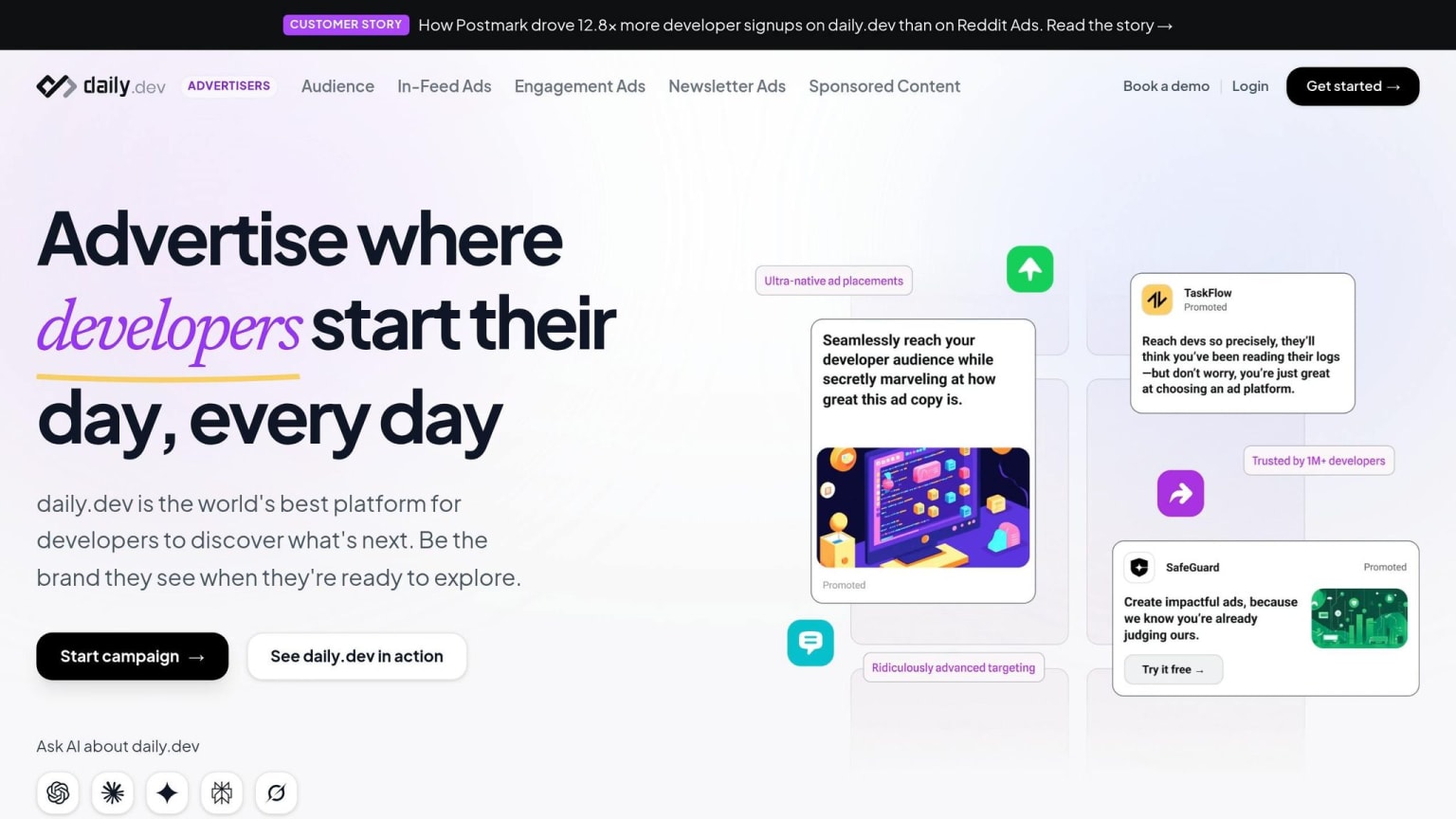
Publishing strong engineering content is only half the job. It also has to reach the right developers.
daily.dev Ads lets teams place engineering blog posts, open source stories, event recaps, and other technical content directly in front of targeted developer audiences, filtered by seniority, programming languages, and tools.
That’s where employer-brand content becomes easier to measure. Campaign views, CTR, and engagement can be tied back to the hiring pipeline. In that setup, distribution becomes a measurement channel, not just a traffic source.
Conclusion: the pattern shared by developer employer brands that work
The companies developers respect earn trust through steady public proof: open source contributions, honest engineering write-ups, transparent postmortems, and real community involvement. The tactic may change. Some teams lead with code. Others lead with content or a strong community presence. But the logic stays the same: show your work, in public, over time. That public track record is what makes the signal last - and what makes it measurable.
You can see that pattern in the numbers too. GitHub activity, branded search, docs traffic, and candidate feedback all show whether the brand is connecting.
The strongest employer brands aren’t built with big claims. They’re built through small acts people can check for themselves: a transparent postmortem, a public release, a talk that teaches something real. That’s the bar these examples set - and the one any engineering team can start building toward.
FAQs
How do I measure employer brand with engineers?
Measure it across three pillars: awareness, consideration, and trust.
Track awareness through direct traffic, brand-name searches, and unprompted mentions in places like Reddit or Hacker News.
Measure consideration with engagement and adoption signals, such as tutorial completions or time-to-first-API-call.
Measure trust with sentiment, Net Promoter Score, retention, plus annual developer experience audits and short quarterly brand-lift surveys.
What should a smaller company publish first?
Start with hands-on technical content that helps developers fix real problems. Think guides, tutorials, or docs with clear steps and working code examples.
That kind of content builds trust faster than broad brand messaging. Skip vague marketing talk. Developers tend to respond better to plain language, technical accuracy, and content that speaks right to the problems they’re trying to solve.
How long does developer trust take to build?
Building developer trust takes time. In most cases, it takes 2 to 3 years before that trust starts to fully take shape.
You don’t earn it with flashy campaigns or high-pressure marketing. You earn it step by step through verifiable actions, steady technical accuracy, and clear, transparent communication.