

In 2026, engineering hiring is harder, slower, and less forgiving. The article’s main point is simple: if you want more engineers to apply - and more of them to say yes - you need to show how your team works, not just say it in job posts.
Here’s the full playbook in plain English:
- Start with a provable EVP. Write down what engineers can expect on your team, but only include claims you can back up.
- Use proof, not slogans. Your engineering blog, public code, talks, and community work should show how your team builds, ships, and learns.
- Distribute your best proof. Good technical content often needs paid support to stay in front of the right people long enough to matter.
- Track hiring impact. Don’t stop at clicks. Watch application volume, offer-to-join rate, and retention.
- Keep the story in sync with day-to-day work. If your stack, team setup, or on-call load changes, your public message should change too.
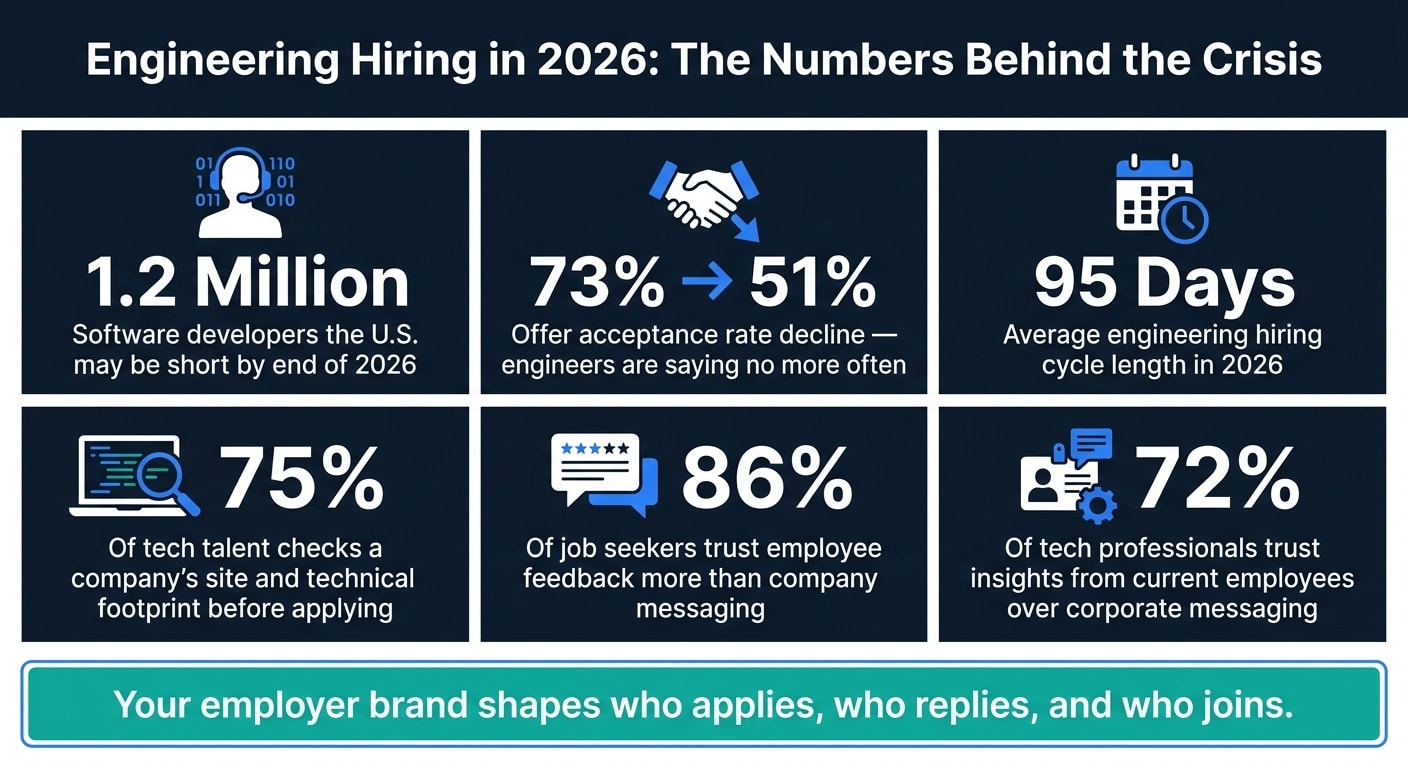
A few numbers set the stakes: the U.S. may be short 1.2 million software developers by the end of 2026, offer acceptance has dropped from 73% to 51%, and the average hiring cycle is now 95 days. On top of that, 75% of tech talent checks a company’s site and technical footprint before applying, while 86% of job seekers trust employee feedback more than company messaging.
This means your employer brand is no longer a side project. It shapes who applies, who replies, and who joins.
If I boil the article down to one line, it’s this: define what makes your engineering team worth joining, prove it in public, put that proof in front of the right developers, and review it every quarter.
Define your engineering EVP before you publish anything
An engineering EVP is a set of claims you can prove about how engineers work, grow, and ship. It should cover the technical setup, team culture, growth paths, and on-call life. If a claim isn’t backed by internal proof, it shouldn’t be in your EVP.
Next comes the hard part: finding the signals that make those claims feel real.
Run internal research to surface real signals
Start with interviews across levels, from junior engineers to principal engineers. Ask direct questions about ownership, what on-call is like, how promotions work, and whether mentorship is good or just talked about. Those conversations help you sort the claims you can support from the ones you can’t.
GitHub showed how this works at scale by building DevSat surveys into its workflows and reaching a 95% participation rate. That research found its engineers had 19% fewer meeting-heavy days than the industry average. That gave the team a clear signal it could use in its EVP .
Turn signals like that into short statements candidates can check for themselves.
Turn research themes into clear EVP statements
Raw research gives you themes. Your job is to turn those themes into statements that can be tested.
“We value ownership” is too fuzzy. “Engineers own services end-to-end, from design through deployment” is much stronger because it can be checked. It’s either how the team works, or it isn’t.
Twilio handled this well with a builder identity. Their pillars were, “We are builders, we are owners, we are curious.” They supported that with onboarding: every new hire builds a working app using the Twilio API before the end of their first week . That’s the pattern to follow. Match each EVP claim to a visible practice. And if autonomy or tooling changes a lot from team to team, don’t present it as universal.
Run an honesty check before content goes live
Before anything goes out, pressure-test it with three questions:
- Would current engineers recognize this?
- Would a new hire believe it?
- Do the people, projects, and processes actually exist?
Alloy Financial used this kind of plainspoken framing in 2026 when it shared its move from a monolith to microservices, including the messy parts. That transparency was associated with a 127% increase in qualified applicants and an 87% improvement in offer acceptance rates . If a claim fails all three checks, cut it.
Once the EVP is clear, the next move is to prove it through content, code, and community.
Build proof through content, code, and community
Once your EVP is set, you need to back it up. That proof should come from three places working together: what you publish, what you build in public, and where your engineers show up. Each channel should prove one EVP claim. It shouldn’t just make you more visible.
Use the engineering blog as your central asset
An engineering blog builds trust when it covers topics developers care about: architecture decisions, incident retrospectives, and migration trade-offs. Teams like Netflix, Cloudflare, and Stripe use engineering blogs to share technical decisions, trade-offs, and incident lessons that candidates can check for themselves. That kind of writing shows there’s real depth behind the scenes.
Use the blog to show how engineers work, decide, and ship. Every post should act as proof for a specific EVP claim - not as promotion.
Individual bylines matter too. When a post is signed by a real engineer, people put more stock in it. 72% of tech professionals trust insights from current employees more than official corporate messaging . Keep editing light. Clean up structure and clarity, but skip the polished marketing tone. A good target is one substantive post per engineer each year .
| Content Type | Examples | Impact on Senior Candidates |
|---|---|---|
| Strong proof | Architecture decisions, incident retrospectives, migration trade-offs | High - shows real technical depth and honesty |
| Weak proof | Generic "What is X" explainers, office perks posts, award announcements | Low - often feels like filler and can hint at thin substance |
Use open source and public code as proof of your work
If the blog makes a claim, the repo should back it up. Public repos give candidates a way to inspect coding standards, documentation quality, and technical leadership.
Different open source paths send different signals. Internal tools can show your stack. Ecosystem contributions can show that your team takes part in the communities around its tools. Flagship projects can signal depth in a much louder way.
| Strategy | Effort | Visibility to Candidates | Hiring Alignment |
|---|---|---|---|
| Internal tools | Medium | High (if genuinely useful) | Excellent for showing daily tech stack |
| Ecosystem contributions | Low | Medium | Good for attracting specialists in specific libraries |
| Flagship projects | High | Very High | Best for building a top-tier technical reputation |
Each open source choice should tie back to a specific EVP claim. And the basics matter more than people think. Set clear licensing, contribution guidelines, and code review standards before you publicize anything.
Support conference talks and developer community participation
Speaking and community work should carry the same proof into public developer spaces. When your engineers speak at conferences or take part in niche communities, they build a reputation that no ad campaign can match. It makes the EVP feel more believable because people can hear the technical thinking straight from the source.
But there’s a catch: the key word is contribute. Engineers who share real knowledge - hard-won lessons, honest trade-offs, and specific technical decisions - build credibility. Engineers who give recruiting pitches burn it fast.
"Encourage your engineers to speak at conferences, contribute to open source, and share their work publicly. Their visibility becomes your recruiting asset." - Katie LaFranchi, HR Consultant, Amplēo
Support that work with talk submissions, speaking coaching, and travel budgets .
| Channel | Reach | Depth of Engagement | Best Hiring Goal |
|---|---|---|---|
| Large conferences | High | Low | Broad brand awareness, top-of-funnel |
| Local meetups | Low | High | Local talent pipelines and referrals |
| Niche online forums | Medium | Very High | Sourcing specialists (e.g., Rust, Kubernetes) |
There’s also a direct hiring upside. Referral hires stay 25% longer and have a 25% higher profit impact . Niche Slack and Discord communities can deliver 35%–48% response rates .
Use your best blog posts, repo announcements, and talk recaps as the assets you amplify next.
Get your engineering brand content in front of developers who are already reading
Those proof points don’t do much if they just sit there after publication. Once the piece is live, distribution becomes the next job. The content most worth pushing is usually technical deep dives and EVP-backed stories - the kind of material developers might stop and read because it says something concrete.
What to promote with Sponsored Post and In-Feed placements
Use Sponsored Posts for long-form content that needs more time and more mileage. Use In-Feed native ads for landing pages, docs, webinars, or technical briefs . If the goal is to get developers to spend time with the content itself, Sponsored Posts are often the better fit because the format feels more natural to read.
For Sponsored Posts, lead with something specific. Think: "How we cut p99 query latency by 40% with async inserts" instead of a generic job ad. That kind of headline tells a developer there’s a real story behind it. For In-Feed placements, keep the message tight and technical. Focus on the stack, team size, and the exact problems the team is working through .
If you’re promoting a post that already lives on your engineering blog, add canonical tags. That way, the SEO value stays with your own domain while the platform helps with reach .
Target by seniority, stack, and region
Once you’ve picked the format, narrow the audience. Fit beats raw volume. Targeting tends to work better when it matches reading behavior, seniority, stack, and region instead of leaning only on static profile data .
Geographic targeting matters most when hiring is tied to a set market or region where you’re actively building a team . If you only need to hire in a few places, broad distribution can waste budget and muddy the signal.
Measure reach, engagement, and hiring influence
The main question isn’t whether someone clicked. It’s whether repeated exposure helped move a person into the hiring funnel. Start with downstream hiring signals, not top-line traffic. Track:
- Inbound application volume
- “How did you hear about us?” responses
- Offer-to-join rate
- 90-day retention for candidates who interacted with brand content
It also helps to train hiring managers to note when a candidate mentions a specific engineering blog post or open-source project during interviews. That kind of comment is often the clearest sign that the content landed.
Repeated exposure matters more than a single spike. A short burst can put content in front of people for a moment. Steady visibility keeps it in circulation across the full hiring window.
It’s also worth separating impressions from Reads. Impressions show feed visibility. Reads, for Sponsored Posts, show that developers actually opened and spent time with the technical content . For In-Feed placements, CTR is still a useful signal. Native in-feed ads on developer platforms have reached peak CTRs of 1.27%, about 3× the industry benchmark of 0.3–0.5% for text ads .
| Feature | Organic Reach Alone | Organic + Paid Amplification |
|---|---|---|
| Consistency | Spiky; content often "dies" after 48 hours | Sustained; delivery paced over 30+ days |
| Audience control | Limited to existing followers and search algorithms | Precise; target by seniority, stack, and region |
| SEO impact | Natural growth | Accelerated; drives traffic to canonical sources |
| Visibility | Dependent on algorithms | Guaranteed; guaranteed delivery over the campaign period |
Keep the brand honest and run it on a quarterly schedule
Be upfront about trade-offs in your engineering environment
After amplification, the next job is maintenance.
Once your EVP and distribution plan are live, they need to match the actual engineering environment. If your team is dealing with heavy technical debt, legacy systems, a high incident load, or strict compliance rules, say that plainly.
That kind of honesty matters. It sets the right expectations and helps avoid the “this isn’t what I signed up for” moment later.
Teams with strong engineering brands, like Netflix, Cloudflare, and Stripe, keep talking about trade-offs as their systems change. When your stack changes, your org gets reworked, or a policy shifts, update any content that mentions it. If you don’t, your public story can drift away from day-to-day reality.
Set a quarterly operating rhythm across channels
Use a quarterly rhythm to keep the brand accurate as the team changes.
| Quarter Activity | Owner | Focus |
|---|---|---|
| Publish engineering blog posts | Engineering + DevRel | Technical depth, EVP alignment |
| Ship one open-source contribution or community talk, meetup, or contribution | Individual engineers | Credibility, peer reach |
| Amplify top-performing content | Marketing | Sponsored Post + In-Feed placements |
| Run brand reality audit | Talent + Engineering lead | Align messaging with current stack and culture |
Run a short internal survey to check whether the public story still matches day-to-day work. Look at the basics: do the blog, repos, and community presence still reflect how the team works now? If the answer is no, update the content before the next amplification cycle.
The 2026 employer brand playbook at a glance
At this point, the playbook comes down to four repeating actions:
- Define a verifiable EVP
- Prove it through blog content, open source, and talks
- Amplify it to developers already reading technical content
- Keep the message honest over time
Strong engineering employer brands - Stripe, Cloudflare, Netflix - don’t come from taglines. They come from published technical work, real community presence, and messaging that stays in step with reality.
FAQs
How do I define an engineering EVP?
Start by getting stakeholders on the same page about the role, what success looks like, and the company’s top priorities.
Then build your EVP around what engineers actually care about: competitive pay, equity, healthcare, remote work rules, growth budgets, fair hiring, technical culture, and long-term well-being. Keep the message clear and transparent. Focus on substance, not office perks.
What proof matters most to engineers?
Engineers care more about what works than what a brand says about itself. When they decide whether to trust something, they usually look at it in this order: code, documentation, then community presence.
The best proof is plain and concrete:
- working, copy-pasteable code samples
- clear documentation of trade-offs, limitations, and specific metrics
- open-source contributions and engineer-reviewed content
How do I measure employer branding ROI?
Measure employer branding ROI with more than clicks. The bigger goal is to track long-term influence and its effect on pipeline. Developers often move through a dark funnel, so multi-touch attribution over 90-day windows gives you a better read on what’s working.
Focus on signals like:
- direct traffic and brand search volume
- unprompted mentions on Reddit or Stack Overflow
- responses to "How did you hear about us?"
- quarterly familiarity surveys
- retention and engagement among exposed vs. unexposed developers over 6–12 months