
Most developers won’t respond to cold recruiter messages. About 70% are passive candidates, 90% ignore standard outreach, and many spend their time reading code, docs, forums, and engineering posts instead of browsing job boards.
If I want to reach them early, I need to do four things: show up where they already learn, publish engineer-led technical content, distribute that content in developer channels, and measure attention before recruiting steps in. The point is simple: earn interest first, then let recruiting handle follow-up.
- Job boards miss passive developers because developers spend more time in repos, Q&A sites, Slack groups, Discord servers, and technical blogs.
- Technical proof beats employer-brand copy. Engineer bylines, code snippets, postmortems, and scaling lessons do more than perk lists.
- Distribution matters as much as writing. Start with organic sharing in communities, then add paid promotion to content that already gets attention.
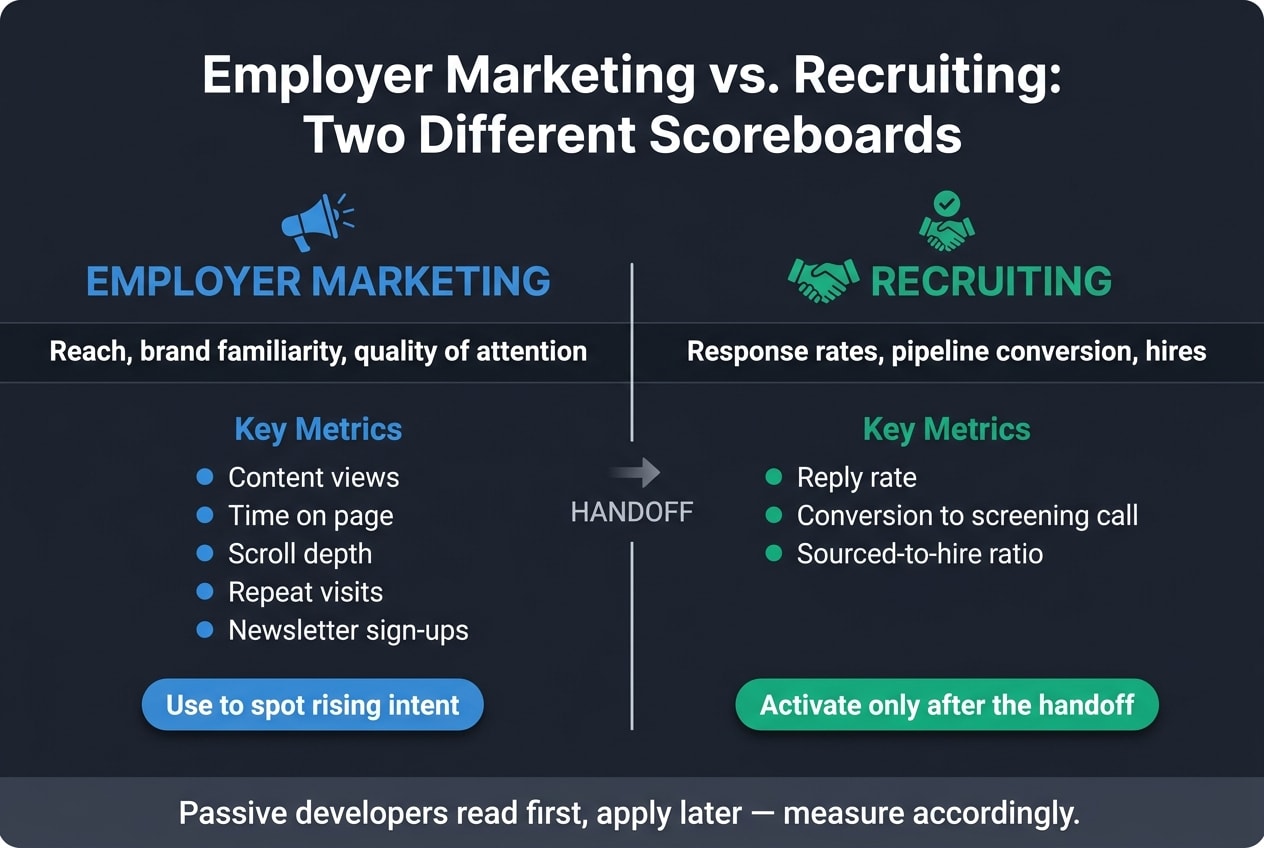
- The handoff should be clean. Marketing tracks views, time on page, scroll depth, repeat visits, and sign-ups. Recruiting tracks replies, screens, and hires.
This article explains how I’d build that path from first read to hiring interest without turning every touchpoint into a job pitch.
1. Define passive developer candidates and map where their attention is
A passive developer candidate is a developer who already has a job and isn’t out there applying for new ones. They may still be open to the right role, but most of their attention goes to shipping code, solving problems, and picking up new tools.
Why job boards miss passive developers
Job boards often miss passive developers because job boards aren’t part of how they spend most days online. Their routine tends to revolve around docs, pull requests, technical blogs, and community discussions. That gap matters. If you know where their attention already goes, you can pick channels that fit how they work instead of hoping they’ll show up on hiring sites.
Where developers spend their time online
Passive developers usually spend time in places like:
- Code repositories
- Technical Q&A forums
- Developer communities
- Framework-specific Slack or Discord groups
Keep the boundary clear: marketing vs. recruiting
Employer marketing should build awareness and credibility. Recruiting should handle sourcing, outreach, screening, and interviews. Keeping that line clear makes the next step easier: creating content developers will trust and choose to read.
2. Build employer content that developers trust
Perk lists and buzzwords don't move developers. Technical proof does. The goal here is to build trust before recruiting even begins. Then you make that trust visible in the content itself.
Use engineer bylines
Publish refactors, scaling lessons, postmortems, and trade-offs. Details about the stack, scope, and architecture matter more than generic employer-brand copy .
That proof should come from real engineers, not polished brand language. Publish under engineer bylines, and include code snippets, terminal output, and architecture diagrams .
Build a repeatable content process
When a format starts working, turn it into a publishing system. Treat the blog like a living record of technical work. Reuse conference talks, postmortems, and open-source releases. Keep a backlog of 20–30 topics pulled from actual engineering problems .
It also helps to keep that content in one place. Put it on an engineering blog so people can find it, reuse it, and measure what works .
3. Get that content in front of developers where they already read
The goal here is simple: put technical content in places developers already spend time, without making it feel like a hiring pitch.
Start with organic distribution in technical communities
Start by sharing proven technical content through the engineers who wrote it. Lead with proof-of-work: deep dives, refactoring stories, and scaling lessons, not job descriptions.
In trusted communities, people expect substance. The bar is high. Erin Mathew, Sr. Tech Talent Sourcer at PayPal, puts it plainly:
"The best advice I can give [for recruiting] in private communities, is to give more than you take."
That’s the right mindset. Spend two weeks adding value before tying your brand to hiring.
When a topic starts getting traction, put paid distribution behind that piece.
Use native developer ads to amplify technical content
Organic distribution is a strong place to start, but paid amplification can push a piece further once it’s already landing with the right audience.
daily.dev Ads places employer content in-feed, on post pages, and in personalized digests, with targeting by seniority, languages, and tools.
Match the ad message to what the developer cares about
Share the technical piece, amplify what works, then match the headline to the developer’s problem. Lead with the technical issue, the stack, or the lesson, not the company name or the open role.
If the ad points to a technical article, make the path to real details short and obvious. That includes:
- The tech stack
- The salary range in USD
- Whether the role is remote, hybrid, or on-site
Technical content tends to get better attention than generic job ads because it fits how developers learn. Salary details should be visible up front.
Next, track which topics earn clicks, saves, and qualified interest so you can separate awareness from intent.
4. Measure employer marketing results and hand off interest to recruiting
Once your content is in front of developers, the next step is to measure whether it builds familiarity and intent - not whether it drives applications right away.
Track signals that show awareness and intent building
Passive-developer campaigns often get judged too soon, and usually by the wrong number: application volume.
That’s a mistake. Passive developers tend to read first and apply later, if they apply at all. So the signals that matter are content views, time on page, scroll depth, repeat visits, and newsletter sign-ups. If certain topics suddenly get more attention, that can point to rising intent.
Use those signals to separate marketing performance from recruiting performance.
Separate marketing KPIs from recruiting KPIs
Employer marketing and recruiting are two different jobs. They need different scoreboards. When teams mix the two, things get muddy fast, and content programs that are doing their job can get cut for the wrong reason.
| Employer Marketing | Recruiting | |
|---|---|---|
| Goal | Reach, brand familiarity, quality of attention | Response rates, pipeline conversion, hires |
| Key metrics | Content views, time on page, scroll depth, repeat visits, newsletter sign-ups | Reply rate, conversion to screening call, sourced-to-hire ratio |
Use marketing metrics to spot intent. Use recruiting metrics only after the handoff.
Conclusion: Build familiarity before outreach begins
The way to reach passive developers early is to show up with content that earns attention instead of asking for time.
Engineering depth beats perk messaging. Real engineers beat polished brand copy. When engagement turns into intent, pass that signal to recruiting.
FAQs
How do I know if my content is reaching passive developers?
Look past vanity metrics and pay attention to technical engagement signals. Plain analytics often miss a lot of developers because ad blockers and privacy settings can block tracking.
Instead, track actions that show hands-on interest:
- Documentation depth
- Code snippet copies
- API key generation
- Sandbox activations
It also helps to use self-reported attribution, like “How did you hear about us?”, and keep an eye on community mentions of your brand or tool.
What technical content do developers actually trust?
Developers put their trust in content that gets the details right. They want writing that is technically precise, accurate, and shaped by practitioners who’ve actually done the work. And they usually want depth, not fluff, especially when the content explains why a code choice was made, how a system was designed, and what trade-offs showed up in practice.
Trust also comes from being open. That means naming limits, sharing performance data people can verify, and including code examples that work. Most developers tune out buzzwords and vague marketing talk. They respond to direct, problem-solving content that respects their time.
When should recruiting step in?
Recruiting should step in once a candidate shows clear interest.
That usually happens after the marketing team has built trust with technical content. Watch for high-intent signals like profile updates, community participation, or direct questions about the tech stack, salary, or work arrangements. At that point, the recruiter should reach out with a warm, personal message that respects the candidate’s time.