
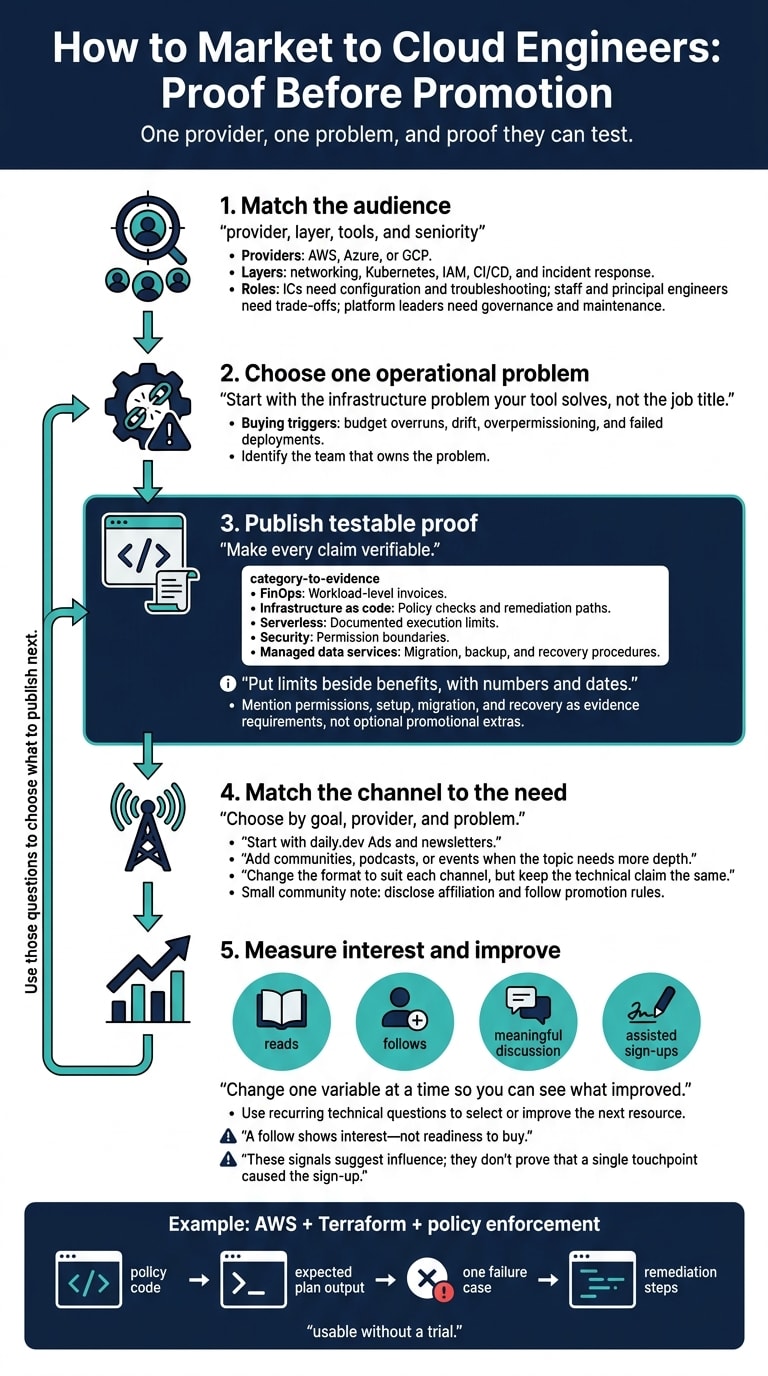
I start marketing to cloud engineers with one provider, one problem, and proof they can test. For example: an AWS Terraform guide with policy code, expected output, a failed check, and steps to fix it - not just a product pitch.
Here’s the approach I use:
- Match the message: Write for AWS, Azure, or Google Cloud, then narrow it by workload, tools, and team role.
- Show the details: Include costs, permissions, setup steps, limits, migration, and recovery. Cover what matters for FinOps, infrastructure as code, serverless, security, or data tools.
- Choose the channel: Use daily.dev Ads and a verified company page, cloud newsletters, and relevant communities. Add podcasts or provider events when the topic needs more explanation.
- Measure interest: Track reads, follows, technical questions, and assisted sign-ups. Use those questions to choose what to publish next.
My rule: proof before promotion. A follow shows interest - not readiness to buy. I build trust by sharing useful technical guidance and keeping it up to date.
How do I market my developer tool to cloud engineers?
Start with the infrastructure problem your tool solves, not the job title. Identify the team that owns the problem and whether it’s buying for one workload or setting a standard across teams. Then give engineers proof they can inspect. Match your message to their provider, infrastructure layer, and seniority.
Match content to providers, tools, and roles
Build your content brief around provider, layer, tools, and seniority. Write for the cloud your readers use: AWS, Azure, or GCP. Separate content by layer: networking, Kubernetes, IAM, CI/CD, and incident response.
Ownership often overlaps across DevOps, platform, SRE, architecture, and security teams. ICs need help with configuration and troubleshooting. Staff and principal engineers need trade-offs. Platform leaders need details on governance and maintenance.
Refine your brief with the guides to tech-stack targeting, programming-language targeting, and reaching DevOps and platform engineers.
Follow one workflow: problem, proof, channel, limitations, migration. For daily.dev, connect each post to the same technical narrative. Track reads, follows, in-depth discussion, and assisted sign-ups to see whether that narrative holds readers’ interest over time. With the brief in place, map the triggers that lead engineers to evaluate a new tool.
Understand buying triggers and requirements
Budget overruns, drift, overpermissioning, and failed deployments can prompt engineers to evaluate a tool. They judge operational fit, not feature lists. Explain compatibility, setup effort, governance, and operational risk.
Spell out the required permissions, who approves adoption, what happens if the tool fails, and how to roll back. Show how it fits into infrastructure as code, version control, and CI/CD rather than adding a separate manual process.
Match your evidence to the tool category:
- FinOps: Workload-level invoices.
- Infrastructure as code: Policy checks and remediation paths.
- Serverless: Documented execution limits.
- Security: Permission boundaries.
- Managed data services: Migration, backup, and recovery procedures.
For hybrid cloud and multi-cloud buyers, explain what can move unchanged, what needs provider-specific configuration, and what requires redesign. These constraints guide where cloud engineers look next and which sources they trust.
Where do cloud engineers get their news and discover new tools?
Cloud engineers find tools in the same places they turn to for updates, troubleshooting, and peer feedback. They trust details about how things work, not just announcements.
Match the channel to the information need. Newsletters such as Last Week in AWS and TLDR DevOps help engineers catch up on updates. Curated feeds highlight releases, explainers, and implementation advice. Keep a clear focus on a provider or tool.
On daily.dev, use a verified company page to share posts, releases, and employer-brand stories in the feed and DevOps and Cloud track. Stick to relevant topics, including #cloud, #aws, #azure, #gcp, #serverless, and #terraform.
AWS re:Invent, Google Cloud Next, and Microsoft Build are places to learn about roadmaps, study architecture, and evaluate tools hands-on. Pair conference coverage with implementation guides rather than recap posts. Podcasts give you room to discuss incidents, architecture decisions, and lessons from running systems. Include links to docs, examples, or postmortems.
Reddit communities such as r/aws, r/azure, r/googlecloud, and r/devops let engineers hear from peers and question product claims. Read discussions to spot recurring concerns, answer relevant questions, and disclose your company affiliation. Join the conversation - don’t just drop promotional links.
Stack Overflow serves troubleshooting; LinkedIn serves broader discovery. On Stack Overflow, address the specific problem with provider context, version details, and reproducible steps. Use recurring questions to improve your documentation. On LinkedIn, share engineering posts, release news, maintainer perspectives, and company updates. Put the technical depth in the linked resource.
What is the best way to reach cloud engineers?
Once you know where cloud engineers read and talk, pick the channel that fits the decision you want to influence. Choose by goal, provider, and problem.
| Channel | Best use | Strength | Limitation | Message format |
|---|---|---|---|---|
| daily.dev Ads | Steady brand and community presence | Verified company presence developers can follow | Requires steady technical content | Technical posts, releases, and employer-brand stories |
| Cloud newsletters | Timely education | Established reading routine | Limited space and editorial context | Short sponsor message with a technical takeaway |
| Cloud conferences | Provider-specific validation | Hands-on learning | Not always-on | Workshop or demonstration |
| Peer discussion | Candid objections | Community promotion rules | Evidence-based discussion with affiliation disclosed | |
| Cloud and DevOps podcasts | Explaining complex decisions | Practitioner trade-offs | Limited control over timing | Technical case discussion |
| LinkedIn Ads | Reaching professional roles | Role targeting, not technical ownership | Titles may not identify buyers | Role-specific post linked to a technical guide |
| Stack Overflow Ads | Awareness during troubleshooting | Implementation context | Brief ad copy cannot establish technical proof | Concise ad copy linked to documentation |
Use the table to narrow your placement options, then tailor the message to the workload and provider. For broader platform-engineering topics, favor channels where readers can examine the architecture and ask questions.
Keep provider, workload, and evidence aligned. When space is tight, shorten the explanation - not the qualifications that make it believable. Judge channel fit by reads, follows, meaningful discussion, and assisted sign-ups.
Which channels work best for marketing to cloud engineers?
Run one technical theme across channels for several weeks. Start with daily.dev Ads and newsletters. Add communities, podcasts, or events when the topic needs more depth.
Use daily.dev Ads to build a verified company page that developers can follow. Share posts, releases, and employer-brand stories in the DevOps and Cloud track. This sequence works because cloud engineers assess provider fit, IaC, and operational constraints before trusting a new tool.
Follow community promotion rules and disclose your affiliation. Change the format to suit each channel, but keep the technical claim the same.
Test a focused audience, problem, and resource
Within that channel mix, test one audience, one problem, and one resource. Define your audience by provider, toolchain, role, and problem.
For this test, focus on AWS engineers using Terraform who need policy enforcement across infrastructure changes. Build a standalone configuration walkthrough with policy code, expected plan output, one failure case, and remediation steps, usable without a trial.
Distribute the walkthrough through daily.dev Ads, reshape the takeaway for a cloud newsletter, and invite technical questions in one relevant community. Don’t copy promotional language into the discussion. Wait until those questions reveal a broader engineering story before using podcasts or conferences.
Once the first resource is live, use early questions and reads, follows, discussion, and assisted sign-ups to pick the next topic. Strong reads with little discussion may point to a need for clearer configuration details. Useful discussion without follows may suggest that your company needs a clearer point of view across its posts.
Let practitioner questions guide the next resource, whether that’s policy options, migration guidance, operational cost, or portability. Change one variable at a time so you can see what improved.
How do I build a brand that cloud engineers trust?
Once you know where cloud engineers are, earn their trust with proof they can check. Make every claim verifiable. Write for the cloud provider they use, and tie your evidence to its permissions, resource model, and deployment flow. Show how adoption fits into infrastructure as code, covering access, dependencies, state changes, upgrades, rollback, code review, CI/CD, state management, and policy checks.
Show proof and explain trade-offs
Once you’ve explained adoption, back up your claims. Separate measured results from projections. Give every numerical claim a named source, date, provider, region, workload, layer, measurement period, and test method.
For cost claims, include a redacted or synthetic invoice that retains the provider, service category, workload, billing period, units, rate structure, credits, and total. Remove account IDs, resource names, IP addresses, and identifying tags. Explain what changed between bills, and label synthetic invoices as illustrative only.
Keep one source of truth for supported configurations and known issues. Update documentation, release notes, and marketing claims together. Use your verified daily.dev company page to share technical evidence: redacted invoice walkthroughs, provider-specific notes, release updates, lessons from incidents, IaC examples, and labeled benchmarks.
Write about cost, portability, and limits
For cost content, explain what changed in the workload, not just the bill. Specify whether savings came from resource sizing, retention policies, commitments, or lower usage.
For multi-cloud content, distinguish portable patterns from provider-specific identity, networking, billing APIs, and managed services. Publish supported resources and exclusions rather than calling your product cloud agnostic.
Cost and portability claims need clear limits. Put limits beside benefits, with numbers and dates. For serverless tools, document cold starts, timeouts, concurrency, payload and package-size caps, and region availability. List prerequisites and unsupported setups. Explain what happens when credentials expire, quotas run out, or deployments only partially complete - and whether recovery requires a retry, rollback, or manual intervention.
How do I market cloud cost management and FinOps to cloud engineers?
After proving the invoice, show engineers how they can control what goes on it. Lead with unexpected spend, unassigned charges, idle resources, and unclear ownership - not a broad promise of savings. Help them trace a charge to its workload and owner, then identify changes that won’t hurt reliability. The FinOps Foundation’s 2025 State of FinOps report names workload optimization and waste reduction as practitioners’ top priority.
Cloud cost management and FinOps
Make allocation provider-specific and enforce it in code. For AWS, activate cost allocation tags for cost reports. For Azure, cover resource tags and Cost Management tag inheritance. For Google Cloud, explain how the resource hierarchy and labels support allocation and budget control. Define required fields such as owner, application, environment, and cost_center, then show how infrastructure as code or governance controls enforce them. With ownership clear, move to rightsizing and deletion decisions.
Give engineers a rightsizing checklist that covers the utilization window, peak demand, service-level objective, approval owner, and rollback plan. For idle resources, check ownership before deletion. Allocating a charge isn’t the same as cutting it: assigning a charge to a team does not reduce the bill. Show the baseline bill, configuration change, new bill, and effect on reliability.
Explain that budgets trigger alerts, not hard caps. A budget alert runbook should name the provider, billing scope, threshold, notification route, and billing-data delay. Tell the receiving team how to investigate and record an action. Keep these reporting controls separate from preventive governance, such as restrictions on unapproved regions, and document exceptions for reliability needs.
Turn that guidance into one practical artifact engineers can use immediately, with verification steps and approval paths - not a broad promise:
An AWS allocation walkthrough, an Azure ownership-tag policy, or a Google Cloud budget alert runbook.
Share it through your daily.dev company page with #cloud and the relevant #aws, #azure, or #gcp tag. Add #terraform for infrastructure-as-code governance, and use the DevOps and Cloud newsletter track.
How do I market infrastructure as code and policy tooling to cloud engineers?
Publish a runnable repository that takes engineers from pull request to approved deployment. Cloud engineers buy through pipelines they already trust. Put the repo, plan, and policy gate in one place so they can test the tool before adding it to their pipeline. Include a Terraform module, CI configuration, plan output, policy results, and recovery instructions. Explain what can stay unchanged and what needs to migrate. Back compatibility claims with code and output.
Infrastructure as code and policy tooling
Document only the providers, resource types, Terraform versions, and CI/CD systems you support. Show module inputs, outputs, and pinned dependencies. Keep reusable module conventions separate from provider-specific resources. A shared interface does not make IAM, role assignments, and bindings interchangeable.
Show actual terraform plan output, including additions, changes, deletions, and replacements. Label sensitive and unknown values. State whether Sentinel or OPA checks inspect configuration, plans, or state. Show where failures block deployment, who approves exceptions, and when those exceptions expire. Explain how the pipeline stops an outdated approved plan from being applied.
Treat drift and failed runs as part of the workflow, not edge cases. Show what drift detection covers, how often it runs, who owns the results, and what safeguards govern remediation. Use terraform plan -refresh-only to inspect external changes without applying them. Keeping drift means updating code; removing it requires a normal plan and apply. After a partial apply, show how to inspect the failed resource and current cloud state before running the next plan. Do not promise instant rollback; data loss may be irreversible.
Disclose how you handle state storage, locking, encryption, backups, environment separation, and access controls. Explain secret-manager integration, short-lived runner credentials, redaction, and what happens when credentials are unavailable. Marking values as sensitive does not protect state or plan artifacts. Include these details in a support matrix and troubleshooting guide.
What other cloud tools do engineers buy?
Beyond IaC, cloud engineers buy tools for runtime, security, and data operations.
Serverless platforms and edge runtimes
Serverless works well for event-driven APIs, jobs, scheduled tasks, and globally distributed apps when you want to avoid managing servers.
Show tests others can reproduce. Include the runtime, deployment configuration, regions tested, request pattern, cold-start and warm latency, error rates, and observability setup. Document timeouts, package and payload caps, concurrency, and supported runtimes. Give a named source and date for each limit.
Separate portable application code from provider-specific events, identity, and storage integrations. If the app needs long-running work or local state, say so plainly.
Cloud security posture and identity
Security buyers want proof that a finding leads to a controlled fix. Excessive permissions, secret sprawl, poor policy visibility, and slow remediation often prompt teams to evaluate security tools.
Trace each finding through the affected identity, proposed permission change, approval path, verified fix, and audit evidence. State which AWS, Azure, and Google Cloud services the tool supports and which permissions each feature needs. Explain its coverage for least-privilege checks, secrets rotation, encryption, and audit-log export.
Be clear about who does what: what security teams approve, what platform teams change, and which findings the tool cannot detect or resolve.
Managed databases and storage
Database and storage buyers want proof of migration and recovery, not just feature lists. Patching, backups, replication, and growth often drive the search for a new tool.
Start with migration blockers: engine and version compatibility, extensions, network access, authentication changes, downtime tolerance, and rollback planning.
Document a restore test. Report recovery point objective and recovery time objective separately, alongside the tested configuration, test date, and failure scenario.
Explain availability, durability, replication mode and lag, latency conditions, connection and storage limits, maintenance windows, and how egress affects costs and data movement. State what the customer still owns, including query tuning, access control, retention, and recovery testing.
How do I measure marketing to cloud engineers?
Once your content is live, check whether it’s building technical trust. Track content reads, daily.dev company-page follows, discussion quality, recurring questions, and assisted sign-ups. Define what counts as a read, then use that definition consistently.
Break results down by provider, toolchain, role, and topic. AWS cost content and Terraform workflow guides serve different needs, so don’t treat them as interchangeable. Look for engineers returning for proof, trade-offs, and implementation details.
A follow means someone wants to hear from your company. It doesn’t mean they’re ready to buy. Group posts into technical education, releases, or employer-brand stories, and judge each by its purpose. Release posts may lead to implementation questions. Engineering stories may start conversations about team practices and technical ownership.
Read the discussions, not just the totals. Label responses as clarification, implementation question, objection, peer experience, or product feedback. Keep a shared question log that records the topic, provider, audience role, source post, and follow-up owner. Repeated questions can point to missing proof, unclear limits, or weak migration guidance - and show which proof points need clearer coverage next.
For assisted sign-ups, record earlier content touchpoints where privacy and consent allow. Use consistent content IDs and state a lookback period that fits your sales cycle. Add a “How did you hear about us?” question to collect self-reported discovery. These signals suggest influence; they don’t prove that a single touchpoint caused the sign-up.
In your monthly report, pair readership and community trends with feedback from sales and solutions teams. Include which guides prospects mention, which objections persist, and which questions come up during evaluations. Compare equivalent reporting periods and note launches. Then choose the next technical topic or proof point and commit to one content action.
For example, update documentation to answer a recurring Terraform adoption question.
How daily.dev Ads helps you reach cloud engineers
Cloud engineers look for provider-specific proof they can trust. daily.dev Ads keeps that proof in front of them through a verified company page. Use the page as a regular home for cloud posts, product releases, and employer-brand stories - not just a one-time announcement.
Your content can appear in developers’ personalized feeds and the newsletter they choose. The DevOps and Cloud track fits topics such as infrastructure as code, cloud operations, Kubernetes, and cost management.
Label each asset with its provider, toolchain, and required background so readers know what to expect. Keep implementation guides separate from content about architecture and team decisions.
Bring a brief that covers the problem, supported providers, technical proof, limits, landing page, rollout plan, and publishing schedule. daily.dev handles setup and delivery.
Already have cloud-focused posts, release notes, or docs? Use them as the starting point for your next publishing plan.
Schedule a planning conversation to discuss your cloud topics, existing assets, and publishing schedule. For available plans, visit the plan information page.
Conclusion
To market to cloud engineers, start with their cloud provider, the workload they own, and the operational problem they need to solve. Prove your product in the same environment they use to evaluate it, with configuration and deployment steps they can reproduce. Publish the bill, limits, and portability trade-offs. Engineers trust evidence they can inspect to judge whether a product fits their setup.
Publish regularly around the questions engineers ask. Choose channels based on where they already learn and how much detail they need. Trust grows when you answer questions and keep guidance up to date - not just announce releases.
Track whether that trust grows over time: measure reads, follows, meaningful discussion, and assisted sign-ups. Keep the order clear: provider, workload, proof, then channel. Technical detail earns attention, and consistently useful guidance brings engineers back. Give proof and repetition more weight than promotion.