
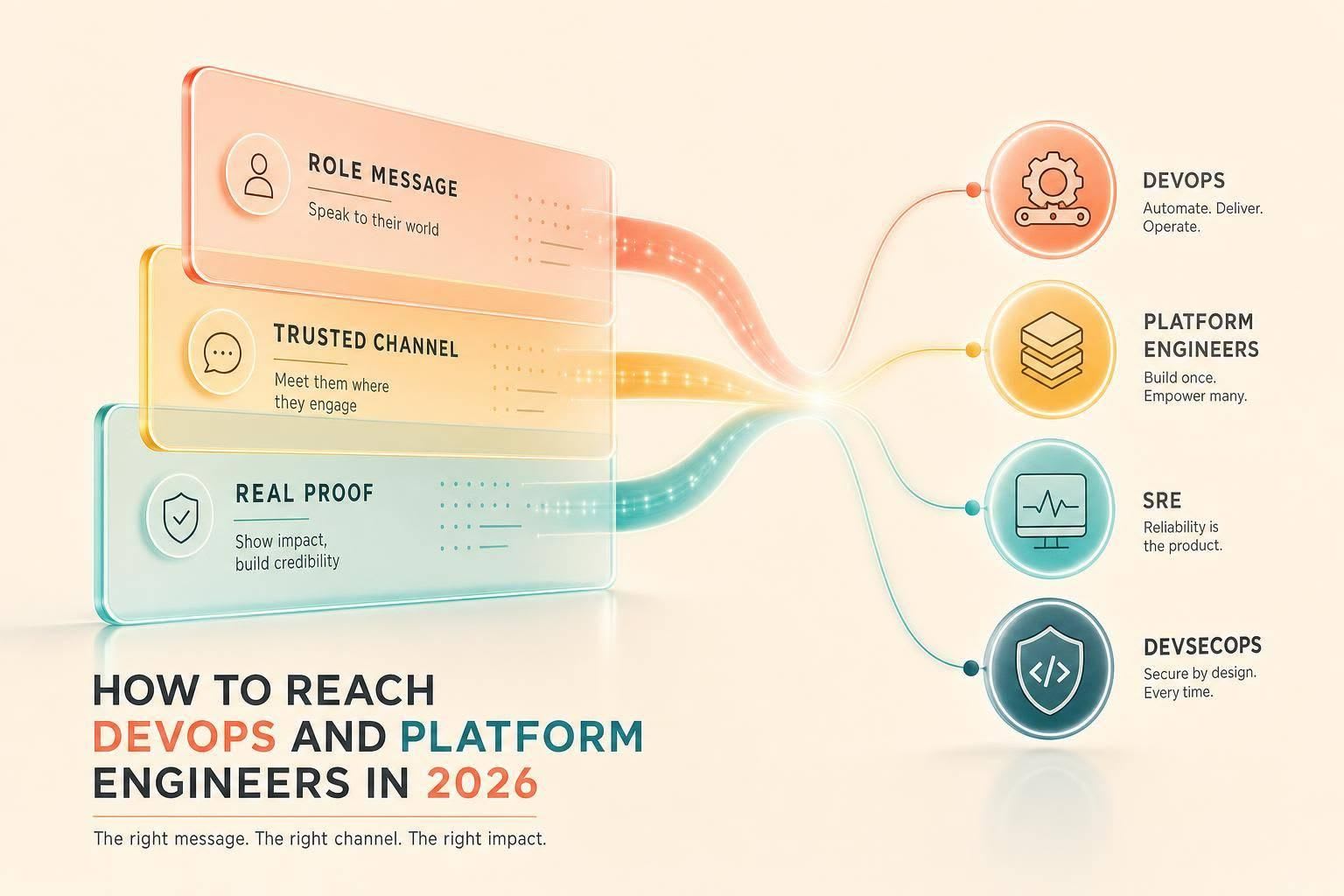
If I want DevOps and platform engineers to pay attention in 2026, I can’t lead with brand talk. I need role-specific problems, proof, and the right channel.
Here’s the short version:
- DevOps engineers care about CI/CD, toil, and shipping more often
- Platform engineers care about internal platforms and golden path use
- SREs care about uptime, incident response, SLOs, MTTR, and change failure rate
- DevSecOps teams care about security checks and compliance work
And the channel matters just as much as the message:
- r/devops works for peer feedback, troubleshooting, and tool research
- Newsletters work for curated discovery with senior engineers and managers
- KubeCon/CNCF spaces work when platform teams are weighing stack and architecture choices
- daily.dev works when engineers are already reading about #devops and #kubernetes
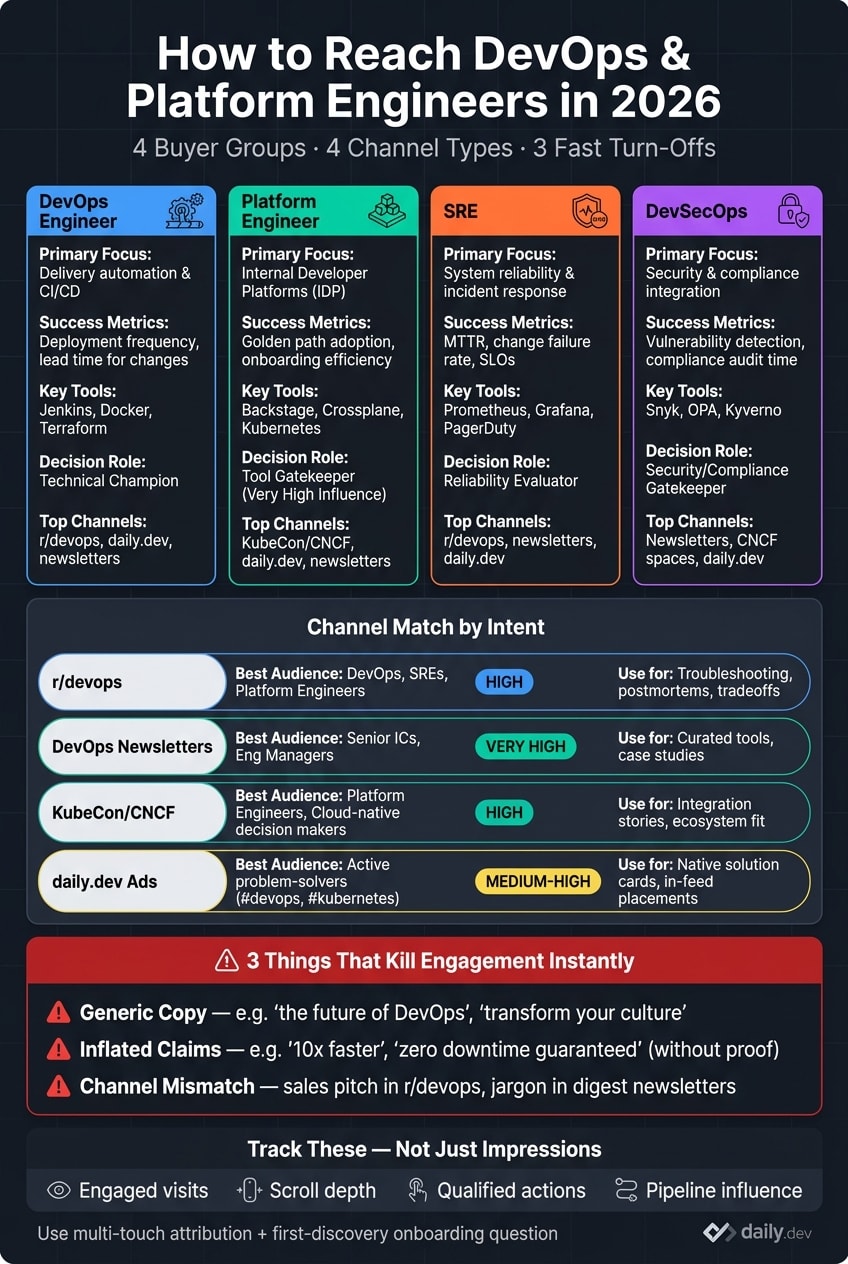
A few numbers tell the story. The article points to 4 buyer groups, 4 main channel types, and 3 fast turn-offs: generic copy, inflated claims, and poor channel fit. That’s the whole game.
What I’d do first:
- Define the role I’m trying to reach
- Pull language from community threads and tool discussions
- Write problem-first copy with limits and tradeoffs stated clearly
- Track engaged visits, scroll depth, qualified actions, and pipeline influence instead of views alone
Here’s a quick side-by-side view:
| Role | Main concern | What they want to see | Best-fit channels |
|---|---|---|---|
| DevOps | Delivery flow | Less toil, better CI/CD | r/devops, daily.dev, newsletters |
| Platform | IDP use | Adoption, onboarding, stack fit | CNCF/KubeCon, daily.dev, newsletters |
| SRE | Reliability | SLO impact, MTTR, failure rate | r/devops, newsletters, daily.dev |
| DevSecOps | Security in delivery | Detection, policy, compliance | newsletters, CNCF spaces, daily.dev |
Bottom line: I’d listen in engineer communities first, turn those pain points into plainspoken copy, then run in channels where technical people already read and compare tools. That is the shortest path to reaching this audience without wasting spend.
Define the DevOps and platform engineer persona before picking channels
Treat these roles as separate buying audiences. They may use some of the same tools, but they don't care about the same things. Their goals differ. Their metrics differ. The proof that wins them over differs too.
That changes how you pick the right channel, format, and message for each one.
How DevOps, platform engineering, SRE, and DevSecOps differ by work and goals
DevOps engineers own delivery automation and CI/CD. They respond to messages about cutting toil and shipping faster. Their day-to-day work centers on infrastructure automation and deployment flow.
Platform engineers build internal developer platforms. They care about adoption of golden paths. If developers ignore those paths, the platform doesn't do its job.
SREs own reliability and incident response. They judge tools by reliability impact first. For them, success comes down to SLOs, MTTR, and change failure rate.
DevSecOps practitioners bake security and compliance into software delivery. They care about vulnerability detection and compliance results.
Map pain points, success metrics, and buying influence by role
Each role also shapes buying decisions in its own way. Once you know the role, the next step is simple: who finds the tool first, and who can stop it from getting used?
DevOps and platform engineers are often the first to find tools through community recommendations and technical reading. Platform engineers also act as gatekeepers. If a tool doesn't fit the internal platform, adoption is unlikely.
SREs look at tools through the lens of reliability and operational impact. Engineering managers usually join during vendor review, where they weigh cost, integration, and DORA metrics. DevSecOps practitioners bring security and compliance requirements into that same review.
Role comparison table: DevOps, platform engineering, SRE, and DevSecOps
The table below turns those role differences into channel and messaging choices.
| Role | Primary Focus | Success Metrics | Typical Tools | Decision Influence | Where they already pay attention |
|---|---|---|---|---|---|
| DevOps Engineer | Delivery automation & CI/CD | Deployment frequency, lead time for changes | Jenkins, Docker, Terraform | High (technical champion) | daily.dev tech tags, r/devops |
| Platform Engineer | Internal Developer Platforms (IDP) | Golden path adoption, onboarding efficiency | Backstage, Crossplane, Kubernetes | Very high (tool gatekeeper) | KubeCon orbit, technical newsletters, daily.dev |
| SRE | System reliability & incident response | MTTR, change failure rate, SLOs | Prometheus, Grafana, PagerDuty | High (reliability evaluator) | r/devops, DevOps newsletters, daily.dev |
| DevSecOps | Security & compliance integration | Vulnerability detection, compliance audit time | Snyk, OPA, Kyverno | High (security/compliance gatekeeper) | DevOps newsletters, CNCF orbit, daily.dev |
These differences matter because each role spends time in different places and trusts different kinds of evidence.
The channels DevOps and platform engineers already trust
Role clarity is only the start. Next, you need to match each audience to the places they already use and believe in.
Reach people who are already debugging, comparing, or adopting tools in r/devops and related technical communities
r/devops is where DevOps engineers, SREs, and platform engineers go when they want peer input, help with a problem, or feedback on tools before they commit.
Trust in r/devops is hard to earn. People there respond to troubleshooting threads, postmortems, and honest discussion of tradeoffs. They tune out fast when they see promo-heavy copy or vague claims. The best way to take part is simple: answer technical questions, be useful, and let the value show up in the discussion instead of forcing a pitch.
Use these communities to test and confirm interest. Then, once the problem and solution are clear, move into curated channels.
DevOps'ish newsletters, KubeCon and the CNCF ecosystem, and daily.dev as discovery channels
For broader reach, shift from peer discussion to curated discovery.
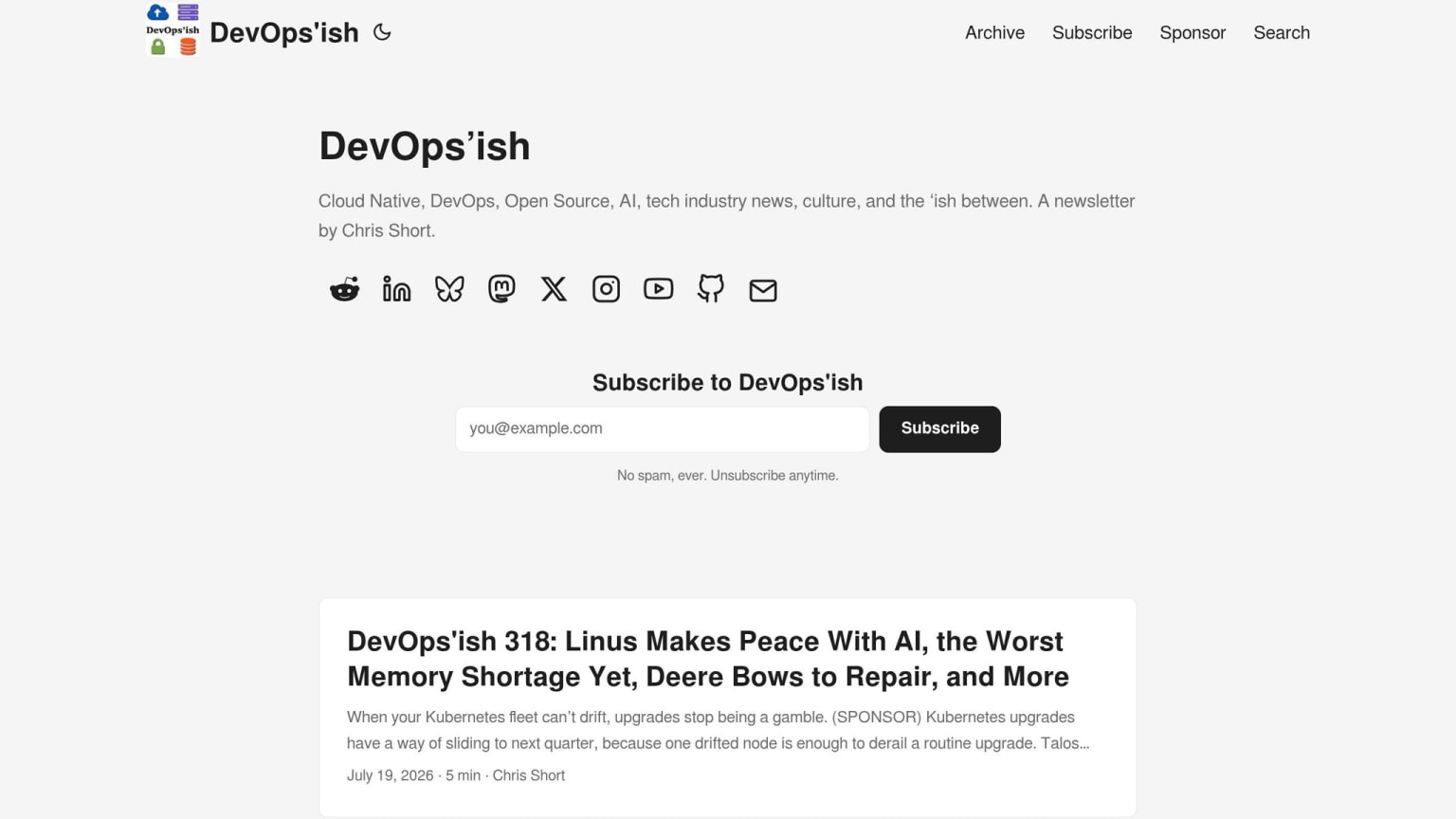
DevOps'ish newsletters are a high-trust discovery channel. Senior ICs and engineering managers subscribe because they trust the curator’s judgment. They respond to curated, practical summaries and ignore hype or brand-heavy language. Sponsorships in these newsletters can drive strong intent-led reach, and inventory often sells out early.
Platform engineers use the KubeCon and CNCF ecosystem when they’re weighing architecture choices. This audience looks for architecture deep-dives, integration stories, and ecosystem fit. Generic product talk usually falls flat. Conference sponsorships need a bigger budget and more lead time, but they put you in front of people who are actively making platform calls.
daily.dev reaches this audience through the DevOps and Cloud Digest track and Stack Placements. These native placements blend into the feed and match how engineers already browse, especially those following #devops and #kubernetes. This audience responds better to native, problem-first placements and tends to ignore interruptive ads or thin copy. That format matters because many developers block intrusive ads.
Channel comparison table for planning and budget allocation
Match each channel to the role and intent you defined above.
| Channel | Audience Focus | Trust Level | Technical Depth | Campaign Objective | Best Message Type |
|---|---|---|---|---|---|
| r/devops | DevOps engineers, SREs, platform engineers in validation mode | High | High | Research / Validation | Troubleshooting, postmortems, tradeoffs |
| DevOps'ish Newsletters | Senior ICs, engineering managers | Very High | Medium–High | Awareness / Launch | Curated tools, case studies |
| KubeCon and CNCF Ecosystem | Platform engineers, cloud-native decision makers | High | High | Brand authority / Pipeline | Integration stories, ecosystem fit |
| daily.dev Ads | Active problem-solvers browsing #devops and #kubernetes | Medium–High | Medium | Lead gen / Signups / PLG | Native solution cards, in-feed placements |
Match your message to the channel so engineers stay engaged
Once you’ve picked the channel, the copy has to fit how engineers use it. The right channel gets attention. The right message keeps DevOps and platform engineers reading.
Write messages around specific problems, not brand slogans
Use a problem-first structure. Start with the problem, the environment, the result, and the proof. Also name the tradeoff: setup cost, integration limits, or operational overhead.
For DevOps, platform, SRE, and DevSecOps buyers, that structure shifts by role. What feels like a meaningful result for an SRE isn’t always what a platform engineer needs to justify adoption.
Tradeoffs matter just as much. Engineers trust messaging that admits limits instead of sounding polished to the point of disbelief. If your tool cuts alert noise but needs extra setup, say that. If you integrate with specific tools, name them instead of saying you fit every stack.
How to frame native placements on daily.dev Ads for DevOps and platform engineers
On daily.dev, match the headline to both the placement and the reader’s intent. Lead with the problem, not the product name, and write it like a technical headline, not an ad.
daily.dev’s DevOps and Cloud Digest track and Stack Placements create different intent windows. Match the detail level to the format:
- Use shorter, sharper copy for in-feed placements
- Add more context on post-page placements
- Keep digest placements tight and easy to scan
Target by role, seniority, interests, and tools.
Behaviors that make this audience leave immediately
Three things cause the fastest drop-off: generic copy, inflated claims, and channel mismatch.
Phrases like the future of DevOps or transform your engineering culture tell readers the content wasn’t written for engineers. Claims like 10x faster deployments or zero downtime guaranteed sound like noise when there’s no specific environment or proof behind them. Thin thought leadership that repeats what engineers already know, without a concrete recommendation, gets skimmed and closed.
A sales-heavy pitch in r/devops pushes readers away. Jargon-heavy copy in a digest makes them lose attention.
These same rules should shape your channel plan and measurement next.
Build and measure a 2026 DevOps channel plan
Sequence channels by intent: from community research to scalable reach
Start with r/devops and nearby technical communities. That’s where you hear the actual problems people are trying to solve and the words they use to describe them. Use that language to shape the copy and ad placements that come next.
Then move into daily.dev's DevOps and Cloud Digest track and Stack Placements to reach engineers who are already in a technical reading mindset. After that, use newsletters to stay in front of the same audience over time and build steady awareness.
Measure outcomes beyond impressions
Don’t stop at impressions. What matters is whether engineers spent time with the message, not just whether they glanced at it. Look at engaged visits, scroll depth, qualified actions, and pipeline influence.
Multi-touch attribution matters here because infrastructure-tool buying cycles usually involve several decision-makers and a long review window. A weighted model that gives credit to both the first and last touch lines up better with how these purchases tend to happen. It also helps to ask one onboarding question about first discovery so you can catch unattributed demand that standard attribution tools often miss.
| Channel | Funnel Stage | Key Metric |
|---|---|---|
| daily.dev Ads | Mid-funnel | Qualified interest, pipeline growth |
| Newsletters | Top to mid | Click quality, engaged visits |
| Reddit (sub-targeted) | Research/trust | Engagement quality, not volume |
If engagement depth looks weak, check message-channel fit before you blame the offer.
Conclusion: The shortest path to credible DevOps reach in 2026
The pattern that works is simple: define the role with precision, listen before spending, show up where engineers already read, and track what actually moves the business.
Channels like r/devops, technical newsletters, and daily.dev's DevOps and Cloud Digest track work because they fit the way engineers already consume technical content. The shortest path is clear: listen first, publish in trusted technical environments, and measure qualified engagement. That combination is what makes DevOps reach credible in 2026.
FAQs
How do I choose the right engineer persona first?
Put technical behavior and live product activity first. Job titles and company demographics can help, but they shouldn't drive the whole profile. What matters more is who uses the tool, who feels the pain, and who nudges the team toward a new setup.
That usually means looking past buyers with budget control and paying closer attention to hands-on people like DevOps engineers, platform engineers, and others who shape day-to-day tool decisions. They're often the ones in the weeds, testing options, flagging issues, and pushing for change.
Define the persona by:
- Tech stack: What tools, cloud providers, languages, and systems do they use every day?
- Seniority: Are they hands-on ICs, team leads, or heads of platform who guide tool choice?
- Immediate pain points and learning habits: What problem are they trying to fix right now, and where do they go to learn: docs, GitHub, Slack groups, YouTube, or peer advice?
- Community involvement: Are they active in open-source projects, niche forums, meetups, Discord servers, or LinkedIn circles tied to their field?
What proof do DevOps and platform engineers trust most?
DevOps and platform engineers put more weight on technical substance than marketing claims. They want peer recommendations, info that’s been tested by the community, and direct proof that a tool works in their own setup.
That proof often looks like working code snippets, performance benchmarks, detailed documentation, source code, and hands-on content like case studies or post-mortems that show actual infrastructure problems.
How should I measure channel performance beyond clicks?
Measure channel performance with downstream metrics that show actual developer adoption and business impact. That means looking past surface-level reach and tracking things like signups, trial-to-paid conversions, and product-level actions such as API usage or active account creation.
It also helps to watch softer signals. Word-of-mouth referrals and community engagement can tell you a lot about whether your message is landing or just floating by.
When you look at ROI, put more weight on the quality of traffic hitting your documentation, signup flows, and landing pages than on top-of-funnel impressions. A smaller stream of high-intent visitors often does more for growth than a big wave of people who never take the next step.