

If I need trust and focused attention, I’d pick newsletter ads. If I need scale, testing, and mid-campaign changes, I’d pick in-feed ads. That’s the core choice.
Here’s the short version:
- Newsletter ads work well for launches, funding news, and event pushes
- In-feed ads work well for trial signups, demos, and always-on programs
- Newsletter ads usually offer stronger attention in the inbox, but less room to change copy once sent
- In-feed ads usually give me more targeting options, more testing, and faster feedback
- Measurement differs too: newsletter results can take longer to play out, while in-feed data often comes in the same campaign window
A simple way to think about it: newsletter ads fit focused reading, while in-feed ads fit active research. That shift affects clicks, testing, and spend.
Developers also don’t act the same in both places. In a newsletter, they’re often reading on purpose. In a feed, they’re browsing, comparing, and looking for tools. So before I set budget, copy, or CTA, I’d match the format to that behavior.
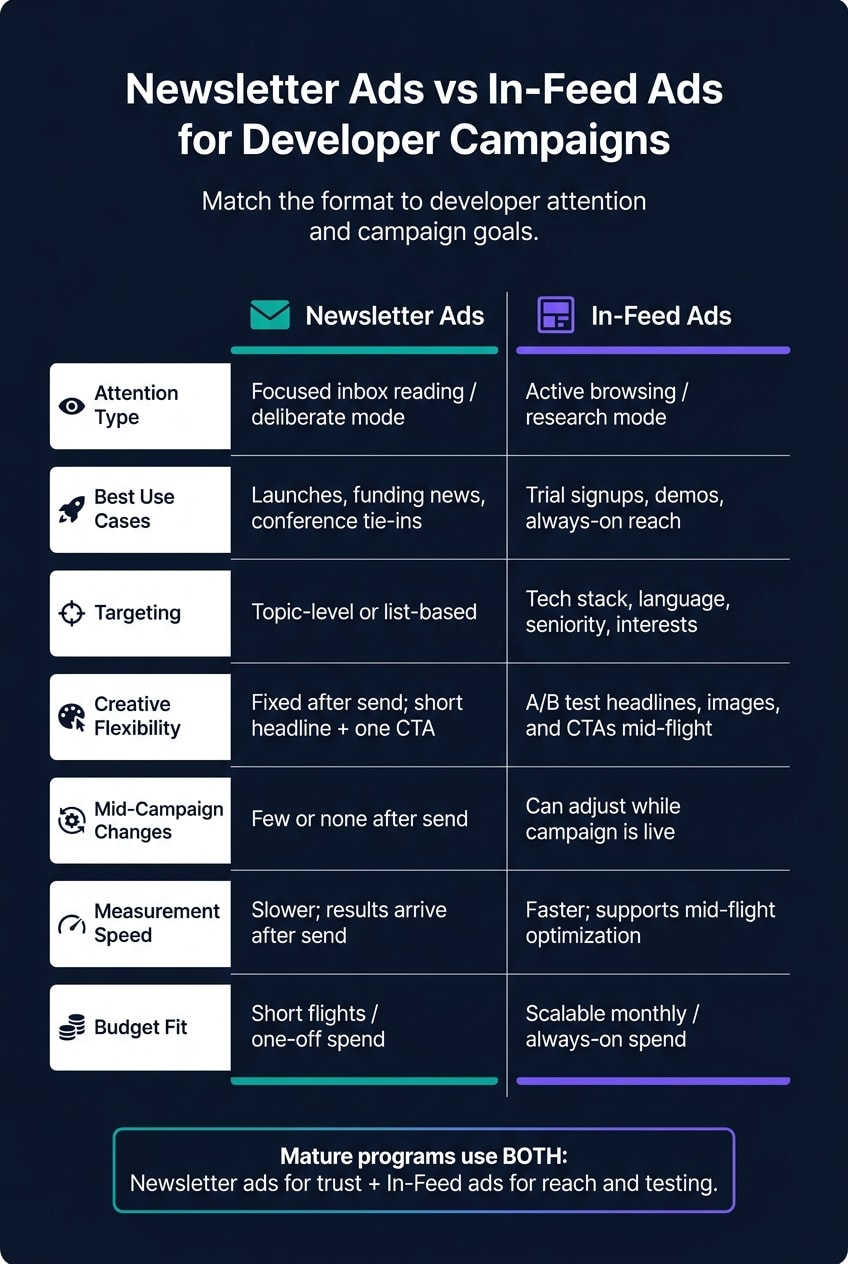
Quick Comparison
| Criteria | Newsletter Ads | In-Feed Ads |
|---|---|---|
| Attention | Focused inbox reading | Browsing and research mode |
| Best use | Launches, announcements, event pushes | Trials, demos, always-on reach |
| Targeting | List or topic based | Stack, language, seniority, interests |
| Ad format | Short copy, one CTA | More room for image, headline, and CTA tests |
| Changes during campaign | Few or none after send | Can change while live |
| Measurement pace | Often slower | Often faster |
| Budget fit | Short flights | Scaled monthly spend |
If I were building a successful advertisement campaign for developers, I wouldn’t treat this as an either-or choice. I’d use newsletter ads for trust and timing, and in-feed ads for reach, testing, and steady demand.
Newsletter ads: stronger attention and trust, tighter creative limits
Newsletter sponsorships work because people choose to open them. That simple fact gives the ad more attention than most feed placements.
Inbox attention supports considered, deliberate messages
When developers subscribe to technical newsletters, they’re usually not in a casual scrolling mode. They’re reading with focus, often to learn, compare options, or keep up with tools they care about. That makes newsletter sponsorships a good fit for short launches, product announcements, and event-driven campaigns.
Digest sponsorships fit this setup well when the goal is reach inside a trusted read. The ad shows up in a place the audience already pays attention to, which can make a direct, deliberate message land better than it would in a busy feed.
Precise audience targeting, but limited room for creative depth
That tight audience match comes with trade-offs. Newsletter targeting usually happens through topic fit, stack fit, or more tailored placements like Digest sponsorships.
But the ad unit itself is small on purpose. Most newsletter slots give you:
- a short headline
- compact body copy
- one clear call to action
So if your message needs a deep product story, a layered visual treatment, or interactive elements, newsletters can feel cramped. They work best when the idea is clear and the next step is simple.
Measurement is useful but slower and less flexible
Open, click, and signup metrics are easy to follow. The harder part is attribution. Developer tools often don’t convert right after the email lands, so results can show up later.
That’s why longer attribution windows matter here. It also means you can’t tweak the placement in the middle of the campaign the way you can with in-feed ads. In-feed formats give up some of that focused attention, but they make it easier to test, learn, and adjust fast.
In-feed ads: broader discovery, faster optimization, more scalable testing
Newsletter ads win attention through trust. In-feed ads win it through relevance. That gap shows up most when a campaign needs to change while it’s still live.
Feed browsing reaches developers during active research
In-feed placements are a strong fit for awareness and for trial or demo signups. daily.dev In-Feed placements show up natively in the content stream, right where developers are already browsing and doing research.
That makes them useful for product launches, trial signups, and audience testing. If you need to test fast and shift spend during the campaign, in-feed gives you more room to move.
More flexibility in targeting and creative testing
In-feed campaigns give you more control while the campaign is running. You can adjust targeting by tech stack, programming language, seniority level, or specific interests. You can also test different headlines, images, and calls to action to see what gets the best response.
Unlike newsletter sponsorships, in-feed campaigns can be optimized mid-flight. That makes them a stronger fit for always-on budgets and repeated testing.
Faster measurement cycles for quicker iteration
In-feed campaigns surface results fast, which means you can make changes within the same flight instead of waiting until the campaign is over.
That’s why the next comparison comes down to attention, control, and budget fit.
Newsletter ads vs in-feed ads: side-by-side format comparison
Here’s the direct comparison to help pick the right format.
Comparison table: attention, targeting, creative, measurement, and budget fit
| Criteria | Newsletter Ads | In-Feed Ads |
|---|---|---|
| Attention | Inbox ritual; deliberate reading. | Active browsing; research mode. |
| Targeting | Topic-level; targeting is at the list or audience level. | Behavioral and precise; filter by tech stack, seniority, programming language, and interests. |
| Creative | Fixed after send; limited iteration. | Flexible; supports A/B testing of headlines, images, and calls to action. |
| Measurement | Slower; reporting arrives after send. | Faster; results support mid-flight changes. |
| Budget fit | One-off spend for launches. | Scalable and always-on; suited to continuous performance spend. |
Newsletter ads put your message in a trusted, focused setting with a technical audience. People are usually in reading mode, not skimming past at high speed.
In-feed ads work differently. They give you more speed, more control, and more room to keep tuning the campaign as results come in.
Which format fits common developer campaign goals
The next step is simple: match the format to the goal.
Use newsletter ads for launch moments, such as:
- Major releases
- Funding announcements
- Conference tie-ins
In-feed ads are a better fit for always-on reach and for campaigns where you want to test messaging, swap creative, and iterate fast.
Why most mature programs run both formats
Many mature programs run both formats at the same time.
Newsletter ads help build trust. In-feed ads extend reach and make it easier to keep testing and improving over time.
Conclusion: match the format to developer attention and campaign goals
Once the trade-offs are clear, the choice depends on what the campaign needs most.
Newsletter ads make sense when clarity and trust matter most. They work well for product launches, funding news, or conference tie-ins, especially when you want a fast awareness spike with a trusted developer audience.
In-feed ads are a better fit when discovery, scale, and fast testing matter most. They let you reach developers while they’re actively researching, try different creative angles, and keep improving the campaign as results come in.
Most mature programs use both: Digest sponsorships for trust and In-Feed placements for steady reach. Developers react differently in inbox and feed settings, so the right format should match the attention context and the timing of the campaign.
FAQs
are newsletter ads worth it for dev tools?
Yes - newsletter ads can be worth it for dev tools, especially for top-of-funnel awareness tied to a specific launch.
They put your message in a credible, opt-in inbox setting, which is a big deal. People chose to be there. And that often leads to strong open rates - 40% to 60% - plus solid engagement, with click rates around 1% to 3%.
That said, they come with tradeoffs. Targeting is often broader, and the shelf life is short. An email goes out, gets opened or ignored, and then it fades fast.
So if your goal is tool adoption and clear measurement over time, newsletter ads usually work best alongside more consistent in-feed placements that let you stay in front of the right audience.