
Developer-focused marketing helps developers test your product before they recommend it. I start with one technical task - like making a successful API call - and give developers the docs, code, and steps to complete it before talking to sales.
For a 2026 campaign, I focus on four things:
- Match proof to the buyer: Developers need working examples; budget owners need cost, security, and business impact.
- Choose channels by purpose: Use feeds, newsletters, video, and paid placements for discovery, then docs, communities, and AI-readable resources for evaluation.
- Show what works: Publish runnable tutorials, explain test limits, disclose paid promotion, and measure activation and retained usage - not just clicks.
- Start small: Test one audience, one problem, one asset, and one activation event. Fix where developers get stuck before increasing spend.
My rule: make the product’s promise testable, then connect successful use to team adoption and buying decisions.
1. Developer-focused marketing vs. generic B2B marketing
Use developer-focused marketing when technical buyers need to test, integrate, or validate your product before recommending it. It works alongside broader B2B marketing: technical evaluators need proof that the product fits, while budget owners need proof of business value.
| Dimension | Generic B2B marketing | Developer-focused marketing |
|---|---|---|
| Who it targets | Business leaders and budget owners | Developers and technical leads |
| Proof | Business outcomes, ROI, customer references, and compliance | Working code, API behavior, benchmark methods, integration guidance, and technical proof |
| Content | Reports, webinars, solution briefs, and executive case studies | Tutorials, API docs, migration guides, troubleshooting content, and comparisons |
| Evaluation path | Form fill, discovery call, demo, proposal, and procurement | Technical research, hands-on testing, validation, internal recommendation, and purchase review |
| Distribution | Search, events, email nurture, account-based campaigns, and business publications | Technical feeds, docs, repositories, communities, newsletters, video, and AI-readable resources |
| Primary conversion signal | Form fill, demo request, or sales opportunity | Successful integration, activated project, qualified trial, retained usage, or team adoption |
| Sales involvement | Early qualification and demos | Technical validation, security, pricing, procurement, and expansion |
These are differences in emphasis, not hard rules. For a 2026 campaign, choose your approach based on what the buyer must validate, not just their job title. Executive messaging won't solve an integration problem. And a successful trial alone won't establish whether the cost or security posture is acceptable. Those needs determine where developer marketing belongs in 2026.
Connect developer adoption to buying decisions
Developers may test and implement a tool without owning the budget. Engineering leadership, security, finance, and procurement may each have their own approval requirements. Give your technical champion a short packet they can share internally.
A small devtool team can pair a focused quickstart with a concise business case. The quickstart should define a measurable success event and explain prerequisites and errors. The business case should address implementation effort, cost, security, and business impact. Keep expected benefits separate from results you've measured.
Pass evaluation context to sales - not just a lead score. Include the activated feature, use case, integration stage, and any open approval requirements. This gives sales the context to connect technical progress with a useful buying conversation. To plan this shared approach, see B2B developer marketing strategy. Use what you learn about developer and buyer evaluation to place proof in the channels they already use to research tools.
2. Choose developer marketing channels in 2026
Choose channels based on the stage they help developers reach: discovery, evaluation, or adoption. Link those channels through one technical task instead of sending every visitor to your homepage. Discovery content should lead to a technical asset that answers the same question.
For channel planning, use the B2B developer marketing strategy, channels, and metrics guide and the Developer marketing channels guide.
Reach developers through feeds, newsletters, and video
Use feeds to introduce one technical problem, newsletters to stay in touch with interested readers, and video to show setup, configuration, output, and failures.
The next step should match the content. An authentication walkthrough should link to authentication docs or a runnable quickstart - not a generic sales form.
Support evaluation with docs, communities, and AI-readable content
Give developers what they need to evaluate your product: accessible API references, authentication instructions, runnable examples, troubleshooting guidance, and product limitations. In communities, answer the question first and disclose your affiliation.
For AI assistants in 2026, keep documentation crawlable. Use stable URLs, descriptive headings, clear version information, and current technical facts. Crawlable docs can help with visibility, but they don’t guarantee inclusion or accurate citation.
Once the technical asset is ready, use paid distribution to put it in front of the right technical audience.
Distribute technical content with daily.dev Ads
Match the ad format to the task. In-Feed Native Ads support discovery. Sponsored Content supports deeper evaluation through guaranteed distribution, a read-floor commitment, and canonical republishing.
Newsletter Ads in the Digest by topic track provide topic-aligned distribution, while Homepage Sponsorship helps your brand reach a broader audience.
Engagement Ads offer Branded Tags, Keyword Spotlights, Custom Upvotes, Tag Page Takeovers, and Stack Placements for contextual brand presence. Agent Ads are in early access for AI visibility on the daily.dev pages AI agents read.
Target by tech stack, seniority, geography, and interests, based on who can use the technical asset. Review the advertising evaluation hub when planning your campaign. For guidance on disclosure and specificity, see the unspoken rules of advertising on dev platforms. Measure each placement by the product action it starts, not just the click it earns.
3. Show technical proof and measure product actions
Developer-focused marketing needs proof, disclosure, and product-level measurement.
Create tutorials, benchmarks, and honest comparisons
Build runnable tutorials, quickstarts, sample apps, migration guides, and troubleshooting steps around one outcome developers can verify. Include supported languages, frameworks, versions, prerequisites, configuration, expected output, and cleanup steps. Give developers a way to check success before they create a project or deploy an integration.
For benchmarks, publish the versions, hardware, workload, configuration, test duration, run count, and limitations. For comparisons, choose evaluation criteria before testing. Document tradeoffs, including migration effort and constraints on running the product.
Date the results so readers evaluating tools in 2026 can judge whether they still apply. A favorable test supports one claim in one setup - not a blanket claim about the product.
Apply the same approach to disclosure and measurement.
Disclose paid promotion and make specific claims
Readers need to know who funded the proof and what the test measured.
Place disclosures next to the claim, not in a footer. State any payment, free access, or other material benefit. The Federal Trade Commission calls for clear, conspicuous disclosure of material connections.
Spell out implementation constraints, separate measured results from opinion, and leave out unsupported figures or boasts about user counts.
Track activation, retained usage, and business results
Once the proof asset is live, measure the product action it was meant to trigger.
Define the primary product action before launch. Map evaluation to quickstart completion, activation to a successful API call or deployment, and retention to active projects over a stated period. Clicks and visits from the intended audience show attention - not proof that a developer received value.
Before spending, record campaign parameters, event names, account identifiers, reporting windows, and who owns the reporting. Connect activated accounts to qualified pipeline and revenue only when consent, reliable identifiers, and a documented attribution model support the connection. If tracking stops at the visit, report discovery only.
4. Launch a developer-focused marketing campaign
Start with one measurable product outcome
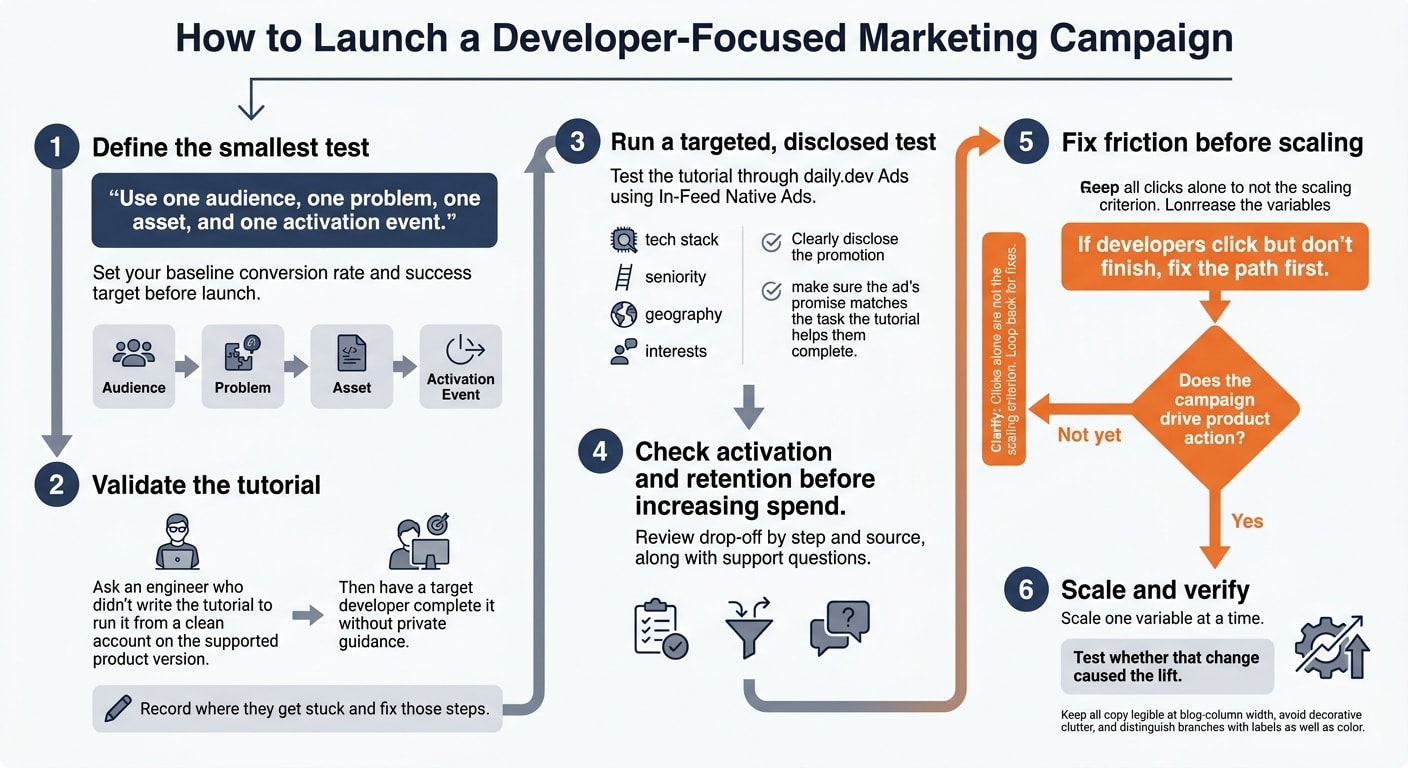
Once you’ve defined proof and measurement, launch the smallest test that can validate both. Use one audience, one problem, one asset, and one activation event. Set your baseline conversion rate and success target before launch.
Before increasing spend, ask an engineer who didn’t write the tutorial to run it from a clean account on the supported product version. Then have a target developer complete it without private guidance. Record where they get stuck and fix those steps.
Test the tutorial through daily.dev Ads using In-Feed Native Ads. Target developers by relevant tech stack, seniority, geography, and interests. Clearly disclose the promotion, and make sure the ad’s promise matches the task the tutorial helps them complete.
If the tutorial works, check activation and retention before increasing spend. Review drop-off by step and source, along with support questions. If developers click but don’t finish, fix the path first. Once the campaign drives product action, scale one variable at a time and test whether that change caused the lift.
When the test is working, discuss next-step fit with daily.dev.
FAQs
Is developer-centric marketing the same as developer-focused marketing?
No. They’re closely related, but developer-focused marketing builds demand-generation campaigns around how developers evaluate tools: “try before trust,” docs over decks, and peers over ads. It uses feeds, documentation, communities, and newsletters to get developers to take action in the product.
Developer-centric marketing goes beyond campaigns. It puts developers at the center of the product and brand experience - not just the messaging and channel choices.
How do I choose the right activation event?
Choose the activation event based on where you want to influence the developer’s decision.
For discovery during tool evaluation, use In-Feed Native Ads. Target developers by tech stack, seniority, geography, and interests.
To build category ownership through repeated engagement, choose relevant Engagement Ads placements.
For a time-boxed launch or distribution aimed at conversions, use Sponsored Content or Newsletter Ads. Match the audience to your topic and run the placement during a defined week.
When should sales join a developer’s evaluation?
Sales should join a developer’s evaluation when active signals show the buyer is making a decision, comparing tools, or asking about options. On daily.dev, time outreach around moments like in-feed discovery, when developers are still researching and weighing their choices. Send targeted traffic to docs, landing pages, or signup flows to help turn that interest into a conversion before the buyer locks in a decision.